1.1 Origins: the Liaotian Jianshan Kiln Site, Sanban Township
Stamped stoneware excavated at the Liaotian Jianshan kiln site in Sanban Township, confirmed by radiocarbon dating and typological comparison, pushes the upper limit of Dehua ceramic production back from the conventionally cited Tang-Song period to approximately 3,700 years ago. Between these grey-brown shards and the ivory-white porcelain that would later captivate Europe lies over two millennia of technical evolution—yet the production site never moved. The path from clay deposit to kiln mouth has run through the same valley for thirty-seven centuries.
What does this temporal depth signify? Jingdezhen’s ceramic tradition, counted from the Eastern Han, spans roughly two thousand years. Meissen has operated since 1710—316 years. Dehua’s 3,700 years are nearly twelve times that of Meissen.
This chronological span does not by itself constitute a quality argument, but as an archaeological fact it is unfalsifiable.
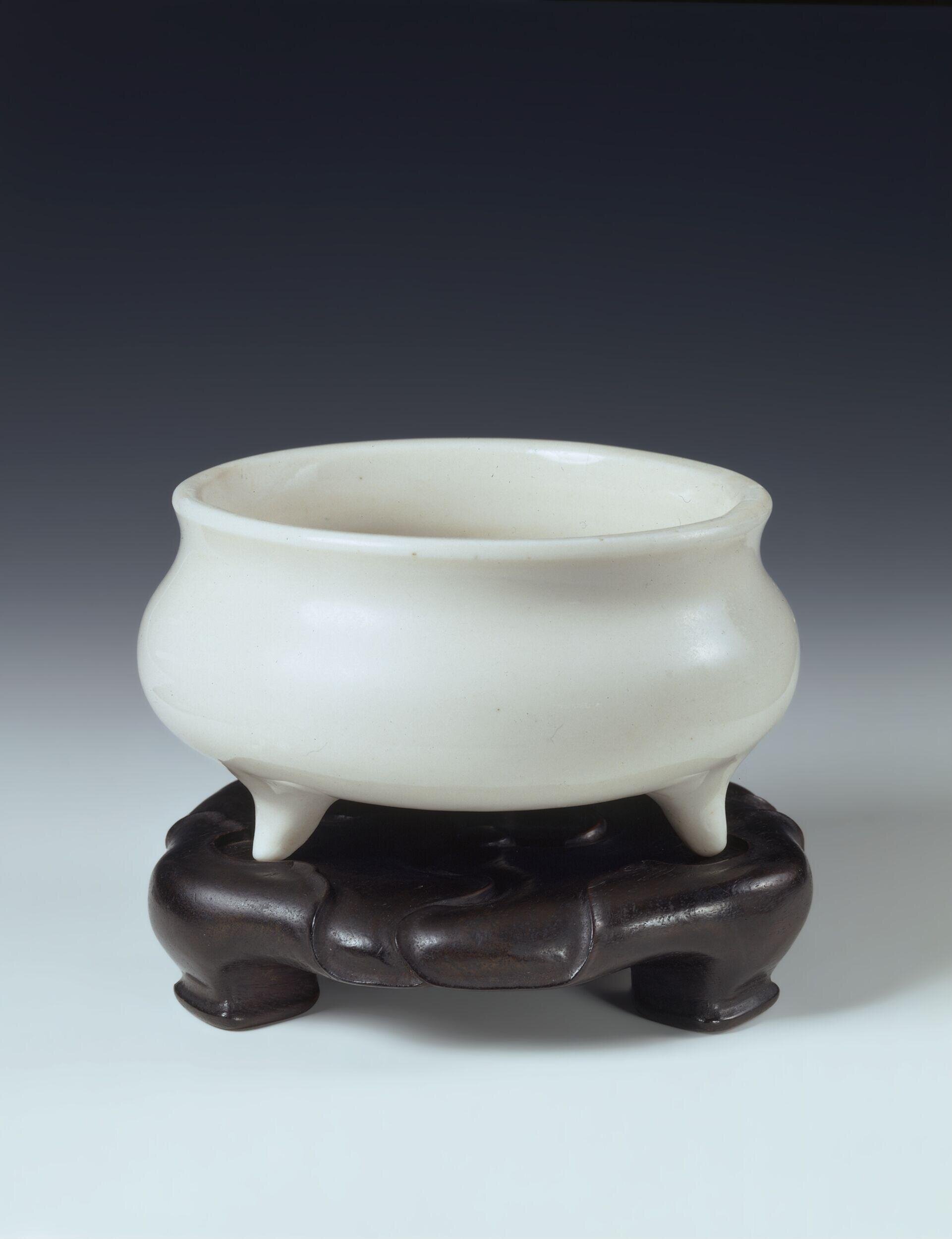
16th–17th century. Victoria and Albert Museum, O126198.
1.2 The Wanpinglun Kiln: Hard Evidence for Dating
The archaeological excavation of the Wanpinglun kiln site has provided the clearest stratigraphic evidence for the early development of the Dehua kilns. Its 4.7-metre cultural deposit yielded thirteen bronze coins—Northern Song issues including Taiping Tongbao, Zhidao Yuanbao, Xianping Yuanbao, and Jingde Yuanbao—distributed across successive layers, forming a chronological ruler calibrated to individual reign titles.
Coin-based dating is a standard method in Chinese archaeology, but the Wanpinglun assemblage is distinctive in that thirteen coins were recovered from different strata, producing not a single-point date but a continuous time-series. This allows ceramic stylistic evolution to be tracked layer by layer across a substantial span of occupation.
Information extracted from the Wanpinglun stratigraphy, combined with typological comparisons from other sites, confirms over three hundred kiln sites within Dehua County during the Song-Yuan period. Three hundred kilns concentrated within a single county.
1.3 The Qudougong Kiln: Industrial Scale in the Yuan Dynasty
The excavation of the Qudougong kiln site fundamentally revised scholarly understanding of Yuan-dynasty Dehua production.
One dragon kiln (jilongyo), surviving to a length of 57.1 metres. 6,793 excavated objects. These two figures speak for themselves: this was no artisanal workshop but a production facility of considerable capacity. The critical evidence is the discovery of saggars inscribed with ‘Phags-pa Mongolian script—saggars are the ceramic containers used to protect wares during firing. The ‘Phags-pa script was promulgated as the official script of the Yuan court under Kublai Khan and fell out of use when the Yuan fell, thereby locking the kiln’s active period to the Yuan dynasty (1271–1368).
The scale of a 57.1-metre kiln reflects the pull of market demand. Yuan-dynasty Quanzhou (known as Zayton) was one of the world’s largest ports—Marco Polo called it the greatest port in the world; Ibn Battuta described it in comparable terms. Dehua lies approximately 100 kilometres from Quanzhou. A 27.5-kilometre overland road built in 974 (the 7th year of Song Kaibao) connected the kiln district to the port. The establishment of the Quanzhou Maritime Trade Office in 1087 (the 2nd year of Yuanyou) institutionalised overseas trade administration, giving Dehua porcelain a formal channel into international markets.
1.4 The Material Genome: Why So White?
The whiteness of Dehua porcelain is a direct consequence of clay chemistry.
X-ray fluorescence (XRF) data published by Li Weidong in Ceramics International (37: 651–658, 2011) provide the precise chemical fingerprint of Ming-dynasty Dehua porcelain bodies:
| Component | Dehua Ming-Dynasty Body |
|---|---|
| SiO₂ | 71.8—74.2% |
| Al₂O₃ | 15—18% |
| K₂O | 6.5—7.3% |
| Fe₂O₃ | <0.5% |
Fe₂O₃ below 0.5%—iron is the decisive variable in porcelain colouration. Jingdezhen clays contain significantly higher iron; they must be fired in a reducing atmosphere to suppress iron colouration, and the slightest kiln irregularity produces yellowing or greying. Dehua’s low-iron clay permits firing in an oxidising atmosphere. Nigel Wood’s analysis in Chinese Glazes (2007) is definitive: it is precisely this oxidising atmosphere that gives Dehua its characteristic warm ivory tone, distinct from Jingdezhen’s cooler white or bluish-white.
K₂O reaching 6.5–7.3%—the high potassium content promotes glass-phase formation, yielding exceptional translucency. Hold a Ming-dynasty Dehua cup against a light source and the light passing through the wall takes on a warm orange-red hue—the optical signature of the high-potassium glass phase.
(For the full materials-science analysis, see Chemical Fingerprint of Dehua White Porcelain. This section establishes only the causal starting point.)
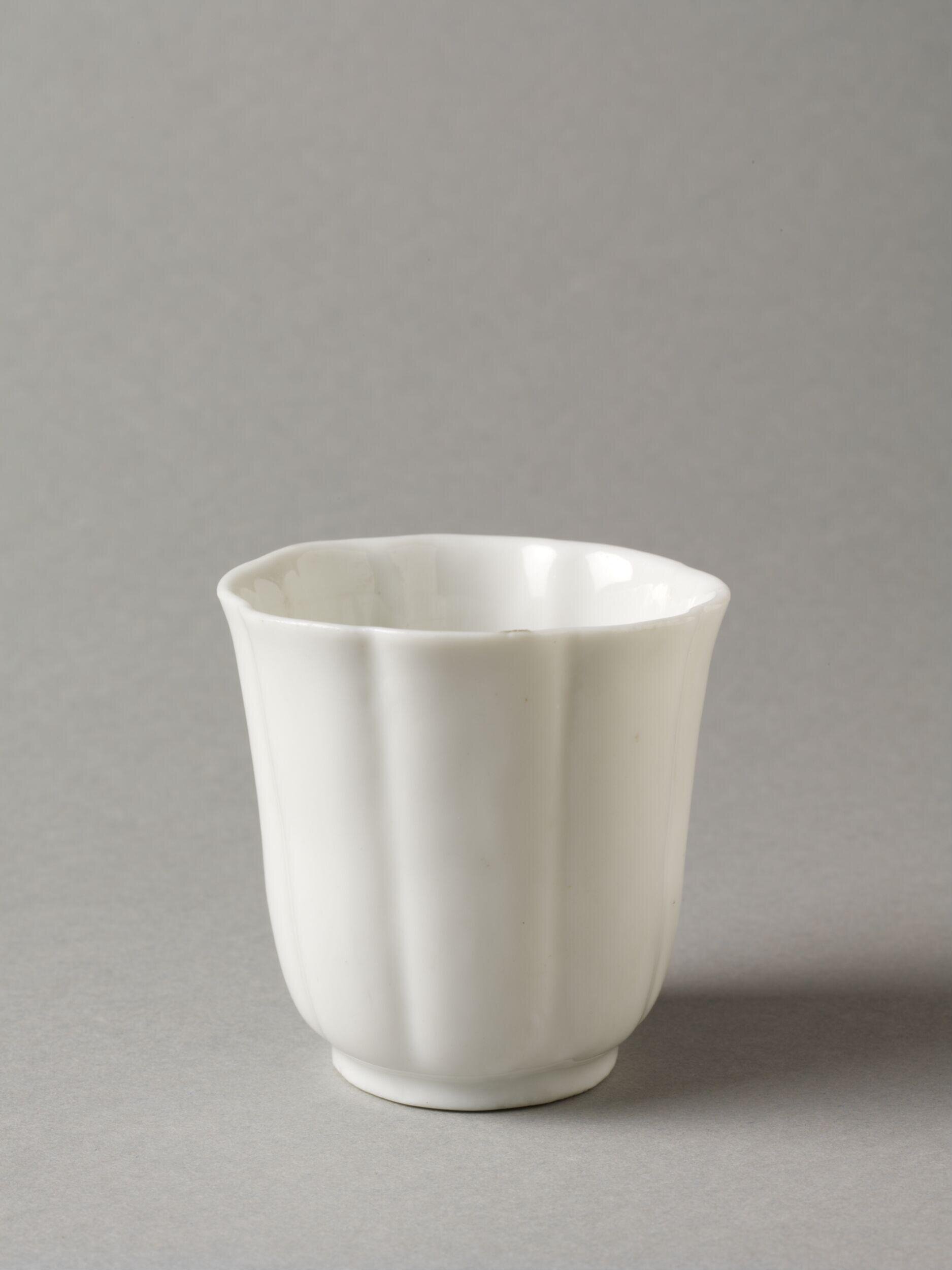
1640–1650. Victoria and Albert Museum, O181942.
1.5 Four Evolutionary Phases: the China Intangible Cultural Heritage Framework
The China Intangible Cultural Heritage Network classifies Dehua porcelain into four developmental phases—a framework corroborated by the chemical data:
Phase I: Qingbai Period (Song–Yuan)—relatively higher iron content in the clay; reduction firing produces a bluish-white (qingbai) tone. Wares excavated at Wanpinglun and Qudougong belong to this phase.
Phase II: Ivory-White Zenith (Mid-to-Late Ming)—Fe₂O₃ falls to its nadir, K₂O rises to its apex, and oxidation-firing technique matures. He Chaozong was active during this period. The Chinese colour-spectrum names “lard white” (zhuyoubai) and “ivory white” (xiangyabai) designate the zenith products of this phase.
Phase III: Scallion-Root White Period (Qing)—Fe₂O₃ rises again; kiln architecture shifts from dragon kilns to stepped kilns (jiejiyao). The colour palette turns cooler and more greenish, with reduced translucency. The term “scallion-root white” (conggenbai) precisely captures this visual shift.
Phase IV: Modern Industrial Period (Republic to Present)—scientific formulation, electric and gas kilns replacing wood-fired kilns; whiteness is controllable but aesthetics have diversified.
Li Weidong’s XRF data trace the intersecting trajectories of declining Fe₂O₃ and rising K₂O from Song through Ming. The two curves meet at their optimal interval during the mid-to-late Ming—the ivory-white zenith was not accidental but the inevitable outcome of chemical evolution. After the Qing transition, Fe₂O₃ rose again, and the zenith ended irreversibly.
1.6 Dehua in the Historical Literature
The Bamin Tongzhi (Comprehensive Gazetteer of Fujian), compiled during the Hongzhi reign of the Ming dynasty: “White porcelain vessels come from Dehua County.”
Seven characters. This is the earliest surviving local gazetteer entry to explicitly associate Dehua with white porcelain.
Song Yingxing’s Tiangong Kaiwu (The Exploitation of the Works of Nature, 1637) records that the Dehua kilns “fire only exquisite porcelain figures and curios”—note the phrasing: not bowls or utilitarian ware, but “exquisite figures and curios.” This aligns precisely with the historical reputation of the Dehua kilns for sculptural porcelain during the He Chaozong era.
Volume 5, Part 12 of Joseph Needham’s Science and Civilisation in China (authored by Rose Kerr and Nigel Wood, published 2004, 918 pages) remains the most authoritative English-language scholarship on Chinese ceramic technology. It provides an exhaustive analysis of the Dehua kiln system, chemical composition, and firing processes, and its scholarly authority in the field is unrivalled.
1.7 The Maritime Era: from the Longqing Lifting of the Sea Ban to Three Million Pieces
In the first year of Longqing (1567), the Ming court opened the port of Yuegang in Zhangzhou, lifting the maritime trade ban.
This policy reversal transformed the export landscape for Dehua porcelain. Before 1567, Dehua’s overseas trade operated in the grey zone between smuggling and tributary commerce. Once the sea ban was lifted, legitimate trade channels opened and production capacity was unleashed.
The archives of the Dutch East India Company (VOC) provide quantitative evidence. Between 1604 and 1657, the VOC shipped over three million pieces of Chinese porcelain to Europe, a substantial proportion of which was Dehua ware. In 1616, VOC employee Kr. Kohn specifically mentioned Dehua white porcelain in a letter. In 1644, Dutch annual orders reached 355,800 pieces.
Three trade routes carried Dehua white porcelain to the world:
The Portuguese Route (the earliest)—via Malacca, Goa, and Lisbon, introducing blanc de chine to the Iberian Peninsula and European courts. The Atalaia shipwreck (1647; see the Shipwreck Archaeological Database) provides physical evidence for this route.
The Dutch East India Company Route (the largest in volume)—via Batavia (modern Jakarta). Through its organisational commercial infrastructure, the VOC scaled the Dehua trade to the three-million-piece level.
The Manila Galleon Route (trans-Pacific)—from Quanzhou/Zhangzhou to Manila, then across the Pacific to Acapulco, Mexico. This route brought Dehua white porcelain into the Americas. The San Cristo de Burgos wreck (1693; see the Shipwreck Archaeological Database) sank on the North American segment of this route.
The English East India Company also participated in the Dehua trade. British records refer to Dehua Guanyin figures as “Sancta Marias”—mistaking Buddhist bodhisattvas for the Virgin Mary. This misidentification is itself a footnote to the cross-cultural semantics of white porcelain.
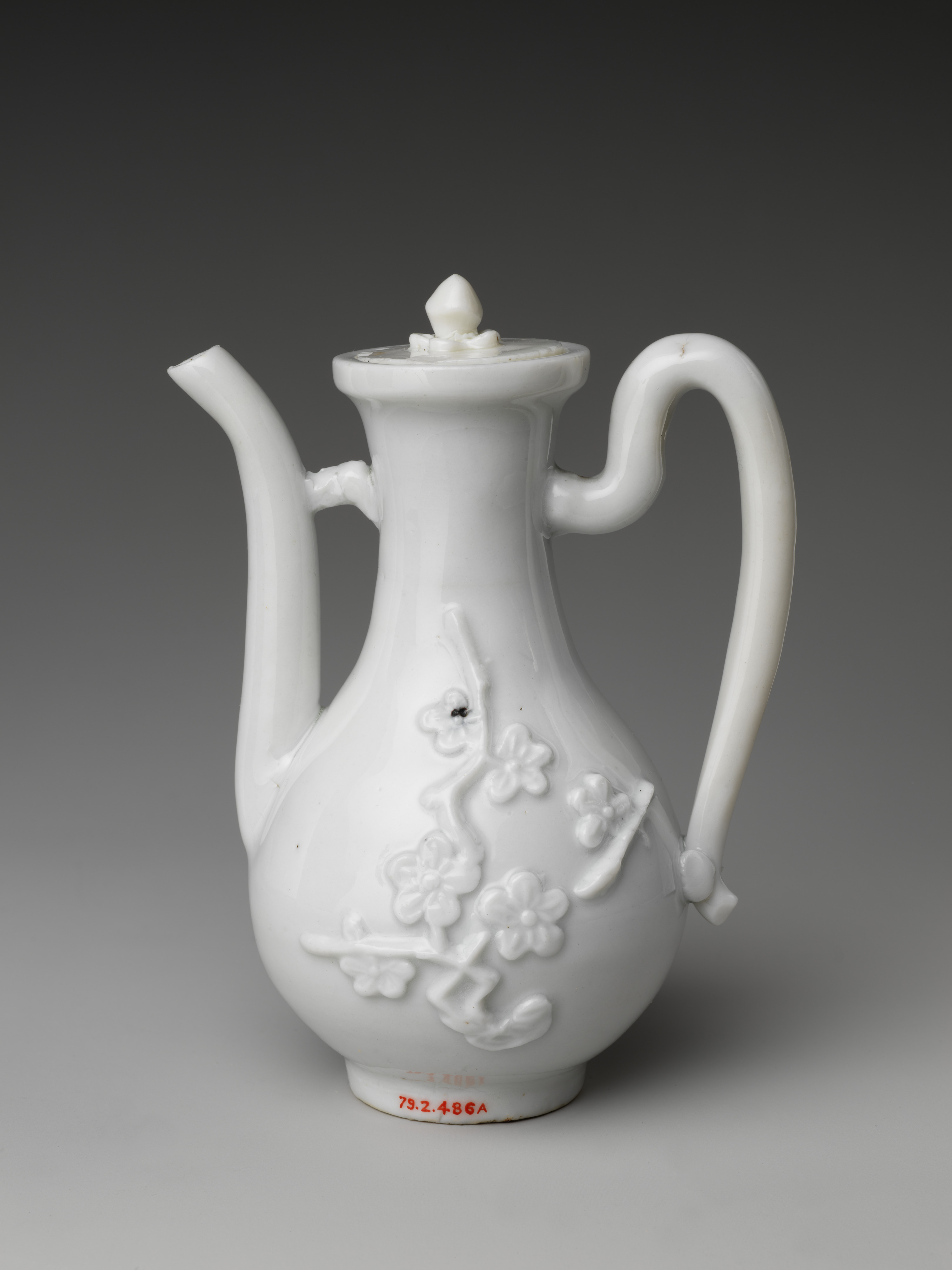
Early 18th century. The Metropolitan Museum of Art, 79.2.486a,b.
1.8 The History of the Name: Where “Blanc de Chine” Came From
In 1862, the French art historian Albert Jacquemart used the term “blanc de Chine” in his writings to designate Dehua white porcelain. This is the earliest documented usage that can be traced.
Merriam-Webster records the first English usage in 1888.
“Blanc de Chine” literally means “white of China” in French. The trajectory of its adoption is a micro-history of cultural transmission: coined by a Frenchman, adopted by the English-speaking world, the French term became the international standard—while China itself only began systematically deploying this international name for cultural export purposes in relatively recent years.
In 2025, a doctoral thesis on Dehua white porcelain was defended at the Sorbonne—163 years after Jacquemart’s coinage, “blanc de Chine” remains the standard term in French-language scholarship.
1.9 UNESCO World Heritage Status
On 25 July 2021, “Quanzhou: Emporium of the World in Song-Yuan China” was inscribed on the UNESCO World Heritage List. The Dehua kiln sites (Weilin–Neiban and Qudougong) were included among the 22 heritage components.
The significance of World Heritage status lies not in the honorific label but in the internationally recognised narrative framework it provides: the Dehua kilns were integral to the Song-Yuan global maritime trade system, and their products reached every major market in the known world. The policy implications and tourism multiplier effects of this framework are analysed in Policy and Institutional Frameworks.
1.10 2025: ¥76 Billion
According to the Dehua County Government’s profile published in March 2026, the output value of Dehua ceramics reached ¥76 billion RMB in 2025.
From Shang-Zhou stamped stoneware to a ¥76-billion industrial cluster, thirty-seven centuries compressed into a single dimension. The core thread is not complex: the same clay, the same valley, a kiln fire that has burned for thirty-seven centuries without interruption. Scale, technology, markets, and institutions have undergone fundamental transformations, but the core raw material—Dehua clay with Fe₂O₃ below 0.5%—has remained the material foundation of the region’s competitive advantage throughout.
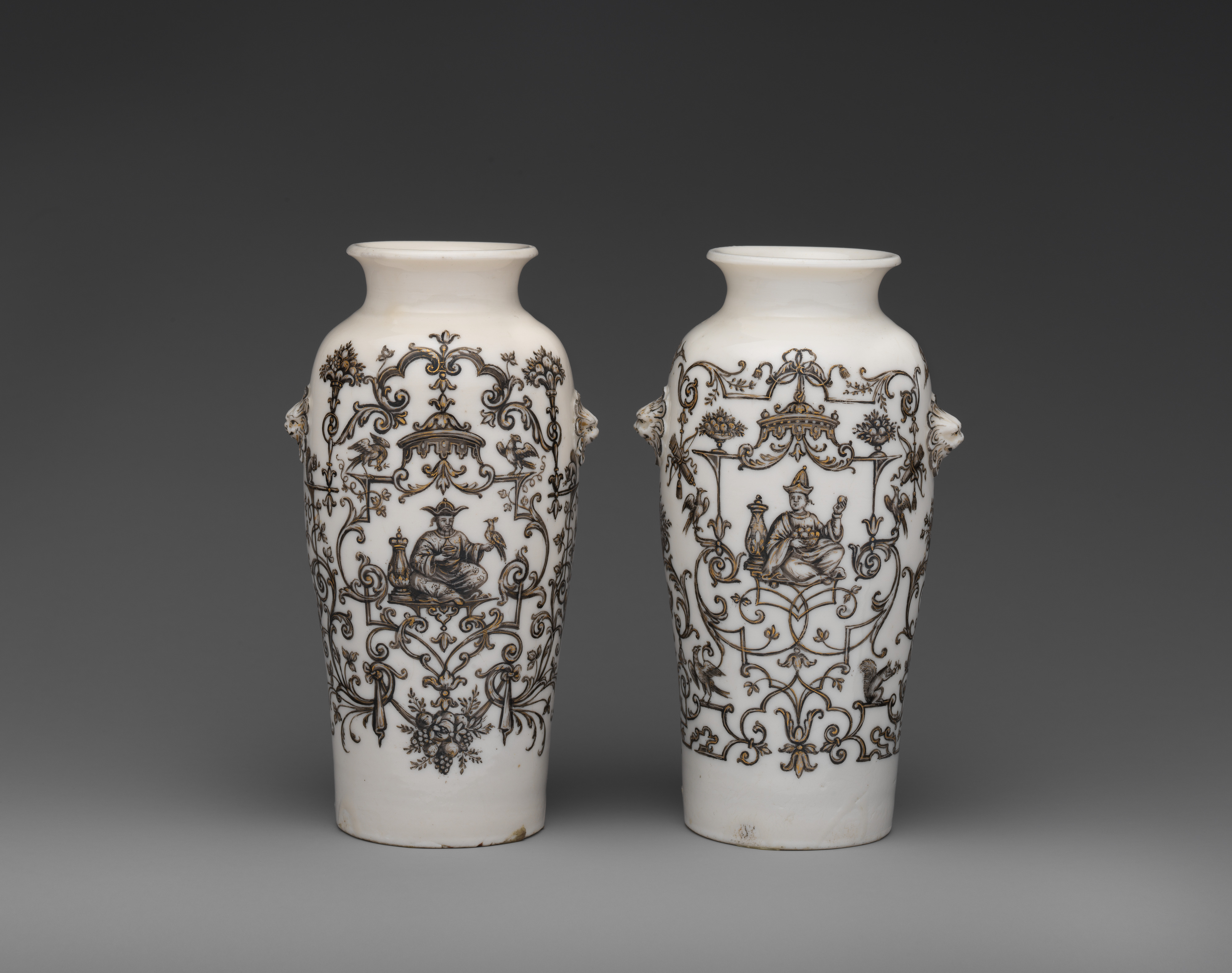
Dehua body, c. 1725–1730 European decoration. The Metropolitan Museum of Art, 50.211.27,.28.
Historical Milestones: A Chronology
Sources & References
Archaeology and Kiln Sites
- Liaotian Jianshan kiln site excavation report—radiocarbon dating and typological comparison establish Dehua’s ceramic origins in the Shang-Zhou period
- Wanpinglun kiln excavation—4.7 m cultural deposit, 13 Northern Song bronze coins providing layer-by-layer dating
- Qudougong kiln excavation—57.1 m dragon kiln (surviving length), 6,793 excavated objects, saggars inscribed with ‘Phags-pa Mongolian script
Chemistry and Materials Science
- Li Weidong. “Chemical composition of Dehua porcelain bodies.” Ceramics International 37 (2011): 651–658.—XRF data: Fe₂O₃ <0.5%, K₂O 6.5–7.3%
- Nigel Wood. Chinese Glazes: Their Origins, Chemistry, and Recreation. University of Pennsylvania Press, 2007.—Causal analysis of oxidising atmosphere and ivory tone
General References
- Joseph Needham, ed. Science and Civilisation in China, Vol. 5, Part 12 (Rose Kerr & Nigel Wood). Cambridge University Press, 2004. 918 pp.—The most authoritative English-language scholarship on Chinese ceramic technology
- Liu Youcheng (刘幼铮). Blanc de Chine: Studies on Dehua White Porcelain (中国德化白瓷研究). Beijing: Science Press, 2007. ISBN 978-7-03-019558-6. 243 pp. + 300 colour plates.—The first systematic archaeological typological and statistical study of nearly 4,000 Dehua white porcelain specimens; nine-chapter structure covering kiln architecture, body and glaze characteristics, dated-ware statistics, object/sculpture typology, chronological models, and artistic achievement
- Albert Jacquemart. First documented use of “blanc de Chine” (1862)
- Song Yingxing. Tiangong Kaiwu (1637)—“fires only exquisite porcelain figures and curios”
- Bamin Tongzhi (Ming Hongzhi era)—“White porcelain vessels come from Dehua County”
Trade Archives
- VOC (Dutch East India Company) commercial archives—over 3 million pieces of Chinese porcelain shipped to Europe, 1604–1657
- Kr. Kohn, VOC employee letter (1616)—specific mention of Dehua white porcelain
- English East India Company trade records—Dehua Guanyin figures catalogued as “Sancta Marias”
Official Data
- Dehua County Government profile (March 2026)—2025 ceramics output: ¥76 billion RMB
- UNESCO World Heritage List (25 July 2021)—Quanzhou: 22 heritage components including Dehua kiln sites
- China Intangible Cultural Heritage Network—Four-phase evolutionary framework for Dehua porcelain
Image Sources
- Fig. D1-01: Victoria and Albert Museum, O126198 · Open Access
- Fig. D1-02: Victoria and Albert Museum, O181942 · Open Access
- Fig. D1-03: The Metropolitan Museum of Art, 79.2.486a,b · CC0 Public Domain
- Fig. D1-04: The Metropolitan Museum of Art, 50.211.27,.28 · CC0 Public Domain
Cross-Dimension References
- He Chaozong and the Global Atlas of Masterworks—the representative artist of the Ming ivory-white zenith and holdings in 60+ museums worldwide
- Shipwreck Archaeological Database—underwater physical evidence for maritime trade (Atalaia, San Cristo de Burgos, et al.)
- European Imitation Evidence Chain—the VOC trade-driven imitation chain from Meissen, Saint-Cloud, Chelsea, and beyond
- Chemical Fingerprint of Dehua White Porcelain—full materials-science analysis of Fe₂O₃/K₂O composition
- Blanc de Chine Auction Market Intelligence—historical auction results and price logic
- Cross-Cultural Semantics of White Porcelain—“Sancta Marias” and other cultural misreadings and transformations
- Dehua Ceramics Industrial Economics—structural analysis of the ¥76-billion industrial cluster
- Policy and Institutional Frameworks—policy effects and tourism multiplier of UNESCO World Heritage status
- Three-Scenario Projection 2027–2035—three possible future pathways
Related Datasets
- Chemical Composition Comparison—XRF data comparison of Dehua, Jingdezhen, and Meissen porcelain bodies
- Shipwreck Archaeological Database—catalogue of discovered shipwrecks containing Dehua white porcelain
- He Chaozong Global Collection Index—distribution of Dehua white porcelain holdings across world museums
- European Imitation Timeline—imitation history from Meissen to Chelsea
- Auction Records Master Table—major Dehua white porcelain auction results by year
- Blanc de Chine Catalogue—136 objects from museum collections worldwide