3.1 Methodology
The moment a ship sinks, every item of cargo aboard is locked into a precise point in time — unlike objects that survive on land, which can be resold, altered, or have their provenance fabricated by subsequent owners. Shipwreck archaeology provides trade evidence of forensic-grade reliability: when, from where, to where, and what was carried.
The eleven shipwrecks below constitute the underwater evidence chain for the overseas trade of Blanc de Chine, spanning from 1183 to 1822 and covering the South China Sea, Indian Ocean, Atlantic Ocean, and Pacific Ocean. They lie along three major trade routes: the Portuguese route (via Malacca and Goa to Lisbon), the Dutch East India Company (VOC) route (via Batavia to Amsterdam), and the Manila Galleon route (via the Philippines across the Pacific to the Americas).
An observation by Robert McPherson — a London antiquarian and specialist in shipwreck porcelain — deserves citation: “Most shipwrecks do not contain white porcelain.” This means that the Dehua blanc de Chine recovered from each of the eleven wrecks below constitutes an archaeological event worthy of special attention.
| Route | Origin | Destination | Key Intermediaries |
|---|---|---|---|
| Portuguese Route | Quanzhou | Lisbon | Malacca → Goa → Cape of Good Hope |
| VOC Dutch Route | Quanzhou | Amsterdam | Batavia → Cape of Good Hope |
| Manila Galleon | Quanzhou | Acapulco | Manila → Pacific Ocean |
| # | Name | Date | Dynasty | Waters | Recovered Objects | Significance |
|---|---|---|---|---|---|---|
| 1 | Nanhai No. 1 | 约1183 | Southern Song | South China Sea (Yangjiang, Guangdong) | 180,000+ pieces (Dehua ≈ 26% ≈ 47,000) | Largest underwater excavation in China; proves Dehua was a major export producer via Quanzhou port by Southern Song |
| 2 | Huaguangjiao No. 1 | 1162年后 | Southern Song | Paracel Islands | 1,000+ powder boxes | Reflects everyday demand in Southeast Asian markets |
| 3 | Java Sea Wreck | 约1340–1352 | Yuan dynasty | Java Sea | 3.5 tonnes recovered (2024 discovery) | Incremental evidence of Yuan-era Dehua export volumes |
| 4 | Hatcher Cargo | 约1643 | Late Ming | South China Sea | 579 pieces (incl. 439 bowls + Guanyin figures) | Milestone: Dehua blanc de Chine enters the international auction market |
| 5 | Atalaia | 1647 | Late Ming | Portuguese route (Atlantic) | 8 sherds | Earliest physical evidence of Dehua porcelain on a Portuguese route |
| 6 | Vung Tau Cargo | 约1690 | Qing Kangxi | South China Sea (Vung Tau, Vietnam) | ≈ 30 Guanyin figures | Proves bulk European trade demand for Dehua sculptural porcelain |
| 7 | Santo Cristo de Burgos | 1693 | Qing Kangxi | Pacific Ocean (Nehalem, Oregon) | Dehua porcelain (quantity unknown) | Earliest Dehua porcelain found archaeologically in North America |
| 8 | Ca Mau | 约1725 | Qing Yongzheng | South China Sea (Cà Mau, Vietnam) | Includes Dehua products | Early Qing underwater anchor point on the South China Sea trade route |
| 9 | Geldermalsen | 1752 | Qing Qianlong | South China Sea | VOC cargo | Turning point: European porcelain factories overtake Asian imports |
| 10 | Diana Cargo | 1817 | Qing Jiaqing | Strait of Malacca | Includes Dehua porcelain | Late-phase picture of Dehua exports in the early 19th century |
| 11 | Tek Sing | 1822 | Qing Daoguang | South China Sea | ≈ 350,000 pieces (predominantly blue-and-white) | Signal of declining Dehua blanc de Chine share in bulk exports |
3.2 Eleven Shipwrecks
(1) Nanhai One (南海一号)
Sinking date: c. 1183 (Southern Song dynasty)
Total recovered artefacts: 180,000+ pieces
Dehua kiln proportion: c. 26%
Nanhai One is the largest underwater archaeological excavation in Chinese history. Of the 180,000+ recovered artefacts, Dehua kiln products account for approximately 26% — roughly 47,000 pieces. The cargo composition proves that by the Southern Song period, Dehua was already one of the primary production centres supplying export porcelain through the port of Quanzhou.
In 2024, a provenance study published in Antiquity (Cambridge University Press) used chemical composition analysis to identify the origins of ceramics recovered from Nanhai One, further confirming the proportion and distribution of Dehua kiln products. This research applied chemical fingerprint analysis directly to underwater archaeological material, establishing cross-validation between shipwreck data and materials science.
(2) Huaguangjiao No. 1 (华光礁一号)
Sinking date: after 1162 (Southern Song dynasty)
Dehua-related artefacts: 1,000+ powder boxes
Huaguangjiao No. 1 sank in the waters of the Paracel Islands. The 1,000-plus powder boxes are typical Dehua products — powder boxes were among the most common vessel types in Song-dynasty export ceramics, reflecting everyday demand in Southeast Asian markets. Compact and stackable for efficient shipping, they were among the most economically viable export items of the Southern Song period. Together with Nanhai One, Huaguangjiao No. 1 confirms that by the twelfth century, Dehua porcelain was already a routine bulk commodity in the Quanzhou–Southeast Asia maritime trade.
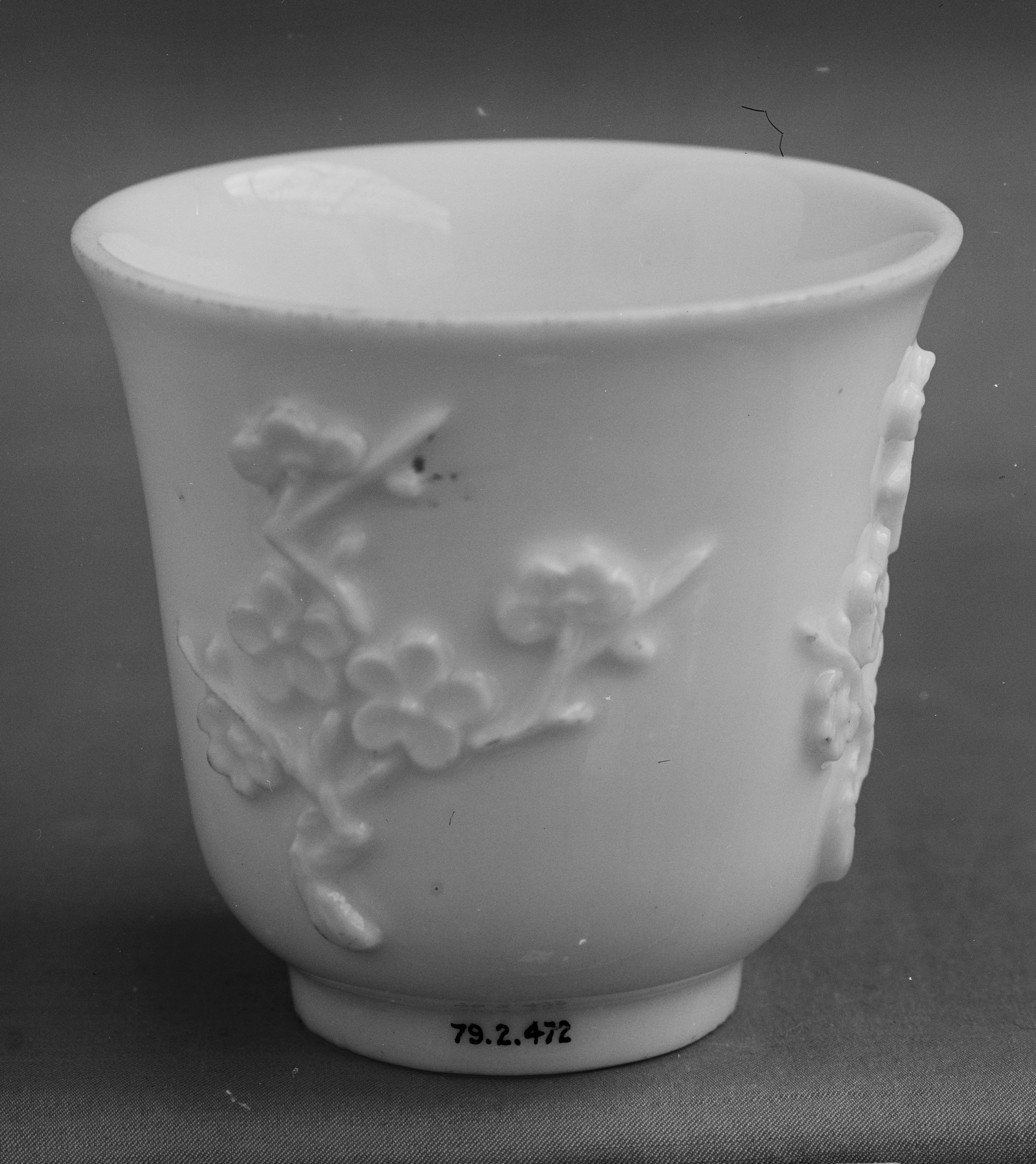
White porcelain with transparent glaze, late 17th to early 18th century, H. 7 cm, Diam. 7.6 cm. Cups and bowls constituted the overwhelming majority of the 47,000 Dehua pieces recovered from Nanhai One; the 1,000-plus powder boxes from Huaguangjiao No. 1 likewise belong to the utilitarian category — this piece is a museum specimen of the same trade typology. The Metropolitan Museum of Art, 79.2.472.
(3) Hatcher Cargo (哈彻沉船)
Sinking date: c. 1643 (late Ming dynasty)
Dehua white porcelain recovered: 579 pieces, including 439 bowls and several Guanyin figures
Auction: Christie’s Amsterdam, c. $2 million
This cargo, salvaged by British captain Michael Hatcher in the 1980s, was a watershed moment for Dehua blanc de Chine in the international auction market. The 579 white porcelain pieces included Guanyin figures — the presence of religious sculptures in a shipwreck demonstrates that European demand for Dehua porcelain extended well beyond utilitarian wares, with sculptural pieces already constituting regular trade goods by the mid-seventeenth century. The combination of 439 bowls and several Guanyin figures precisely reflects the structure of an export manifest: bulk utilitarian wares at the base, high-value sculptures at the apex.
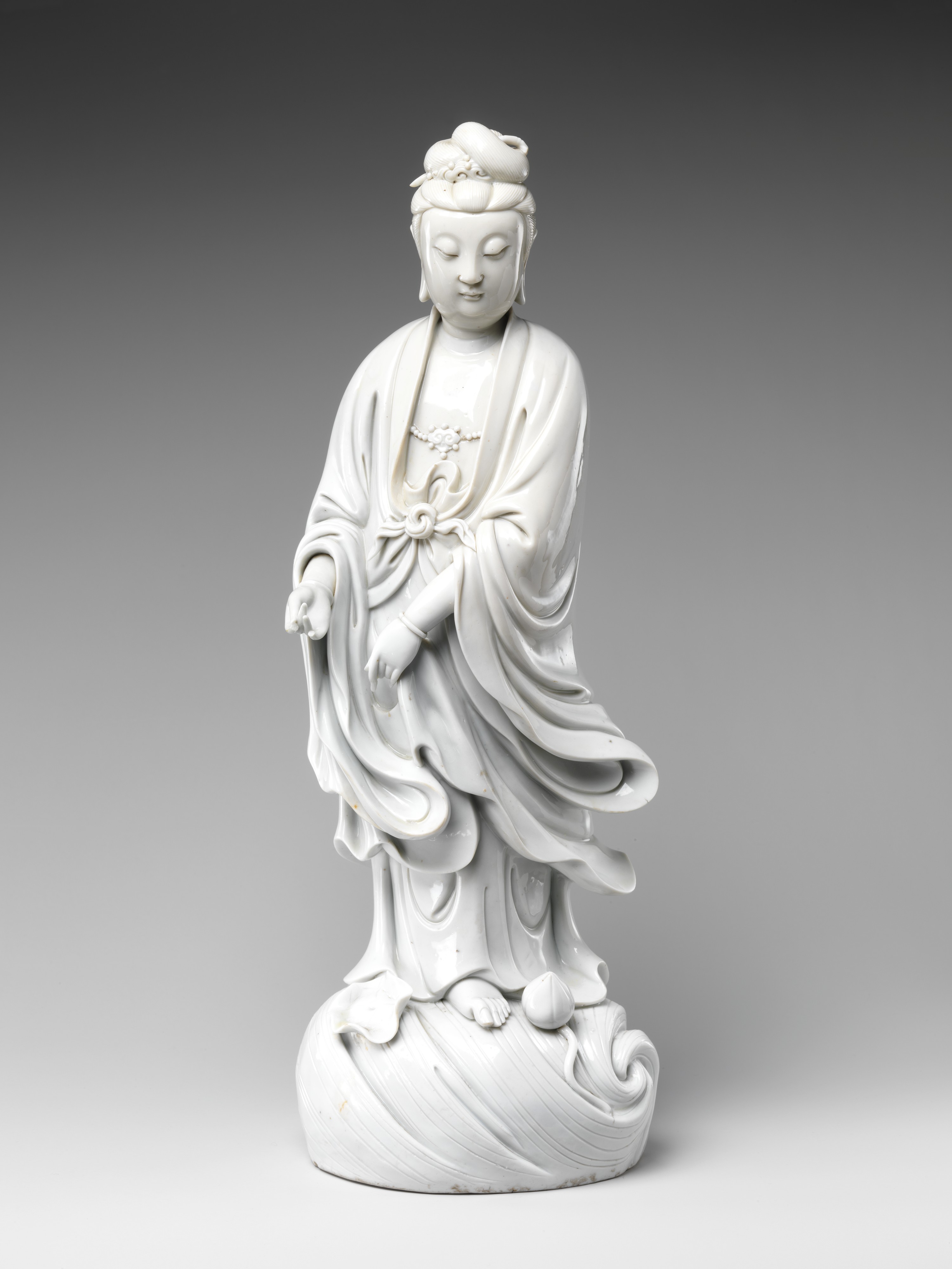
White porcelain with ivory-white glaze, 17th century. The Hatcher Cargo (c. 1643) yielded 579 white porcelain pieces including Guanyin figures; the Vung Tau Cargo (c. 1690) yielded approximately 30 Guanyin figures — this piece is a museum specimen of the same period and type. The high frequency of sculptural porcelain in maritime trade represents a direct commercial extension of the artistic tradition documented in the He Chaozong global corpus. The Metropolitan Museum of Art, 24.80.155.
(4) Vung Tau Cargo (头顿沉船)
Sinking date: c. 1690 (Qing Kangxi era)
Dehua white porcelain recovered: c. 30 Guanyin figures
Auction: Christie’s, $7.3 million
The concentrated recovery of approximately 30 Guanyin figures indicates that by c. 1690, European market demand for Dehua sculptural porcelain had reached bulk-trade scale rather than incidental inclusion. The Vung Tau Cargo’s Christie’s auction total of $7.3 million far surpassed the Hatcher Cargo’s $2 million, reflecting the escalating 1990s market enthusiasm for shipwreck porcelain. This price-escalation trend connects directly to the seven-tier price model constructed in the auction market intelligence analysis.
(5) Atalaia (阿塔拉亚号)
Sinking date: 1647
Dehua white porcelain recovered: 8 sherds
Route: Portuguese (Lisbon–Asia)
Significance: Earliest physical evidence of Dehua blanc de Chine on the Portuguese trade route
The 8 white porcelain sherds constitute the earliest confirmed physical evidence that the Portuguese trade route carried Dehua blanc de Chine. The Atalaia was a Portuguese merchantman whose route connected Asia to the Iberian Peninsula. These sherds confirm that Dehua porcelain reached Europe via the Portuguese westward sea route. This archaeological discovery drew on Portuguese-language documentation — a direct application of the eight-language research framework employed in this report.
(6) Santo Cristo de Burgos (布尔戈斯圣基督号)
Sinking date: 1693
Sinking location: Nehalem, Oregon
Route: Manila Galleon (Philippines–Acapulco)
Significance: Earliest Dehua porcelain found in North American archaeology
This Manila galleon departed the Philippines and crossed the Pacific, sinking off the coast of North America. The Dehua blanc de Chine recovered from the wreck is the earliest Dehua porcelain in the North American archaeological record — confirming the trans-Pacific trade route as an authentic channel for the global dissemination of Dehua wares.
This case demonstrates that by the late seventeenth century, the Manila Galleon trade had extended the circulation of Dehua blanc de Chine to the Pacific coast of North America. Spanish-language archives (AGI, Archivo General de Indias) provide primary documentary support for this vessel’s route and cargo — an application of the report’s eight-language research framework in the Spanish-language domain.
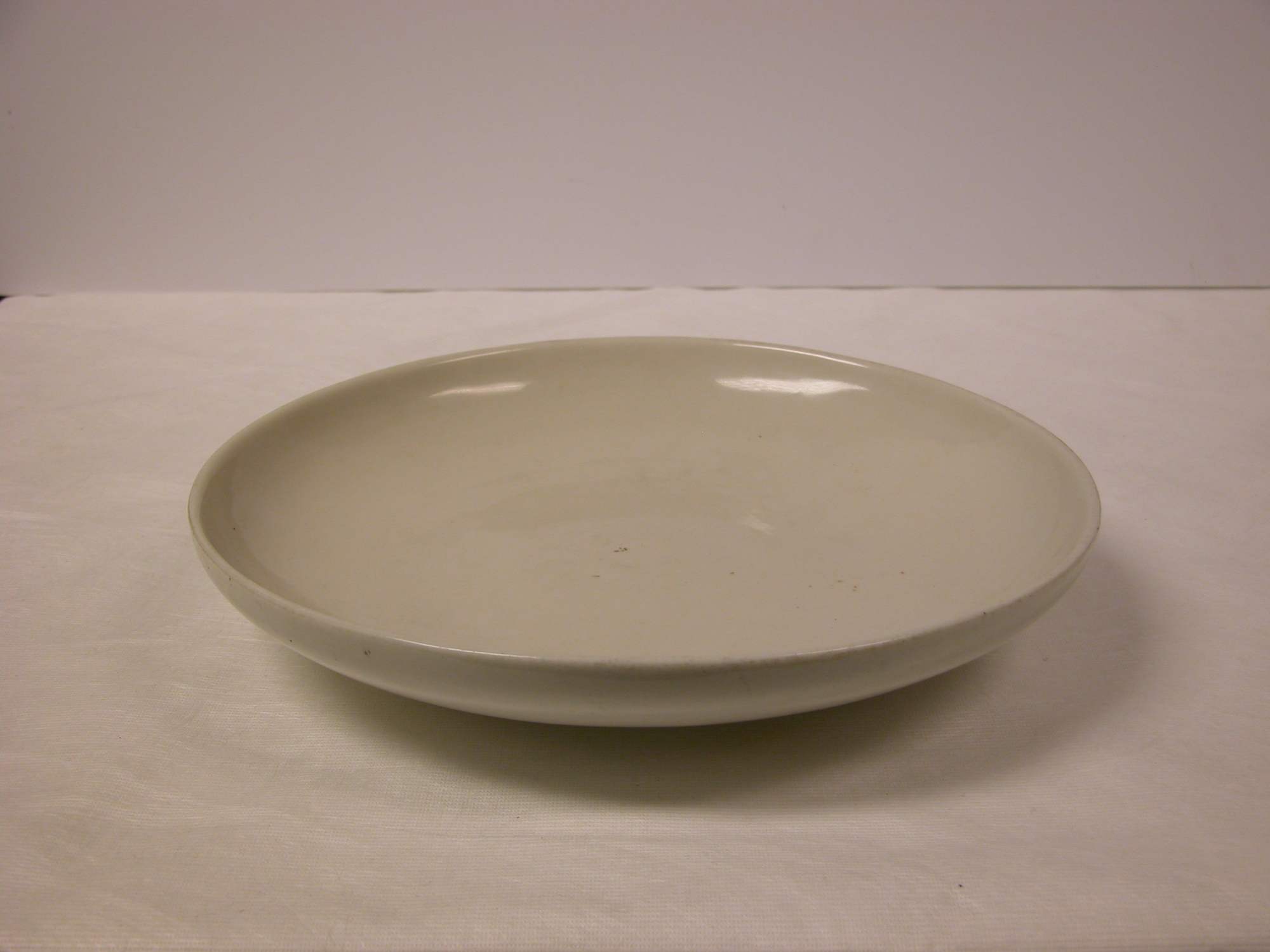
White porcelain, Ming dynasty 17th century, Diam. 28.6 cm. Of the 579 white porcelain pieces recovered from the Hatcher Cargo, 439 were bowls and dishes — this piece is a museum specimen of the same period and type. Utilitarian wares constituted the foundation of the export trade, forming a pyramid structure with high-value sculptural pieces at the apex. The Metropolitan Museum of Art, 67.13.
(7) Tek Sing (泰兴号)
Sinking date: 1822
Total recovered objects: c. 350,000 pieces
Significance: Signal of industrial transition
The Tek Sing is the latest-dated wreck in this database. Its 350,000 recovered ceramics were predominantly blue-and-white utilitarian wares. This cargo composition itself constitutes a signal: by 1822, the share of Dehua blanc de Chine in bulk export trade had declined significantly, displaced by blue-and-white and other categories. This aligns with the declining quality trajectory of the Qing-dynasty “spring onion white” glaze described in the historical evolution — as the product lost the aesthetic pinnacle of the Ming ivory-white glaze, market preferences naturally shifted. Concurrently, the European porcelain factories described in the European imitation evidence chain had completed their transition from imitation to independent innovation, further compressing the market space for Chinese export porcelain.
In 2019, the Aquatic Cultural Group donated a collection of Tek Sing artefacts to the National Museum of China.
(8) Ca Mau (金瓯沉船)
Sinking date: c. 1725 (Qing Yongzheng era)
Sinking location: Ca Mau province, Vietnam
The Ca Mau wreck cargo included Dehua products, serving as another underwater anchor point on the early Qing South China Sea trade route. Ca Mau lies at the southernmost tip of the Mekong Delta — this location indicates that the South China Sea trade lanes remained active during the Yongzheng era.
(9) Diana Cargo (黛安娜号)
Sinking date: 1817
Related auction: Christie’s
Dehua porcelain recovered from the Diana Cargo, together with the Tek Sing, delineates the late-phase landscape of Dehua ceramic exports in the early nineteenth century. Separated by only five years (1817–1822), a comparison of the two vessels’ cargo compositions reflects the rapid category shifts in Chinese export ceramics during this period.
(10) Java Sea Wreck (德马西克沉船)
Sinking date: c. 1340–1352 (Yuan dynasty)
Major discovery: 3.5 tonnes of artefacts recovered in 2024
The 2024 discovery provides significant new evidence for the overseas trade of Dehua porcelain during the Yuan dynasty. The scale of 3.5 tonnes of recovered material indicates that Yuan-dynasty Dehua kiln output for export was already substantial — corroborating the production capacity reflected by the 57.1-metre “chicken coop” kiln (jilongyo) at the Qudougong kiln site described in the historical evolution. Chronologically, the Java Sea Wreck fills a 260-year archaeological gap between the Southern Song (Nanhai One, c. 1183) and the late Ming (Hatcher Cargo, c. 1643).
(11) Geldermalsen (盖尔德马尔森号)
Sinking date: 1752
Operator: VOC (Dutch East India Company)
Significance: A pivotal node in the European imitation evidence chain’s “great reversal”
The sinking of the Geldermalsen (a VOC vessel) and its subsequent salvage auction hold turning-point significance within the narrative of the European imitation evidence chain — 1752 marks precisely the era when European porcelain factories were achieving competitive scale and Chinese export porcelain began facing displacement. Dutch-language archives (VOC commercial records) provide detailed documentation of this vessel’s cargo and route.
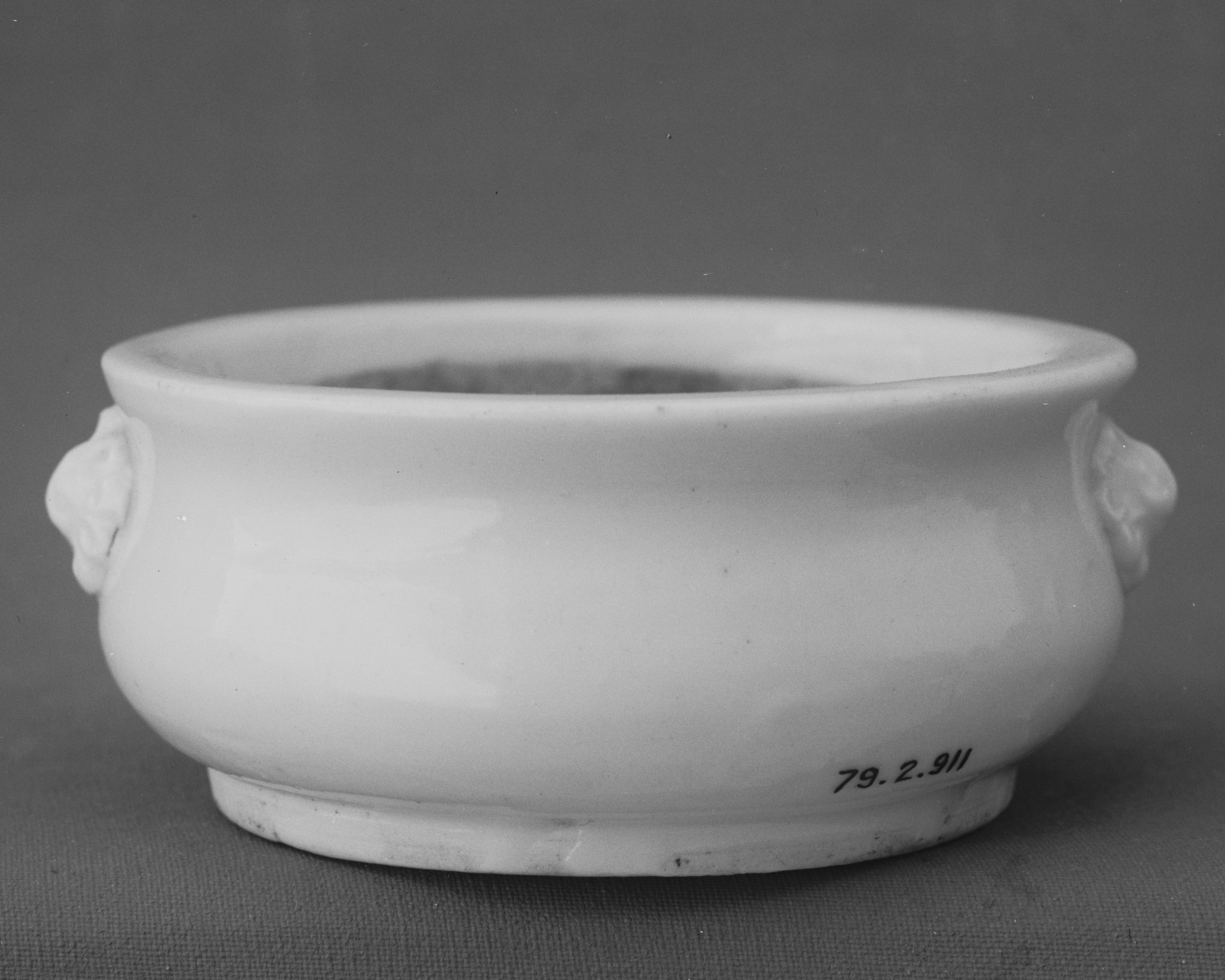
White porcelain with transparent glaze, 17th century, H. 3.8 cm, W. 8.9 cm. Dehua white porcelain in the export trade was not limited to sculptures and utilitarian wares — incense burners and other ritual vessels constituted a third category. VOC manifests and shipwreck recoveries alike include such small implements, which were repurposed for indoor fumigation and display in European households. The Metropolitan Museum of Art, 79.2.911.
3.3 The Complete Underwater Evidence Chain
The eleven shipwrecks span 639 years (1183–1822) and cover four oceans: the South China Sea, the Indian Ocean, the Atlantic, and the Pacific. Arranged chronologically, the narrative arc of this evidence chain emerges with clarity:
The timeline above traces a complete narrative arc: in the Southern Song, Dehua porcelain was already a bulk export commodity from the port of Quanzhou (Nanhai One, Huaguangjiao No. 1) → Yuan-dynasty volumes expanded further (Java Sea Wreck) → by the late Ming, blanc de Chine had become a star product in the European market (Hatcher Cargo) → early Qing demand peaked, with Guanyin figures exported in bulk (Vung Tau Cargo) → mid-eighteenth-century competitive dynamics shifted (Geldermalsen / Ca Mau) → by the nineteenth century, the share of blanc de Chine in bulk export trade had declined (Diana Cargo, Tek Sing).
The defining characteristic of this underwater evidence is that every recovered piece carries a precise sinking date and route attribution, constituting independently verifiable trade records.
3.4 Route Distribution and Geographic Analysis
The eleven shipwrecks are distributed along three major trade routes, with geographic coverage extending from the South China Sea to the Atlantic and Pacific:
| Route | Wrecks | Ships | Time Span |
|---|---|---|---|
| South China Sea Regional | 6 | Nanhai One, Huaguangjiao No. 1, Java Sea Wreck, Hatcher, Ca Mau, Tek Sing | 1162–1822 (660 years) |
| VOC / Dutch East India Co. | 3 | Vung Tau Cargo, Geldermalsen, Diana Cargo | 1690–1817 (127 years) |
| Portuguese Route | 1 | Atalaia | 1647 |
| Manila Galleon | 1 | Santo Cristo de Burgos | 1693 |
The South China Sea regional route has the highest shipwreck density (6 wrecks) and the longest time span (660 years), reflecting the enduring centrality of the South China Sea as the core waterway for Dehua porcelain exports. The three VOC-route wrecks precisely mark the critical interval from the peak of Dutch East India Company trade (1690) to its inflection point (1752). The Portuguese and Manila Galleon routes each have only one wreck record, but their archaeological significance lies not in quantity but in route confirmation — respectively proving the existence of the Atlantic westward channel and the Pacific eastward channel.
The coverage of four oceans constitutes a geographic completeness argument: the South China Sea (8 wrecks), the Indian Ocean (a necessary transit segment with no wreck record), the Atlantic (1: Atalaia), and the Pacific (1: Santo Cristo de Burgos). Although the Indian Ocean has no direct shipwreck record, both the Portuguese and VOC routes traversed Indian Ocean waters — wrecks from these routes in other seas indirectly confirm transit through the Indian Ocean segment.
3.5 Shipwreck Master Table
| # | Shipwreck | Sinking Date | Dynasty | Dehua-Related Artefacts | Key Significance |
|---|---|---|---|---|---|
| 1 | Nanhai No. 1 南海一号 | 约1183 | Southern Song | 180,000+ pieces (Dehua ≈ 26% ≈ 47,000) | Largest underwater excavation in China; proves Dehua was a major export producer via Quanzhou port by Southern Song |
| 2 | Huaguangjiao No. 1 华光礁一号 | 1162年后 | Southern Song | 1,000+ powder boxes | Reflects everyday demand in Southeast Asian markets |
| 3 | Java Sea Wreck 德马西克沉船 | 约1340–1352 | Yuan dynasty | 3.5 tonnes recovered (2024 discovery) | Incremental evidence of Yuan-era Dehua export volumes |
| 4 | Hatcher Cargo 哈彻沉船 | 约1643 | Late Ming | 579 pieces (incl. 439 bowls + Guanyin figures) | Milestone: Dehua blanc de Chine enters the international auction market |
| 5 | Atalaia 阿塔拉亚号 | 1647 | Late Ming | 8 sherds | Earliest physical evidence of Dehua porcelain on a Portuguese route |
| 6 | Vung Tau Cargo 头顿沉船 | 约1690 | Qing Kangxi | ≈ 30 Guanyin figures | Proves bulk European trade demand for Dehua sculptural porcelain |
| 7 | Santo Cristo de Burgos 布尔戈斯圣基督号 | 1693 | Qing Kangxi | Dehua porcelain (quantity unknown) | Earliest Dehua porcelain found archaeologically in North America |
| 8 | Ca Mau 金瓯沉船 | 约1725 | Qing Yongzheng | Includes Dehua products | Early Qing underwater anchor point on the South China Sea trade route |
| 9 | Geldermalsen 盖尔德马尔森号 | 1752 | Qing Qianlong | VOC cargo | Turning point: European porcelain factories overtake Asian imports |
| 10 | Diana Cargo 黛安娜号 | 1817 | Qing Jiaqing | Includes Dehua porcelain | Late-phase picture of Dehua exports in the early 19th century |
| 11 | Tek Sing 泰兴号 | 1822 | Qing Daoguang | ≈ 350,000 pieces (predominantly blue-and-white) | Signal of declining Dehua blanc de Chine share in bulk exports |
3.6 English East India Company Shipping Records
Shipwreck archaeology captures randomly preserved cross-sections of trade — only ships that sank leave records. The complementary source is commercial archives: the English East India Company (EIC) cargo manifests document trade data from voyages that were completed successfully. The records below, compiled from Rose Kerr’s systematic study of EIC archives, reflect the scale and category structure of Dehua blanc de Chine shipped from the port of Xiamen to England between 1699 and 1707.
| Ship | Date | Cargo Summary | Notes |
|---|---|---|---|
| Nassau | Returned to England 1699 | 175 Virgin Mary figures, 70 lady-and-child figures, 71 smaller lady figures, 37 large white lions, 1,247 small white lions, 255 white jars and handled cups, 497 white handled cups, 1,470 white chocolate cups | Resold in London, 1699 |
| Dorrill | Returned to England before April 1702 | 4,200 white chocolate cups, 52 Virgin Mary figures, 42 lady-and-child figures | Sold April 1702 |
| Dashwood | Arrived at Xiamen winter 1701 | Virgin Mary figures, pulpit priest figures, lady-and-child figures, figure-on-beast and various birds, beasts and white handled cups; also figures never before imported to England: 41 Dutch family groups, 14 Dutch horsemen, 110 Dutch figures | Auctioned in London, 1703 |
| Union | Arrived at Xiamen 1703 | 22 kiln-loads of white porcelain figures (including 2 Dutch family groups, 2 Dutch figures, 2 Virgin Mary figures, 65 pulpit priest figures, 3 plain figures without priest) | Sold in a series of auctions, March 1705 |
| Fleet | Returned to England before September 1705 | 2,240 lions, 118 double josses, 310 birds, 35 elephants | Sold September 1705 |
| Regard | Returned to England before September 1705 | 4 standing Virgin Mary figures | Sold September 1705 |
| Tavestock | April 1706 | 4 standing Virgin Mary figures, 6 small white lady figures, 6 white chocolate cups, etc. | — |
| Somers | Returned to England before June 1707 | 2 horseman figures, 2 roosters, 2 lady-and-child figures, 3 small lady-and-child figures, 3 standing Virgin Mary figures, 8 white toy figures, 9 cold-painted lions, 10 cold-painted figures | Auctioned June 1707 |
| Toddington | Returned to England before June 1707 | 2 large cold-painted figures, 1 cold-painted lady-and-child figure, 2 smaller cold-painted lady-and-child figures | Auctioned June 1707 |
Sources: Rose Kerr, “Dehua Blanc de Chine Trade to Europe and the New World, Late 17th to Early 18th Century” (Part I), Fujian Wenbo, 2012, No. 4; Wan Jun, “Production and Trade of Dehua Blanc de Chine in a Global Perspective,” Journal of the Palace Museum, 2021, Vol. 22, Appendix II.
The table above reveals several key trade characteristics. First, religious sculptures (Virgin Mary figures, pulpit priest figures) were bulk trade goods — the Nassau alone carried 175 Virgin Mary figures, demonstrating that these were not curiosities shipped on occasion but regular export items with a stable European clientele. Second, the sheer quantity of animal figures is remarkable — the Fleet carried 2,240 lions, 310 birds, and 35 elephants — a scale proving that Dehua’s porcelain sculpture output far exceeded the “masterpieces by celebrated artisans” scope typically emphasised in academic discourse. Third, the Dashwood’s manifest listed 41 “Dutch family groups” and 14 “Dutch horsemen” — direct evidence of bespoke production, with Dehua potters working from models or drawings supplied by European merchants to create European-subject sculptures. Fourth, the Somers and Toddington manifests include “cold-painted” (enamelled after firing) items, indicating that some Dehua blanc de Chine underwent secondary decoration upon arrival in Europe — consistent with the overpainting phenomena discussed in the European imitation evidence chain.
3.7 Terrestrial and Coastal Archaeological Evidence
Shipwrecks are trade snapshots intercepted en route; terrestrial sites are reception records at the destination. The following archaeological discoveries confirm that the global circulation of Dehua blanc de Chine extends beyond museum collections of heirloom objects — Dehua porcelain has been excavated from sites and ruins across Southeast Asia, South Asia, East Africa, and the Americas.
| Region | Site | Excavated Material | Date / Notes |
|---|---|---|---|
| Macau | Ruins of St. Paul’s and adjacent college | Dehua blanc de Chine sherds | Portuguese route transshipment node |
| Goa, India | Church of St. Augustine ruins (built 1602) | Dehua sherds: straight-necked vases, lids, betel-nut boxes, magnolia-form cups, bird and large figure fragments | Second half of 16th century, Portuguese trading post |
| Bijapur, India | Urban ruins of the Bijapur Deccan kingdom | Dehua porcelain sherds | Before 1686 (conquest by Aurangzeb) |
| Kenya | Coastal sites and tombs | Chinese ceramics including Longquan celadon, Jingdezhen blue-and-white, Dehua blanc de Chine | 9th to mid-19th century |
| Nigeria | Waters near Cape Nigaras | Dehua blanc de Chine sherds | 1686, near the wreck site of the Nossa Senhora dos Milagros |
| Cape Town, South Africa | Waters near the Cape | Dehua blanc de Chine cups, boxes, Buddhist figures, candlesticks, etc. | From the VOC vessel Oosterland |
| Mexico | Oaxaca (Monte Albán and multiple sites) | Animal figures, prunus-blossom cups, octagonal cups | Post-1521 Spanish colonial period |
| Mexico | Mexico City, Templo Mayor, municipal plaza, etc. | Animal figures, prunus cups, plain cups; Oaxaca monasteries: 65 small dishes, 377 prunus or plain bowls and cups | Manila Galleon route terminus |
| Alabama, USA | Old Mobile site | 86 Dehua blanc de Chine peony-motif cup sherds, 44 other white porcelain sherds | 1693, redistributed via Manila Galleon route |
| Oregon, USA | Nehalem Bay beach | Dehua blanc de Chine sherds | From the Santo Cristo de Burgos (1693) |
| Alkmaar, Netherlands | Alkmaar ruins | Several Dehua porcelain pieces (including a puzzle cup / gongdaobei) | VOC trade end-consumer site |
Sources: Wan Jun, “Production and Trade of Dehua Blanc de Chine in a Global Perspective,” Journal of the Palace Museum, 2021, Vol. 22; Rose Kerr, “Dehua Blanc de Chine Trade to Europe and the New World, Late 17th to Early 18th Century” (Parts I & II), Fujian Wenbo, 2012/2014.
Terrestrial site evidence and shipwreck evidence are mutually complementary: shipwrecks mark trade routes and en-route cargo composition, while terrestrial sites mark final consumption and use contexts. The blanc de Chine sherds at the Goa church ruins demonstrate that Dehua porcelain entered the religious spaces of Portuguese colonies; the 377 bowls and cups excavated from Oaxaca monasteries in Mexico show that Dehua utilitarian wares reached daily life in Spanish America via the Manila Galleon route; the 86 peony-cup sherds at the Old Mobile site confirm that Dehua blanc de Chine penetrated French colonial territory through North American redistribution networks. These sites span four continents, corroborating the three-route geographic analysis presented in §3.4.
Sources and References
- Wan Jun, “Production and Trade of Dehua Blanc de Chine in a Global Perspective,” Journal of the Palace Museum, 2021, Vol. 22
- Rose Kerr, “Dehua Blanc de Chine Trade to Europe and the New World, Late 17th to Early 18th Century” (Parts I & II), Fujian Wenbo, 2012/2014
- Cambridge University Press, Antiquity, 2024 — Provenance study of Nanhai One ceramics using chemical composition analysis
- Robert McPherson, personal communication (observation on the frequency of white porcelain in shipwrecks)
Image Sources
- Fig. D3-01: Metropolitan Museum of Art, 24.80.155 · CC0 Public Domain
- Fig. D3-02: Metropolitan Museum of Art, 67.13 · CC0 Public Domain
- Fig. D3-03: Metropolitan Museum of Art, 79.2.472 · CC0 Public Domain
- Fig. D3-04: Metropolitan Museum of Art, 79.2.911 · CC0 Public Domain
Frequently Asked Questions
- How many Dehua porcelain pieces were recovered from the Nanhai One shipwreck?
- The Nanhai One (sunk c. 1183) yielded over 180,000 artefacts in total, with Dehua kiln products accounting for approximately 26% — roughly 47,000 pieces. A 2024 provenance study published in Antiquity (Cambridge University Press) used chemical composition analysis to further confirm the proportion of Dehua kiln products.
- How many shipwrecks carried Dehua Blanc de Chine porcelain?
- This database documents 11 shipwrecks carrying confirmed Dehua blanc de Chine, spanning 639 years (1183–1822) across four oceans and three major trade routes: the Portuguese route, the VOC / Dutch East India Company route, and the Manila Galleon route.
- What Dehua porcelain was recovered from the Hatcher and Vung Tau shipwrecks?
- The Hatcher Cargo (c. 1643) yielded 579 pieces of white porcelain, including 439 bowls and several Guanyin figures, sold at Christie’s Amsterdam for approximately $2 million. The Vung Tau Cargo (c. 1690) yielded approximately 30 Guanyin figures, with Christie’s auction total reaching $7.3 million.
- What Dehua blanc de Chine did EIC ships carry?
- Based on Rose Kerr’s systematic study of EIC archives, at least 9 EIC ships carried Dehua blanc de Chine from Xiamen to England between 1699 and 1707. The Nassau alone carried 175 Virgin Mary figures, 1,247 small white lions, and 1,470 chocolate cups. The Dashwood’s manifest listed 41 “Dutch family groups” — direct evidence of bespoke production for European clients.
Cross-Dimension References
- Historical evolution of Dehua blanc de Chine — The 57.1-metre chicken-coop kiln at Qudougong corroborates the 3.5-tonne recovery from the Java Sea Wreck
- He Chaozong global corpus — The Guanyin figures from the Hatcher and Vung Tau wrecks are a direct commercial extension of the He Chaozong sculptural tradition
- European imitation evidence chain — The Geldermalsen (1752) marks the inflection point where European factory production began displacing Chinese export porcelain
- Chemical fingerprint analysis — The provenance study of Nanhai One ceramics establishes cross-validation between shipwreck data and materials science
- Auction market intelligence — The Vung Tau Cargo’s $7.3 million Christie’s result connects directly to the seven-tier price model