5.1 Chemical Composition: Four White Porcelain Centres Compared
The chemical data below isolate the core parameters that set Dehua apart from every other white porcelain tradition.
The comparison synthesises three key academic sources:
- Li Weidong, 2011, Ceramics International 37:651–658
- Cui Jianfeng & Nigel Wood, 2012, Journal of Archaeological Science 39:818–827
- Hayman, 2024, Archaeometry
| Component | Dehua (Ming body) | Jingdezhen (tianbai body) | Ding (Song body) | Meissen (early hard-paste) |
|---|---|---|---|---|
| SiO₂ | 71.8–74.2% | 70–75% | 64–68% | 65–70% |
| Al₂O₃ | 15–18% | 18–23% | 25–30% | 24–28% |
| K₂O | 6.5–7.3% | 3–4.5% | 2.5–4% | 1–2% |
| Fe₂O₃ | <0.5% | 0.8–1.5% | 1–2% | 0.5–1% |
| Na₂O | 0.3–0.8% | 0.5–1.5% | 0.5–1% | 2–4% |
| CaO | 0.5–2% | 1–5% | 2–5% | 1–3% |
Two key parameters distinguish Dehua from every other centre: Fe₂O₃ < 0.5% and K₂O 6.5—7.3%.
5.2 Single-Formula Body and Levigation
Jingdezhen uses a “dual-formula” body — porcelain stone blended with kaolin clay. This has been standard practice since the Yuan dynasty. The dual formula raises the alumina content and refractoriness of the body, making it possible to fire large-scale vessels.
Dehua is different. Dehua uses a single porcelain stone. One rock, ground and levigated (washed repeatedly in water to separate coarse from fine particles), shaped directly into ware. No second raw material is needed.
The physical consequence of the single formula: body and glaze have closely matched thermal expansion coefficients. A Song-dynasty assessment noted that Dehua ware “resembles Ding ware but without crazing” — meaning Dehua was as fine as Ding, yet free of crackle (the network of fine fractures in the glaze surface). Crazing results from a mismatch in the thermal expansion of body and glaze. Dehua has no crazing because the body is the chemical foundation of the glaze itself; the two contract in unison as the kiln cools.
5.3 High Potassium and Translucency
K₂O at 6.5—7.3% — this figure leads all four white porcelain centres by a wide margin. Jingdezhen: 3—4.5%. Ding: 2.5—4%. Meissen: 1—2%. Dehua’s potassium content is three to seven times that of Meissen.
The physical effect of high potassium: it promotes the formation of a glass phase — the non-crystalline fraction of the fired body. The higher the glass-phase proportion, the denser and more translucent the body becomes.
Hold a thin-walled Ming Dehua cup against natural light. Light passes through the wall and emerges as a warm amber-orange tone — the result of scattering and absorption by the high-potassium glass phase. Jingdezhen’s tianbai glaze also shows some translucency, but in a cooler, bluish register, sharply distinct from Dehua’s warmth.
This translucency cannot be reproduced through craftsmanship in a low-potassium formulation, because it is a direct physical expression of chemical composition.
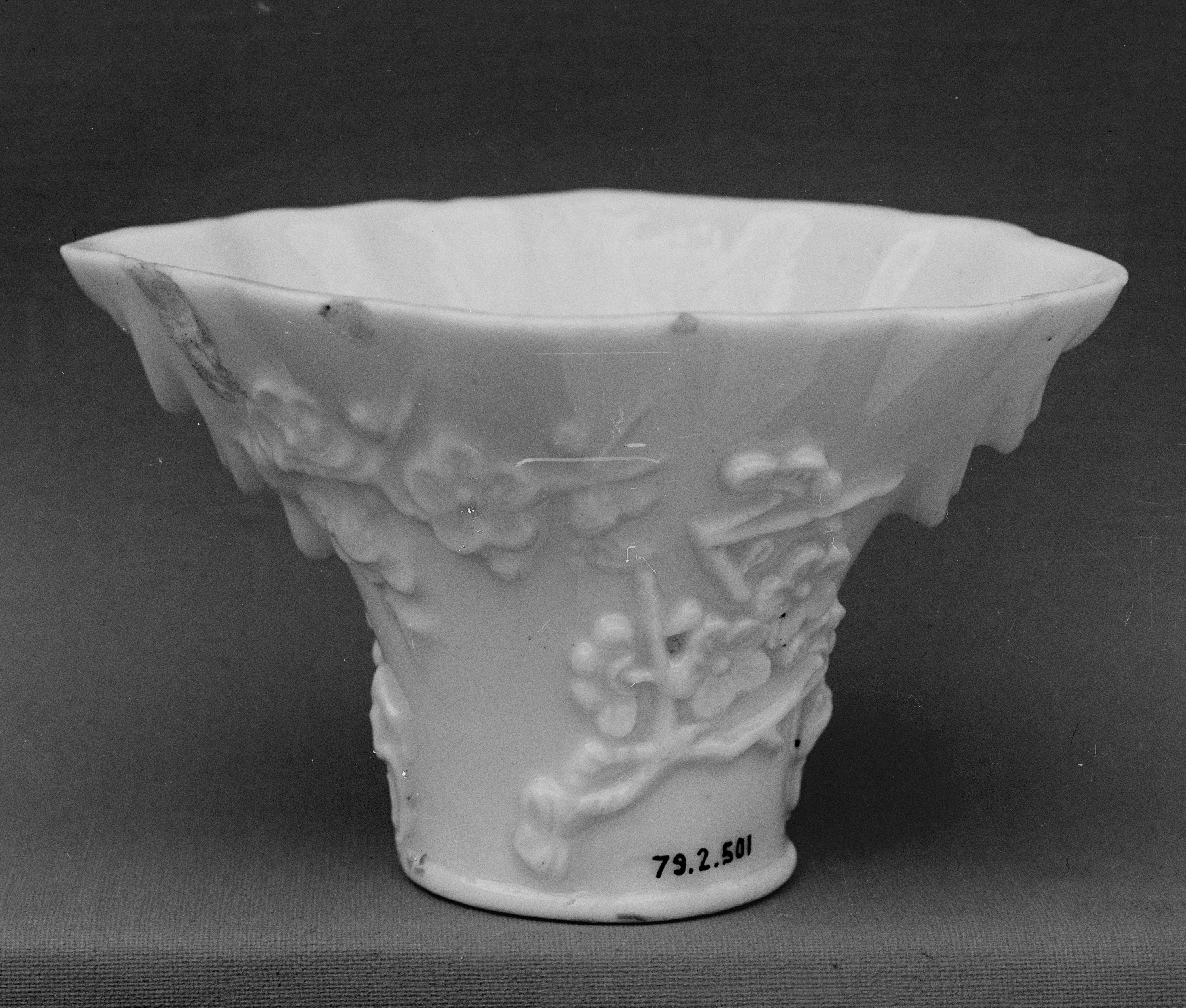
White porcelain with incised decoration under transparent glaze, late 17th to early 18th century, H. 6.4 cm, W. 10.5 cm, Wt. only 90.7 g. The extremely thin wall allows the incised motifs to emerge in transmitted light — an effect that arises directly from the high-potassium (K₂O 6.5–7.3%) glass-phase proportion. The Metropolitan Museum of Art, 79.2.501.
5.4 Oxidising versus Reducing Atmospheres
Kiln atmosphere falls into two categories: reducing (low oxygen, high carbon monoxide concentration) and oxidising (ample oxygen).
Jingdezhen must fire in a reducing atmosphere. The reason: its clay has high iron content (0.8—1.5%). In an oxidising atmosphere, iron exists as ferric iron (Fe³⁺), which colours the body yellow or brown — the porcelain turns sallow. A reducing atmosphere converts ferric iron to ferrous iron (Fe²⁺), which shifts the colour toward blue-green — this is the physical principle behind qingbai (bluish-white) ware. But reduction is difficult to control; minor fluctuations in kiln temperature and atmosphere cause colour variation and lower the yield.
At Fe₂O₃ below 0.5%, the iron content is so low that even in an oxidising atmosphere the colouring effect of ferric iron is negligible. Dehua can therefore fire in oxidation — technically simpler, with more uniform temperature and atmosphere across the kiln, and more stable colour.
Nigel Wood’s analysis in Chinese Glazes (2007) provides the authoritative conclusion: it is precisely the oxidising atmosphere that gives Dehua its distinctive warm white tone, visually quite unlike the cool white (bluish-white) produced under Jingdezhen’s reducing conditions.
Jingdezhen relies on a complex reducing process to counteract high iron for whiteness, while Dehua’s low-iron clay fires naturally white under oxidation.
5.5 From Song to Qing — Chemical Composition over Time
Li Weidong’s XRF data reveal a critical temporal curve:
Song dynasty: Fe₂O₃ relatively high (approaching the 0.5% ceiling), K₂O relatively low. Colour tended toward bluish-white.
Mid-to-late Ming: Fe₂O₃ dropped to its minimum (around 0.3%), K₂O rose to its maximum (approaching 7.3%). The two curves crossed here, reaching the optimal range. The ivory-white peak.
Qing dynasty: Fe₂O₃ rose again (above 0.5%), K₂O declined. Colour shifted cool and slightly blue — “scallion white” (congren bai).
This chemical trajectory maps directly onto the traditional colour vocabulary:
- Ivory white (xiangya bai, Ming peak) — low iron, high potassium, warm white
- Lard white (zhuyou bai, Ming fine ware) — extremely high translucency, milky white
- Scallion white (congren bai, Qing) — rising iron, cooler bluish-white
- Baby red (haier hong) — “few were made, fewer survived.” An uncontrollable kiln-atmosphere fluctuation caused trace iron colour shifts, producing a rare pale pink under extremely uncommon conditions. Irreproducible, and therefore the most prized.
Why was the Ming peak unsustainable? A likely explanation is that the source of clay changed. The Ming-period strata may have occupied the geological zone with the lowest iron and highest potassium. Once that zone was exhausted, Qing-era potters turned to strata with marginally higher iron. Changes in kiln architecture (from dragon kilns to step kilns) also altered the control of firing atmosphere.
The temporal evolution of chemical composition, overlaid with the shift in kiln technology, together produced an irreversible decline in Qing-era white porcelain quality. The conditions for Ming ivory white depended on the chemical signature of a specific geological stratum matched to the kiln technology of the period; once that stratum was depleted, the combination could not be reassembled.
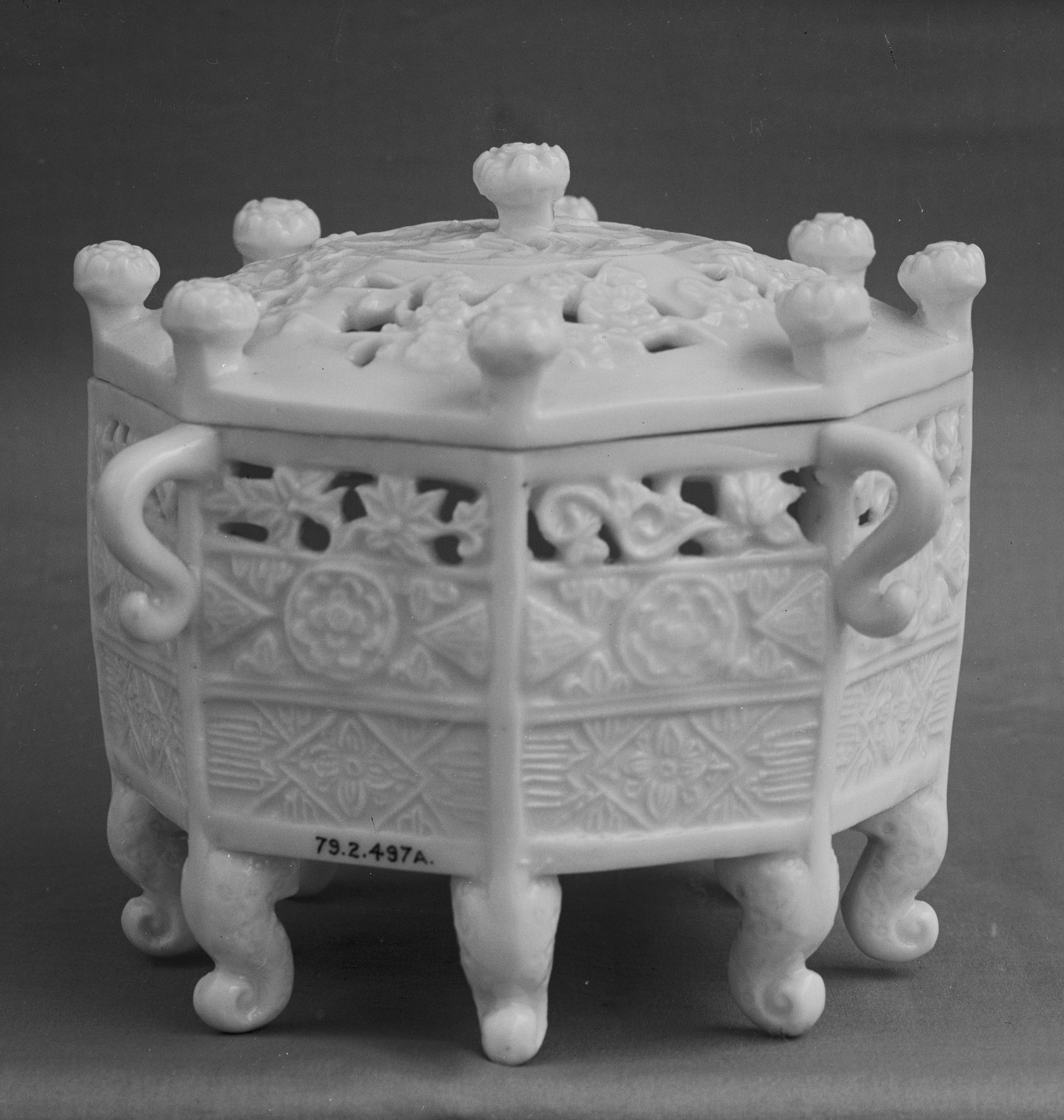
White porcelain with transparent glaze, early 18th century, H. with cover 10.8 cm, W. 13.7 cm. The warm white surface is a direct result of low-iron (Fe₂O₃ < 0.5%) clay fired in an oxidising atmosphere — the “warm white tone” as defined by Nigel Wood. The Metropolitan Museum of Art, 79.2.497a, b.
5.6 Nigel Wood’s Definitive Verdict
A passage in Nigel Wood’s Chinese Glazes (2007) serves as the concluding evidence for the materials-science dimension:
“Fundamental chemical differences” exist between Dehua and Jingdezhen porcelain, and these differences mean that the texture and tone of Dehua white porcelain “cannot be replicated” — not “difficult to replicate,” but “cannot be replicated.”
This judgement comes from the foremost authority on Chinese ceramic technology in the English-speaking world. Its implication: Dehua’s colour is determined by the geochemistry of its clay, not by process control. Even with complete mastery of firing technique and temperature profile, if the Fe₂O₃ content is 0.8% instead of 0.3%, the Dehua whiteness cannot be obtained. Meissen has been producing hard-paste porcelain since 1710, and its products have long commanded among the highest prices in the global market, yet it has never reproduced Dehua’s warm white tone — precisely because the clay chemistry is irreplaceable.
5.7 Reserves and Depletion — An Identified Information Gap
Proven Dehua clay reserves total 11.37 million tonnes.
For comparison: in 2009, the Ministry of Land and Resources designated Jingdezhen a “resource-depleted city.” After centuries of large-scale extraction, Jingdezhen faces severe resource constraints.
Dehua’s 11.37 million tonnes appear ample, but one critical figure is missing: annual consumption. Reserves divided by annual consumption equals extractable lifespan. Without the consumption figure, the lifespan cannot be calculated, and the point at which resource constraints become a hard limit on industrial growth cannot be assessed.
This is one of three information gaps identified by this report. In the 2027–2035 scenario projections, the quantitative assessment of Scenario C (resource-constraint scenario) is accordingly limited. The order of magnitude of reserves is known, but the extractable lifespan remains indeterminate.
5.8 Energy Transition
“Electricity replaces firewood” (yi dian dai chai) has been one of the most consequential technological shifts in Dehua’s ceramics industry over the past two decades.
The environmental cost of traditional wood-fired kilns was enormous. Dehua lies in the Daiyun mountain range, historically rich in forest resources, but centuries of continuous logging for kiln fuel placed significant ecological pressure on the area. The adoption of electric and gas kilns severed the causal link between ceramic production and deforestation.
Dehua County’s forest coverage has since recovered to a high level — largely thanks to the ecological space freed by the fuel transition in the kiln industry.
The energy transition has a second dimension: electric and gas kilns offer far greater precision in temperature control than wood-fired kilns, raising the pass rate accordingly. This is one of the foundational conditions for the industry’s efficiency upgrade; detailed figures appear in Dehua ceramics industrial economics.
Sources & References
Chemical Analytical Data
- Li Weidong. “Chemical composition of Dehua porcelain bodies.” Ceramics International 37 (2011): 651–658. — XRF data for Ming-dynasty Dehua bodies
- Cui Jianfeng & Nigel Wood. Journal of Archaeological Science 39 (2012): 818–827. — Multi-centre chemical comparison
- Hayman. Archaeometry, 2024. — Updated analytical methodology
General Academic Literature
- Nigel Wood. Chinese Glazes: Their Origins, Chemistry, and Recreation. University of Pennsylvania Press, 2007. — Authoritative analysis of oxidising / reducing atmospheres and colour; the “cannot be replicated” verdict
- Joseph Needham, ed. Science and Civilisation in China, Vol. 5, Part 12 (Rose Kerr & Nigel Wood). Cambridge University Press, 2004. — The Chinese ceramic technology system
Historical Sources
- Song-dynasty assessment: “resembles Ding ware but without crazing” — a historical attestation of body–glaze thermal-expansion matching
- Traditional colour vocabulary: ivory white, lard white, scallion white, baby red — each corresponding to a distinct chemical range
Resource and Industry Data
- Dehua proven clay reserves: 11.37 million tonnes (source: geological survey public data)
- Jingdezhen: designated a resource-depleted city by the Ministry of Land and Resources, 2009
Image Sources
- Fig. D5-01: The Metropolitan Museum of Art, 79.2.501 · CC0 Public Domain
- Fig. D5-02: The Metropolitan Museum of Art, 79.2.497a, b · CC0 Public Domain
Cross-Dimension References
- Historical evolution of Dehua white porcelain — the Fe₂O₃ / K₂O crossover curve from Song to Qing defines the chemical conditions of the ivory-white peak
- Shipwreck archaeological database — a 2024 Antiquity paper applied chemical-fingerprint analysis to ceramics recovered from the Nanhai No. 1 wreck for provenance identification
- European imitation evidence chain — shrinkage and firing cracks in Meissen imitations stem from the chemical-composition gap between Dehua and Meissen clays
- Dehua ceramics industrial economics — energy-transition and industrial-efficiency data
- 2027–2035 scenario projections — Scenario C (resource constraint) depends on reserves and annual-consumption data
Frequently Asked Questions
- Why is Dehua porcelain whiter than porcelain from other kiln sites?
- Dehua clay contains less than 0.5% Fe₂O₃ (Jingdezhen: 0.8–1.5%; Ding: 1–2%). This extremely low iron content allows the body to fire naturally white under an oxidising atmosphere. Simultaneously, K₂O reaches 6.5–7.3% (Meissen: only 1–2%), promoting glass-phase formation that gives the body its distinctive translucency and warm white tone. Nigel Wood judged in Chinese Glazesthat this tone “cannot be replicated.”
- What makes Dehua porcelain translucent?
- The exceptionally high K₂O content (6.5–7.3%) promotes glass-phase (non-crystalline) formation during firing. The higher the glass-phase proportion, the denser and more translucent the body. Held against natural light, a thin-walled Ming Dehua cup transmits a warm amber-orange tone — a direct physical expression of high-potassium chemistry that low-potassium formulations cannot achieve.
- What is the difference between ivory white, lard white, scallion white, and baby red?
- Four traditional colour names correspond to distinct chemical ranges: ivory white (xiangya bai, Ming peak) — low iron, high potassium, warm white; lard white (zhuyou bai, Ming fine ware) — extremely high translucency, milky white; scallion white (congren bai, Qing) — rising iron, cooler bluish-white; baby red (haier hong) — uncontrollable kiln-atmosphere fluctuations causing trace iron colour shifts, irreproducible, and therefore the rarest.
- Why did ivory white quality decline in the Qing dynasty?
- Li Weidong’s XRF data show that Ming-peak Dehua had the lowest Fe₂O₃ (~0.3%) and highest K₂O (~7.3%). By the Qing dynasty, Fe₂O₃ rose above 0.5% and K₂O dropped — likely because the optimal geological stratum was exhausted. Combined with the shift from dragon kilns to step kilns, the chemical conditions for ivory white were irreversibly lost.