7.1 The Question
A single Dehua white porcelain Guanyin: in China it is a Buddhist image; in Europe it is “Sancta Maria”; in Japan it is the secret Madonna of hidden Christians; in the Islamic world it is a symbol of cleanliness and the sacred. The same object, unaltered, accepted simultaneously by four civilizations — each assigning it an entirely different meaning.
In known cases of cross-cultural material transmission, the vast majority of objects require modification in shape, decoration or function before they can be accepted by another culture. Dehua white porcelain required almost none. Its plain white, undecorated surface carries no culture-specific symbols, allowing each civilization to project its own system of meaning directly onto it.
This dimension enters the interior of five civilizational systems one by one, tracing the position of “white” within each semantic field, then analyses the common structural features of the five reception mechanisms.
7.2 China — The Philosophical Foundations of White
The Five Virtues (wu de)
Xu Shen’s Shuowen Jiezi: “White is the colour of the West.”
The position of white in the Chinese colour system is determined by the Five Elements: white → metal → west → autumn. The Five Elements, Five Colours, Five Directions and Five Seasons are all mapped onto one another; white is not an isolated colour term but a node in a comprehensive cosmological coding system.
The Five Virtues correspond precisely to the physical properties of Dehua white porcelain:
| Virtue | Meaning | Physical Correspondence in Porcelain |
|---|---|---|
| Ren 仁 | Warmth | The warm tone of ivory white; tactile feel of congealed fat |
| Yi 义 | Rectitude | Dense, hard body; rings clear when struck |
| Zhi 智 | Lucidity | Translucency from the high-potassium glass phase |
| Yong 勇 | Fortitude | Fired at 1,280–1,350 ℃; indelible |
| Jie 洁 | Purity | Fe₂O₃ < 0.5%; virtually no chromatic impurity |
The Five Virtues are themselves the Chinese cultural framework for evaluating “good material” — the virtues of jade are the Five Virtues. Dehua white porcelain satisfies all five criteria at the physical level, granting it an aesthetic status in Chinese culture nearly equivalent to jade.
The Huainanzi: “White stands, and the five colours are complete.” In this philosophical framework, white is not one of the five colours but their precondition — without white, no other colour can appear. The plain white of Dehua porcelain is therefore not regarded in traditional aesthetics as the absence of decoration, but as the foundation upon which all decorative possibilities rest.
The Colour Vocabulary — A Dialect of White
Chinese connoisseurs developed an extraordinarily fine colour vocabulary for Dehua white porcelain:
Ivory white (xiangya bai) — the standard colour of the Ming peak, a faintly yellow warm tone, like aged ivory.
Lard white (zhuyou bai) — extremely high translucency, milky white, with the full lustre of solidified lard.
Scallion white (congren bai) — the cooler, slightly bluish white of the Qing dynasty, like the moist white of a scallion root.
Baby red (haier hong) — the rarest, most elusive tone. A chance fluctuation in the kiln micro-environment causes trace iron to produce a faint pink. “Few were made; fewer survived.” The colour cannot be controlled through the formula and depends entirely on accidental kiln conditions.
All four names are drawn from everyday tactile and visual experience — ivory, lard, scallion root, infant skin. This naming system classifies by sensory experience rather than spectral data, reflecting an appreciation tradition that demands the naked eye and fingertips to discern subtle gradations of whiteness.
7.3 Europe — Christian White and the Misread Compassion
White = Purity
In the Christian visual tradition, white is the colour of purity, holiness and revelation. Angels’ robes are white. At the Transfiguration, Christ’s garments “became shining, exceeding white” (Mark 9:3). The Pope’s white cassock. The white garment of baptism. The white of Easter.
When Dehua white porcelain Guanyin figures arrived in seventeenth-century Europe, their whiteness needed no translation within the Christian context — white = holy, a natural equivalence.
Guanyin → Madonna: A Profitable Misreading
The British East India Company’s trade records labelled Dehua Guanyin figures as “Sancta Marias” — the Virgin Mary.
From a Buddhist iconographic perspective, the Bodhisattva Guanyin and the Virgin Mary are entirely distinct beings in two separate religious systems. From a commercial perspective, however, the relabelling was instantly effective: it converted an unfamiliar Eastern religious sculpture into a devotional object familiar to European buyers, dissolving the cultural barrier at the level of naming.
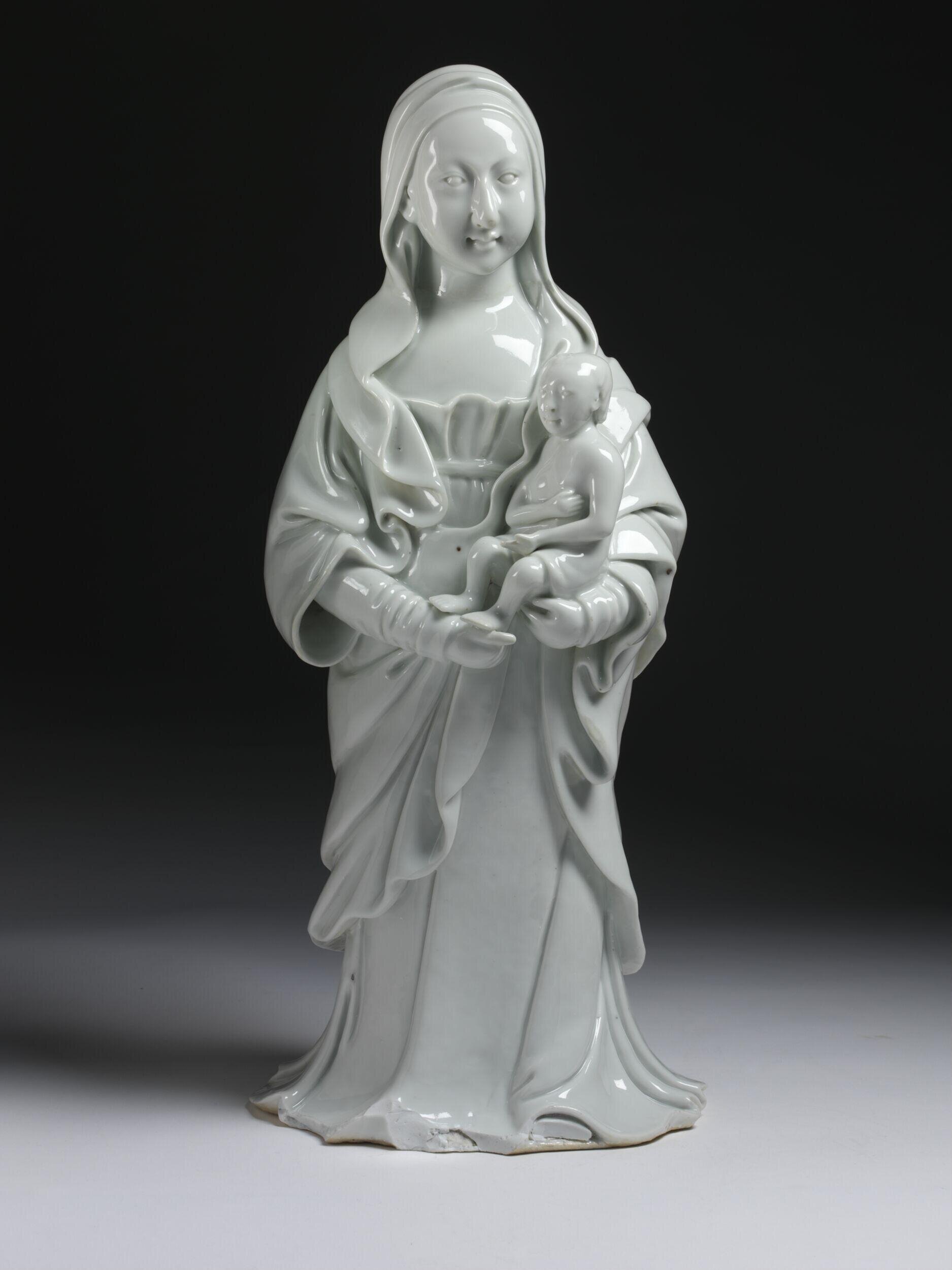
Dehua porcelain, c. 1620–1700. Victoria and Albert Museum, O181536.
Mary II (wife of William III, reigned 1689–1694) displayed six Dehua porcelain figures at Hampton Court Palace. In the European court context, these figures were “Chinese Madonnas” — not “Buddhist bodhisattvas.”
Augustus the Strong’s 1721 porcelain inventory described Dehua figures as “dolls with children on their arms” (Puppen mit Kindern auf dem Arm). “Dolls” — a Saxon Elector’s classification for Buddhist sculpture. What he saw was not religion but decoration.
The Metropolitan Museum of Art’s 2023 exhibition “Compassion, Mercy, and Love” directly presented this cross-cultural projection in its title: Compassion (Buddhist), Mercy (Christian), Love (universal) — three words covering three semantic layers, deliberately juxtaposed without resolution.
Ormolu Mounts — A Second Identity Rewrite
The European imitation evidence chain detailed the physical operations of ormolu mounting. From a semantic perspective, the mounts completed a second identity rewrite for Dehua porcelain in Europe:
First rewrite: Guanyin → Madonna (religious identity)
Second rewrite: Eastern curiosity → French interior element (cultural identity)
Neither rewrite required altering the porcelain itself. One was achieved through naming, the other through a bronze mount. The object stays the same; the meaning changes entirely.
7.4 Japan — The Most Complex Semantic Field
Japan’s reception of Dehua white porcelain is the most complex of the five civilizations.
Hakugorai (“White Goryeo”)
In Japanese tea-ceremony terminology, Dehua white porcelain is sometimes classified under hakugorai — literally “white Goryeo (Korean) ware.” This classification is inaccurate in ceramic terms (Dehua and Korean wares are entirely separate in origin and tradition), but within the aesthetic context of tea practice, it reflects a generalised Japanese perception of “East Asian continental white porcelain.”
Butsudan (Home Altar)
Dehua white porcelain Guanyin figures were widely used in Japanese home altars (butsudan). The butsudan is a miniature shrine in the Japanese home for venerating ancestors and Buddhist images — the core material carrier of daily religious life. The use of Dehua Guanyin in the butsudan brought it into the most intimate devotional space of the Japanese household.
Maria Kannon — The Material Carrier of Dual Religious Meaning
In 1587 Toyotomi Hideyoshi issued the Bateren expulsion edict; in 1614 the Tokugawa shogunate imposed a comprehensive ban on Christianity; the ban was not lifted until 1873 under the Meiji government. During this nearly 300-year period, Japan’s hidden Christians (kakure kirishitan) used Dehua white porcelain Guanyin figures as secret substitutes for the Virgin Mary in their worship.
The same white porcelain figure: before Buddhist believers, it was Guanyin; before hidden Christians, it was the Virgin Mary. Two faiths shared the same material carrier, each reading it in its own way, without interference. Persecutors saw a legitimate Buddhist statue; the persecuted saw a secret object of Christian worship. The “silence” of Dehua porcelain — plain white, no text, no explicit doctrinal markings — was precisely what made this dual identity possible. Had the Guanyin borne Buddhist scripture, the hidden Christians could not have adopted it as the Virgin; had it borne a cross, persecutors would have identified it at once.
During the prohibition, this material characteristic carried life-or-death consequences.
White and Funerary Association
In Japanese culture, white has a strong association with death and funerals. Mourning clothes are white. Bone-ash urns are white. This association creates a subtle psychological barrier for Dehua white porcelain in everyday contemporary Japanese consumption: “the funerary association causes a modern-day distancing.” The purity of white porcelain is a virtue in tea-ceremony and butsudan settings, but at the everyday dining table it may trigger uncomfortable associations.
Wabi-Sabi and the Paradoxical Unity with White Porcelain
Wabi-sabi aesthetics value imperfection, impermanence and austerity. The technical perfection of Dehua porcelain — dense, smooth, uniform — appears on its face to contradict wabi-sabi’s principle of imperfection. But Dehua’s “perfection” is itself built on an extreme act of subtraction — removing all colour and decoration to leave only white. This minimalism shares a structural affinity with wabi-sabi’s reductive spirit. Meanwhile, the subtle undulations of the Dehua body and the natural flow marks in the glaze are read within the wabi-sabi framework precisely as the life traces left by hand and kiln fire, not as flaws.
The Japanese sencha (steeped-tea) tradition’s preference for Dehua vessels (rather than figures) is a concrete expression of this aesthetic orientation.
7.5 The Islamic World — Cleanliness Materialised
White in the Quran and Hadith
At least thirteen Quranic passages carry positive associations with white. Those whose faces are whitened on Judgement Day receive Paradise’s favour. Rivers of Paradise flow with “white drink.” The prophetic traditions (hadith) are denser still: white garments for Friday prayer (jumu’ah); the ihram — two unsewn white cloths — for the Hajj pilgrimage.
White = cleanliness = proximity to the divine — this equation is deeply embedded in the Islamic semantic system. When Dehua white porcelain reached the Islamic world, its whiteness naturally aligned with the Islamic cultural preference for ritually clean vessels.
Kundika — Functional Customisation
The kundika is a water vessel used for ritual ablution (wudu) in the Islamic world. The Dehua kilns produced large quantities of kundika-form white porcelain, explicitly customised for the Islamic market. The Muslim merchant community at Quanzhou was already substantial in the Song and Yuan periods (the Qingjing Mosque was founded in the Northern Song). Their orders fed directly back to the Dehua kilns, making the kundika a vessel form produced to external religious-functional specifications.
V&A object 1649-1876 — a Dehua white porcelain vessel fitted with an Iranian metal lid. The logic is identical to European ormolu mounts: localised adaptation without altering the porcelain itself, merely adding fittings suited to local use.
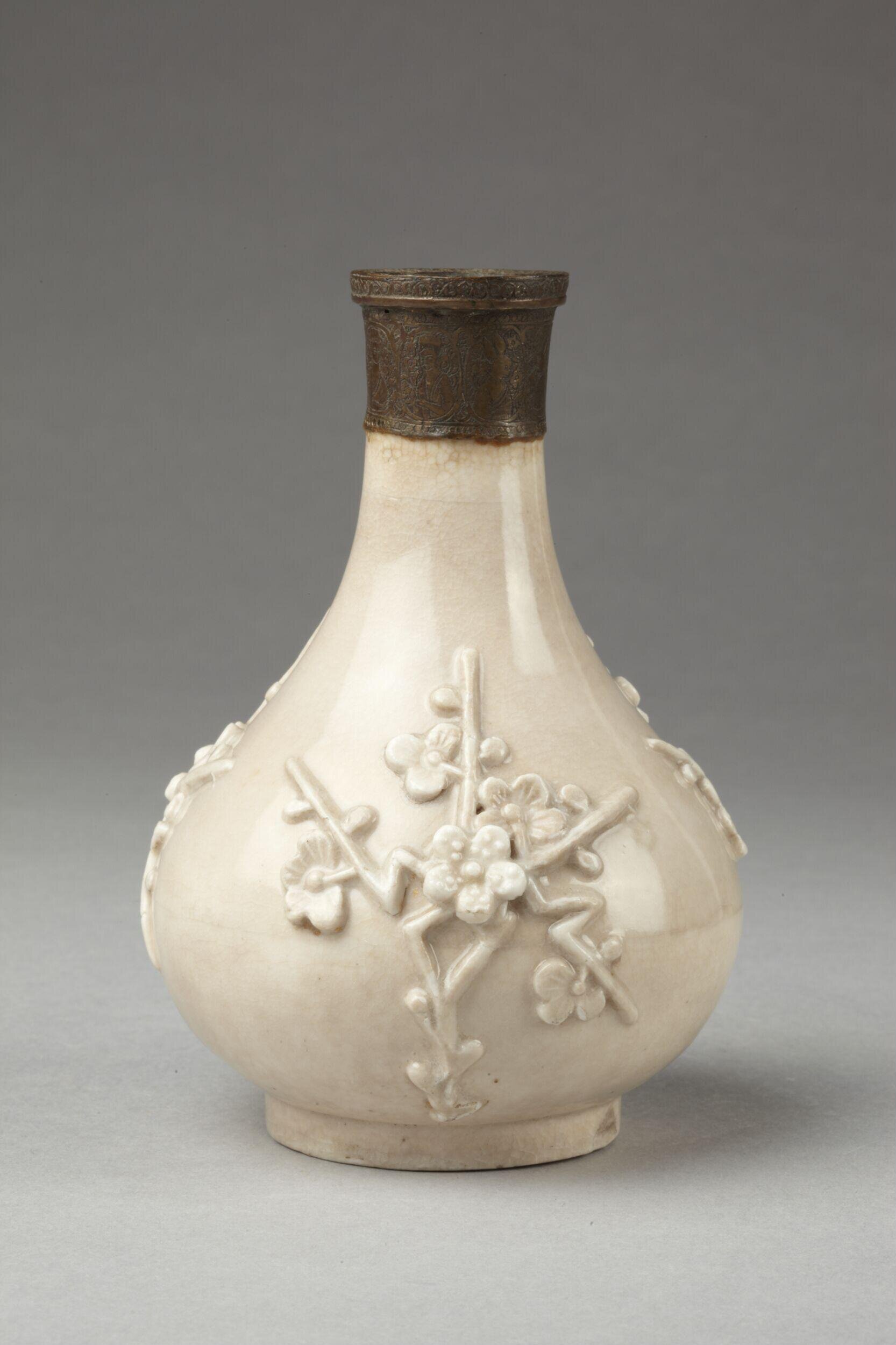
Dehua porcelain, c. 1620–1720; brass lid (Iran). Victoria and Albert Museum, 1649-1876.
Archaeological Evidence
Dehua white porcelain sherds have been recovered from archaeological sites across the Islamic world:
- Minab (southern Iran, near the Strait of Hormuz)
- Qalhat (Oman) — inscribed on the UNESCO World Heritage List in 2018
- Kush (East African coast)
These three sites trace an arc from the Persian Gulf to the East African coast, aligning precisely with Arab maritime trade routes.
7.6 Common Structure of Five Reception Mechanisms
The five civilizations received Dehua white porcelain in outwardly different ways, but the underlying logic can be distilled into five mechanisms:
(1) Material scarcity — in the seventeenth and eighteenth centuries, porcelain itself was a scarce, high-value material in Europe, Japan and the Islamic world. The material value of Dehua porcelain was accepted before its cultural meaning.
(2) Symbolic compatibility — white carries positive transcendent symbolism in Chinese (Five Virtues / purity), European (Christian holiness), Japanese (Shinto sacred / Buddhist purity) and Islamic (cleanliness / paradise) traditions. By contrast, red is celebratory in China but associated with warning in some Western contexts; blue points to paradise in Islamic tradition but occupies a secondary rank in the Chinese colour hierarchy. White is the only known colour that points toward “purity,” “holiness” and “transcendence” across all these major civilizational systems.
(3) Aesthetic universality — a plain white, undecorated surface generates no culture-specific visual information. Blue-and-white porcelain patterns can puzzle non-Chinese viewers (what does the dragon mean? why is the cloud that shape?), but white creates no such questions. Its aesthetic message is “nothing” — and “nothing” is a signal every culture can process.
(4) Religious plasticity — the Dehua Guanyin image is sufficiently “ambiguous” — a compassionate female figure holding an infant or a vase — to be claimed simultaneously by Buddhism, Christianity and even clandestine Catholicism. The plain white, text-free surface locks in no specific doctrine.
(5) Tactile biological basis — this mechanism is rarely discussed but may be the most fundamental. The ivory-white surface of Dehua porcelain is warm and fine-grained to the touch, approximating the visual-tactile associations of human skin and animal fat. The positive human response to a “warm, smooth, white surface” may have a cross-cultural biological foundation — it signals health, cleanliness and adequate nourishment. The cross-cultural consistency of this response suggests a possible evolutionary-psychological substrate rather than a purely cultural construction.
7.7 Preference Divergence — Figures versus Vessels
The five civilizations show a clear pattern of divergent preferences for different Dehua categories:
Figures preferred: Buddhist Asia (China, Vietnam, Thailand) + Christian Europe
Vessels preferred: Islamic world + Japanese sencha
The divergence is straightforward: the Islamic tradition’s restriction on figural imagery (especially in religious contexts) favoured vessels; the Japanese sencha ceremony’s functional requirements centre on cups, teapots and saucers. Both Buddhism and Christianity have strong traditions of figurative devotion, making the Guanyin / Madonna figure a core demand.
7.8 How Each Civilization Adapted Blanc de Chine
| Civilization | Adaptation Method | Purpose | Porcelain Altered? |
|---|---|---|---|
| Europe | Ormolu (gilt bronze) mounts | Integration into Rococo interiors | No |
| Islamic world | Metal lids / fittings | Ritual ablution and functional needs | No |
| Japan | Semantic re-encoding | Guanyin ↔ Virgin Mary dual identity | No |
All three adaptation methods share one feature: none altered the porcelain itself. European ormolu was added without grinding the porcelain; Islamic metal lids were fitted without changing the form; Japan’s semantic re-encoding occurred entirely at the cognitive level of the viewer. Every receiving civilization chose “addition” over “subtraction” — adding localised attachments or new meanings on top of the porcelain rather than modifying it. This fact indirectly reflects the completeness that Dehua white porcelain had already achieved when it left the kiln.