2.1 The Mystery of His Dates
The birth and death dates of He Chaozong remain unresolved.
For an artist described by the 1763 Quanzhou Gazetteer as one whose works are “treasured by the whole world” (天下共宝之), this silence is itself revealing. Dehua's porcelain masters occupied an extraordinarily low position in China's traditional literati recording system. The assessment “treasured by the whole world” is the highest possible praise, yet the craftsman's social rank in the traditional hierarchy of written culture placed him near the bottom — works cherished, makers unrecorded. This contradiction runs through the entire history of Chinese craftsmanship.
Multiple scholarly positions exist regarding He Chaozong's dating: some place him in the Jiajing-to-Wanli reign (c. 1522–1600), others in the Chenghua-to-Jiajing period (c. 1465–1560), and still others argue for a Song-dynasty attribution (per the survey of competing views in Blumenfield 2002). Suzanne G. Valenstein, in A Handbook of Chinese Ceramics (Metropolitan Museum of Art, revised edition 1989, ISBN 0-87099-514-6), favoured a late-Ming dating. The positions stand in parallel, none supported by decisive evidence.
Donnelly discussed the question at length in his 1969 monograph Blanc de Chine. Blumenfield's 2002 assessment was more blunt — he used the word “shocking” to describe the paucity of biographical documentation for He Chaozong.
Blumenfield's choice of “shocking” is not without justification: an artist whose works are distributed across more than ten of the world's leading museums lacks, to this day, a single primary source that permits cross-verification of his life dates.
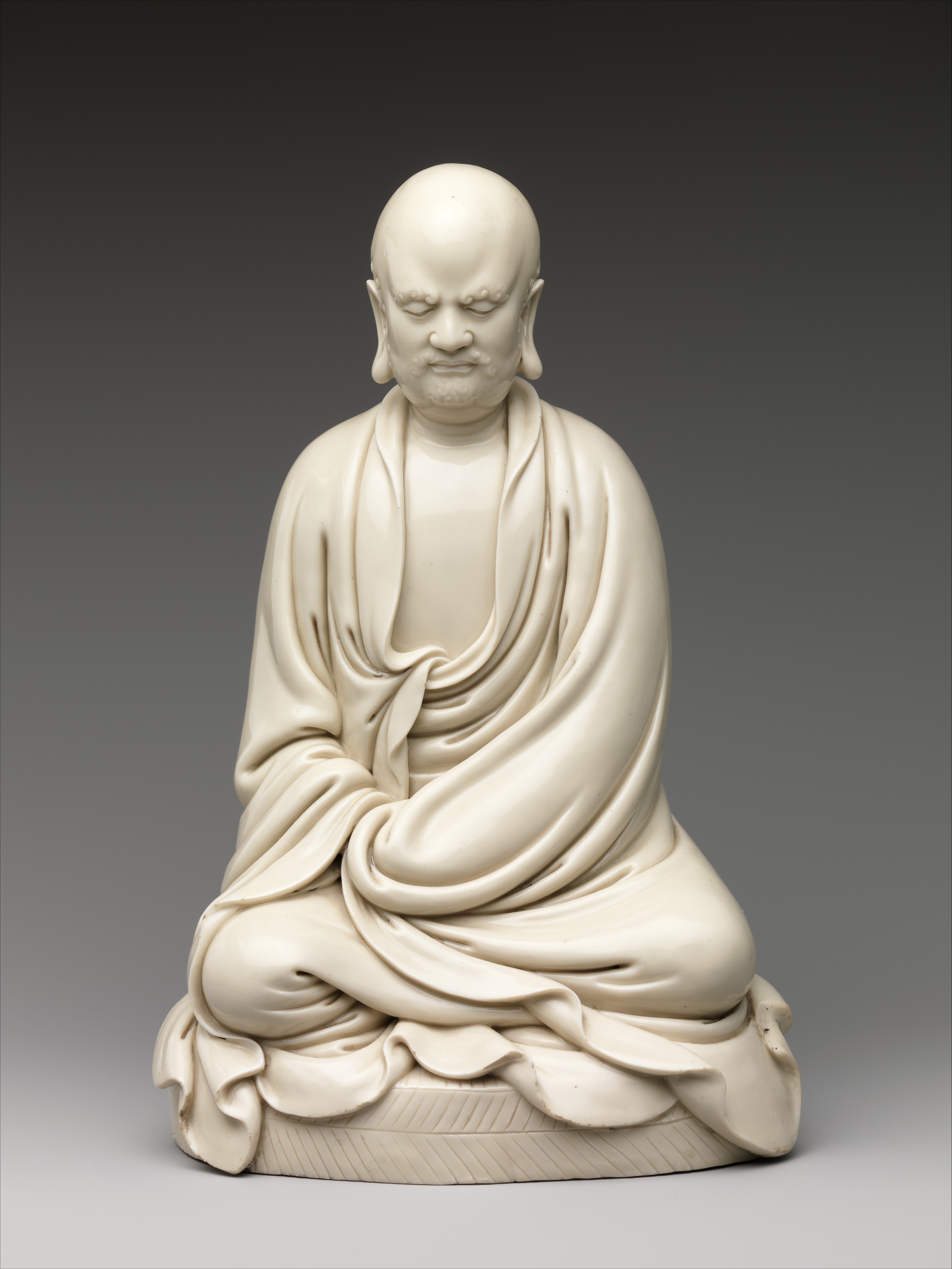
Dehua white porcelain, c. 17th century. Metropolitan Museum of Art, 63.176.
2.2 Family Lineage and Artistic System
His family can be traced back to He Kunyuan, through He Shanfu, to He Chaozong as the ninth generation. This was a family that worked in porcelain sculpture for generations. The depth of He Chaozong's mastery is explained by hereditary transmission — he stood on the accumulated expertise of eight preceding generations.
He Chaozong's technical core is traditionally summarised in eight characters: niē, sù, diāo, kè, guā, jiē, tiē, xiū (pinching, moulding, carving, incising, scraping, joining, appliqué, finishing). His treatment of drapery folds synthesised two opposing aesthetites from the Chinese tradition — cáo yī chū shuǐ (“Cao's robes emerging from water,” the wet-clinging effect attributed to the Northern Qi painter Cao Zhongda) and wú dài dāng fēng (“Wu's sashes caught in the wind,” the billowing drapery style of the Tang-dynasty painter Wu Daozi). These two modes were regarded as polar opposites in the painting tradition; He Chaozong unified them in three-dimensional porcelain sculpture.
His seal marks fall into two categories: gourd-shaped seals and square seals. The distribution patterns and period attributions of these two types remain a focal point of connoisseurship debate.
The lineage of notable Dehua porcelain sculptors: in the Ming dynasty, He Chaozong, Lin Xizong, Lin Chaojing, Zhang Shoushan, and Chen Wei; in the Qing, He Chaochun, Xu Liangxi, and others. He Chaozong's achievement stands at the apex. His works have been called masterpieces of Eastern art and are held in museums worldwide. Traditional Chinese religious statuary continued to be a major export category, with new generations of sculptors emerging continually.
2.3 Global Museum Holdings: An Itemised Inventory
Works by He Chaozong and important Dehua Blanc de Chine pieces are dispersed across museums worldwide. The following is an itemised list of verified key holdings:
| Institution | City | Key Accessions | Provenance |
|---|---|---|---|
| Palace Museum | Beijing | 4 pieces attributed to He Chaozong | Former Qing imperial collection |
| Victoria and Albert Museum | London | C.546-1910; FE.52:1,2-2012; FE.52-2018 | George Salting bequest (1910) |
| Rijksmuseum | Amsterdam | AK-MAK-594 | T.H. Westendorp collection |
| Musée Guimet | Paris | G 535 | Ernest Grandidier collection |
| Nelson-Atkins Museum | Kansas City | 33-588 | Laurence Sickman, purchased in Beijing, 1933 |
| British Museum | London | Prefix 1980,0728 | P.J. Donnelly, donated in full, 1980 |
| Art Institute of Chicago | Chicago | 1925.1482 | Acquired 1925 |
| Metropolitan Museum of Art | New York | 63.176; 79.2.479; 1974.356.319 | — |
| Staatliche Kunstsammlungen Dresden | Dresden | PO 8638; PE 2373; PE 2188 | Augustus the Strong (1,000+ Dehua pieces) |
| Asian Civilisations Museum | Singapore | 160 pieces | Frank Hickley collection |
| Quanzhou Maritime Museum | Quanzhou | — | Regional excavations and transmitted works |
| Blenheim Palace | Oxfordshire | — | Vanderbilt marriage connection |
| San Marco Basilica | Venice | — | Early trade route (Lin Meicun 2017 argument) |
| Institution | City | Notes |
|---|---|---|
| Place of Origin | ||
| Dehua / Quanzhou | Fujian, China | Birthplace of Blanc de Chine |
| Europe (13 locations) | ||
| V&A · BM · Blenheim | London | Three major London collections |
| Percival David Foundation | London | Now part of British Museum |
| Ashmolean Museum | Oxford | |
| Rijksmuseum | Amsterdam | |
| Groninger Museum | Groningen | |
| Musée Guimet | Paris | |
| Dresdner Porzellansammlung | Dresden | 1,000+ pieces of Dehua porcelain |
| Tesoro di San Marco | Venice | |
| Nationalmuseet | Copenhagen | |
| Hallwyl Museum + 3 others | Stockholm | Four Stockholm institutions |
| Nasjonalmuseet | Oslo | |
| Collection Baur | Geneva | |
| State Russian Museum | Moscow | |
| Asia-Pacific (5 locations) | ||
| Palace Museum | Beijing | |
| Quanzhou Maritime Museum | Quanzhou | |
| Asian Civilisations Museum | Singapore | 160 pieces (Hickley Collection) |
| Tokyo National Museum + 1 other | Tokyo | Two Tokyo institutions |
| AGNSW | Sydney | |
| North America (6 locations) | ||
| Metropolitan Museum of Art | New York | |
| Nelson-Atkins Museum | Kansas City | |
| Art Institute of Chicago | Chicago | |
| MFA Boston | Boston | |
| Getty Museum | Los Angeles | |
| Royal Ontario Museum | Toronto | |
Palace Museum (Beijing)
The Palace Museum holds four pieces of Dehua porcelain attributed to He Chaozong. These represent the transmission lineage of the former Qing imperial collection — works that have been preserved through the Qing court's collection system to the present day.
Victoria and Albert Museum (London)
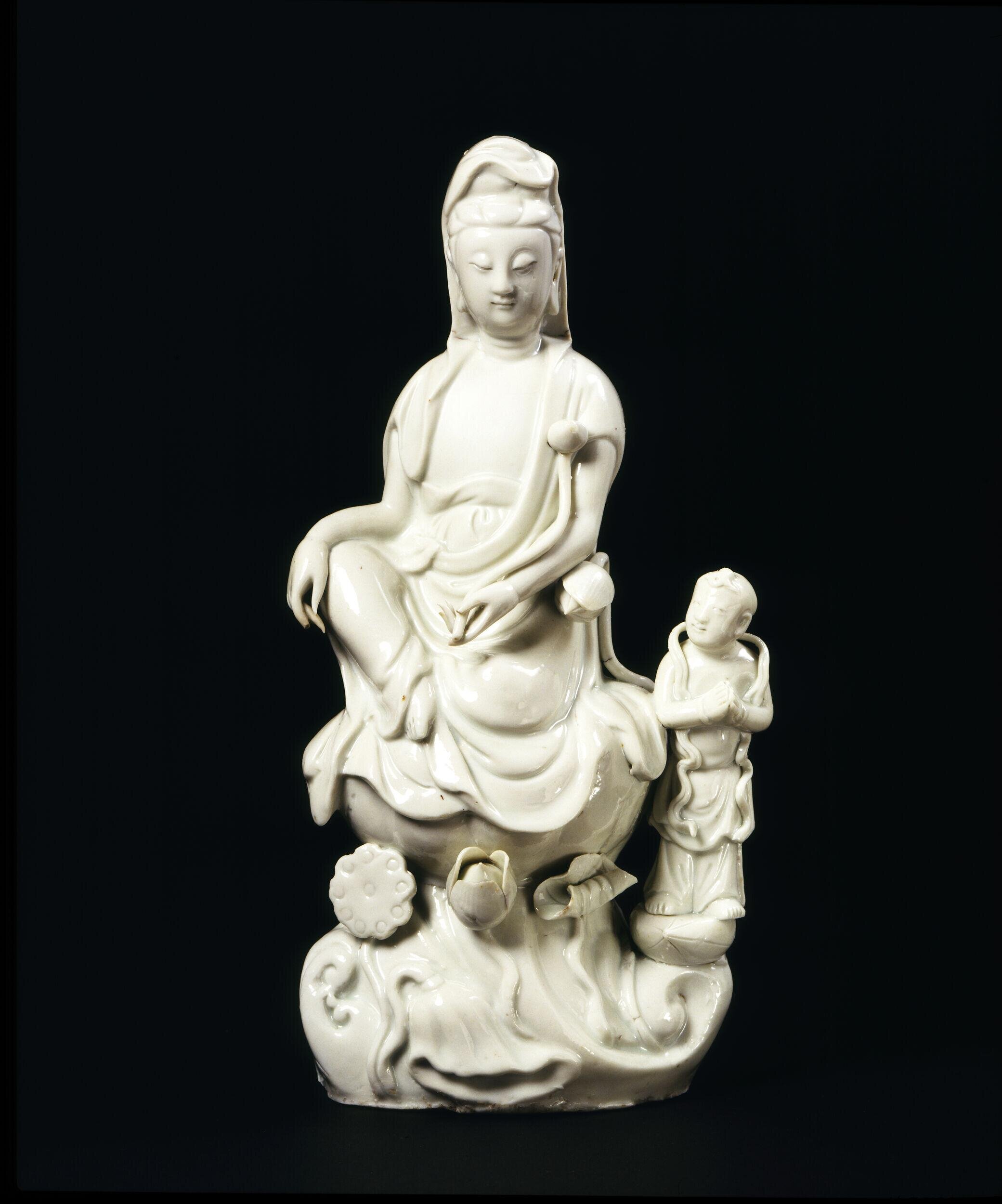
Dehua white porcelain, c. 1610–1640. Victoria and Albert Museum, C.546-1910. George Salting bequest.
C.546-1910 — Guanyin, seated. Provenance: George Salting bequest (1910). Salting was one of the most important Asian art collectors in Victorian London; his bequest forms one of the cornerstones of the V&A's Asian ceramics collection.
The V&A's Dehua porcelain holdings span four centuries, from Ming-dynasty classics to contemporary works. Two contemporary acquisitions are particularly noteworthy:
FE.52:1,2-2012 — Peter Ting, Buddha Hands. Acquired 2012. (See Contemporary Ceramic Art from Dehua.)
FE.52-2018 — Su Xianzhong, Paper series. Acquired 2018. (See Contemporary Ceramic Art from Dehua.)
An earlier holding, C.49-1953, was identified in 2019 by Su Xianzhong himself as the work of his great-grandfather Su Xuejin (1869–1919). An object accessioned in 1953, recognised sixty-six years later by the maker's descendant in the museum — this detail speaks to the continuity of the Dehua sculptural tradition more eloquently than any scholarly argument.
Rijksmuseum (Amsterdam)
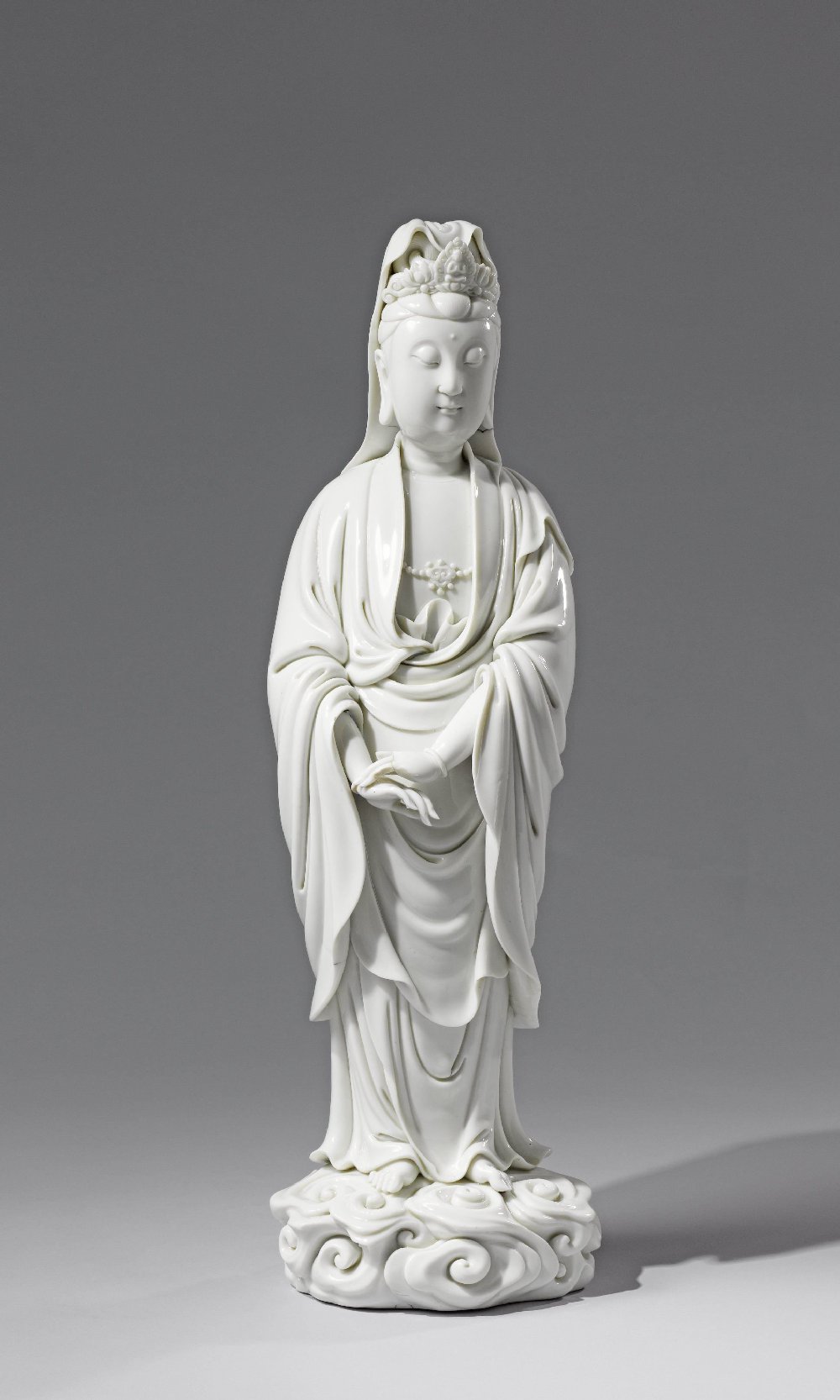
Dehua white porcelain. Rijksmuseum, AK-MAK-594. Former collection of T.H. Westendorp.
AK-MAK-594 — Guanyin. Former collection of T.H. Westendorp. Westendorp was one of the most significant Asian art collectors in the Netherlands at the turn of the nineteenth century.
Musée Guimet (Paris)
G 535 — Dehua porcelain. Ernest Grandidier collection. Grandidier was nineteenth-century France's most systematic collector of Chinese ceramics; his holdings of several thousand pieces form the core of the Musée Guimet's Chinese ceramic collection.
Nelson-Atkins Museum of Art (Kansas City)
33-588 — Guanyin. Purchased by Laurence Sickman in Beijing in 1933. Sickman later became the first curator of Asian art at the Nelson-Atkins Museum and one of the foremost American scholars of Chinese art in the first half of the twentieth century.
British Museum (London)
The Donnelly collection constitutes the most important component of the British Museum's Dehua porcelain holdings. P.J. Donnelly donated his entire collection to the British Museum in 1980, accessioned under the prefix 1980,0728. Donnelly was not merely a collector but a scholar — his 1969 publication Blanc de Chine: The Porcelain of Tehua in Fukien (507 pages, 160 plates) remains the single most important English-language reference on the subject.
Art Institute of Chicago
1925.1482 — Dehua porcelain. Accessioned in 1925, making it one of the earliest Dehua porcelain acquisitions in the American museum system.
Quanzhou Maritime Museum
As the specialist museum for the region where Dehua is located, the Quanzhou Maritime Museum holds extensive Dehua porcelain, with particular strength in excavated and transmitted works related to overseas trade.
Staatliche Kunstsammlungen Dresden
The porcelain collection of Augustus the Strong (Augustus II) stands as one of the most extraordinary acts of personal collecting in history. Some 29,000 pieces of East Asian ceramics in total, including more than 1,000 pieces of Dehua porcelain — the largest single collection of Dehua ware in Europe. Augustus's Porzellankrankheit (“porcelain sickness”) directly drove the founding of the Meissen porcelain factory (see European Imitation Evidence Chain).
Three pieces of particular research value — PO 8638, PE 2373, PE 2188 — serve as core comparative material for studying Dehua originals alongside Meissen copies (see European Imitation Evidence Chain).
Metropolitan Museum of Art (New York)
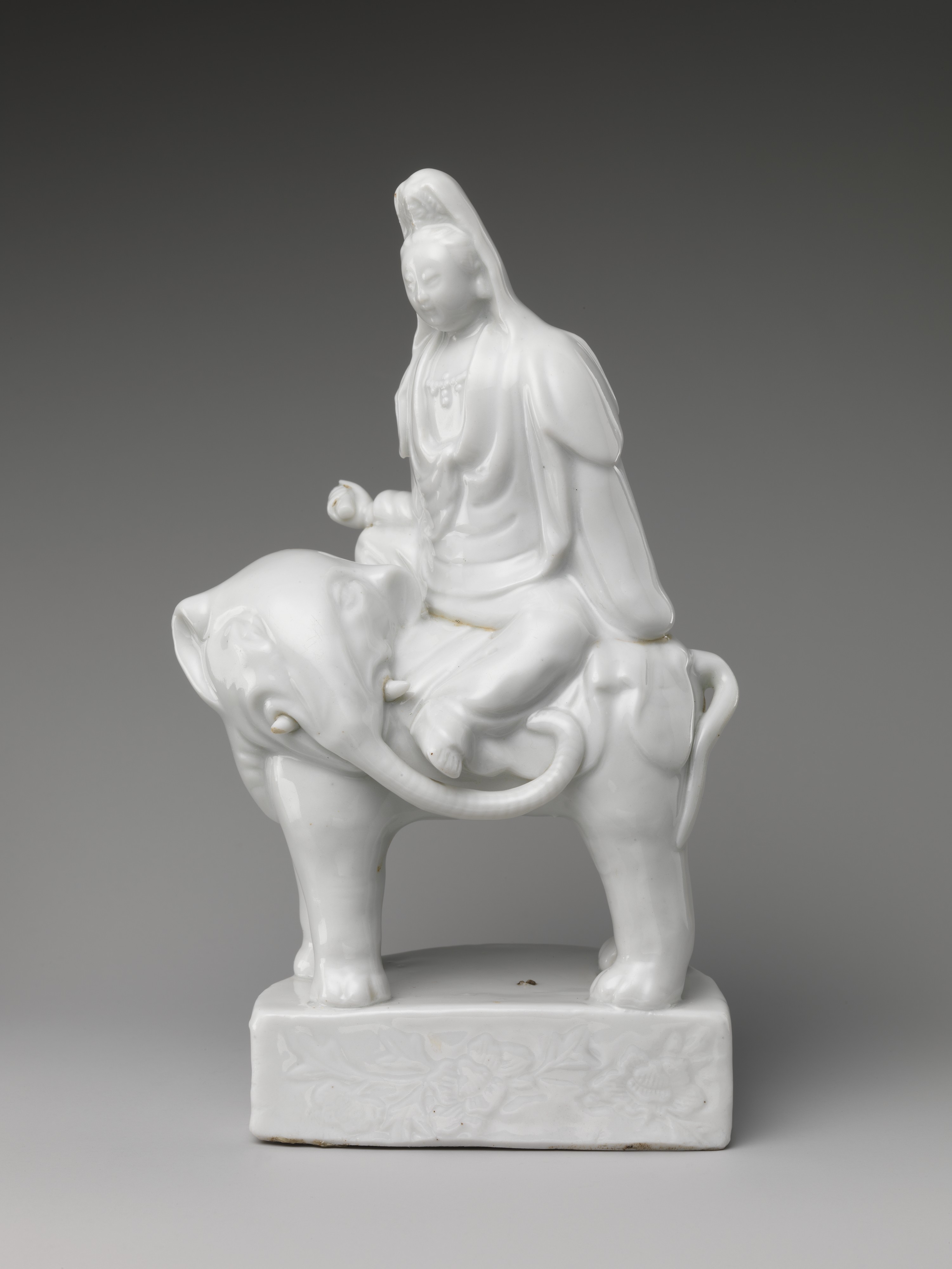
Dehua white porcelain. Metropolitan Museum of Art, 79.2.479.
The Met holds multiple Dehua porcelain pieces, among which 1974.356.319 (H 37.5 cm) is analysed in detail in European Imitation Evidence Chain in the context of Meissen copying.
Cleveland Museum of Art
Cleveland holds important Dehua porcelain, representing a core collection in this field for the American Midwest.
Blenheim Palace
The Dehua porcelain at Blenheim Palace carries a transatlantic provenance. In the late nineteenth century, the 9th Duke of Marlborough married Consuelo Vanderbilt, granddaughter of the American railroad magnate Cornelius Vanderbilt. The Vanderbilt dowry and subsequent funds helped sustain Blenheim Palace's operations. The collecting history of some Dehua porcelain at the Palace is closely tied to the wealth flows of this Anglo-American marriage alliance.
Asian Civilisations Museum (Singapore)
Frank Hickley's collection of 160 Dehua porcelain pieces forms the core of the ACM's holdings in this field. Rose Kerr and John Ayers published a dedicated study of this collection in 2002, establishing the foundational scholarly text for Dehua porcelain research in Southeast Asia.
San Marco Basilica (Venice)
A 2017 paper by Lin Meicun in the European Journal of Archaeology discussed a small jar held at Venice's San Marco Basilica, arguing that it may be one of the earliest Dehua porcelain pieces to reach Europe via early trade routes. The dating and route attribution remain contested, but the object's existence itself suggests that Dehua porcelain may have entered Europe considerably earlier than the large-scale trade of the Age of Exploration.
Ashmolean Museum (Oxford)
The Ashmolean's holdings span from the Song dynasty to the Republican period, including early treasures such as qingbai-glazed incised dishes and Persian-style vases (popularly known as “Marco Polo vases”). The museum's Dehua collection carries considerable weight in international collecting circles.
Percival David Foundation (London)
The Percival David Foundation collection includes censers, vases, water droppers, boxes, bowls, dishes, brush washers, and Guanyin and other religious figures — encompassing multiple works bearing He Chaozong seals as well as pieces by other master sculptors.
Staatliche Kunstsammlungen Dresden (Detail)
The Staatliche Kunstsammlungen Dresden holds the largest collection of transmitted Dehua porcelain outside China. Some 400 sets (1,255 individual pieces) survive, the majority white-glazed, comprising Buddhist figures, secular figures, bowls, dishes, vases, spoons, boxes, and cups. The collection was built on the foundation of Augustus the Strong's acquisitions. The 1721 royal porcelain inventory (Kangxi 60th year) inscribed each piece with a letter, a number, and a symbol on the base. In 1727, 81 pieces were added (6 foreign lots containing 469 Dehua pieces); in the same year, another 57 pieces were added (32 lots containing 71 “Blanc de Chine” pieces); in 1723, 133 lots were added (70 lots containing 588 “Blanc de Chine” pieces).
Copenhagen Museum Group (Denmark)
The Copenhagen City Museum (Københavns Bymuseum) and the Design Museum Denmark both hold Dehua porcelain, with the earliest catalogue entries dating to the 1690s. The Rosenborg Castle's earliest inventory of 1718 records five Guanyin figures and three standing lady figures wearing long robes and tall head ornaments.
Stockholm Museum Group (Sweden)
Four institutions hold Dehua porcelain: the Museum of Far Eastern Antiquities, Drottningholm Palace (the Chinese Pavilion, a royal residence outside Stockholm where objects have been housed since 1769), the Kempe Collection (one of the world's largest private collections), and the Hallwyl Museum.
2.4 Auction Records
Auction results for He Chaozong works and significant Dehua Blanc de Chine, ranked by hammer price in descending order:
| # | Lot Description | Auction House / Date | Lot | Price Realised | Notes |
|---|---|---|---|---|---|
| 1 | White-glazed Guanyin Crossing the Sea, "He Chaozong yin" seal, H 51.5 cm | Christie's Hong Kong, 27 Nov 2017 | 8120 | HK$19.3M (≈$2.47M) | International auction house record |
| 2 | "He Chaozong yin" seal Bodhidharma standing figure | Kami Auction (Osaka), Autumn 2022 | — | ≈RMB 12.07M (≈$1.7M) | Japanese market record |
| 3 | He Chaozong-attributed work | Shizhuzhai, 2023 | — | RMB 15M | Mainland China high |
| 4 | White-glazed Bodhidharma, "He Chaozong" seal, Ming 16th c., H 40.8 cm | Christie's Hong Kong, 26 Nov 2014 | 3120 | HK$14.44M | |
| 5 | He Chaozong Bodhidharma seated, "He Chaozong" seal script | China Guardian Shengjia, Spring 2023 | — | RMB 12.075M | |
| 6 | White porcelain Guanyin, 20th c., H 39.3 cm | Christie's London, 12 May 2015 | 155 | £818.5K (≈$1.27M) | Non-He Chaozong; 20th-c. high |
| 7 | White-glazed Guanyin seated, "He Chaozong" seal, Qing 18th c., H 36.2 cm | Sotheby's, 17 Mar 2015 | 259 | $970K | |
| 8 | He Chaozong-attributed Guanyin | Christie's Hong Kong, 2015 | 2912 | HK$8.92M | |
| 9 | White porcelain Bodhidharma seated, "He Chaozong yin" seal, 17th/18th c., H 34.6 cm | Lempertz (Cologne), 15 Dec 2014 | 56 | €856K | Continental Europe high |
| 10 | White-glazed Guanyin standing, "He Chaozong yin" seal, 17th c., H 51.5 cm | Sotheby's Hong Kong, 6 Apr 2016 | 3606 | HK$7.28M | |
| 11 | Dehua Blanc de Chine Guanyin | Sotheby's New York, 2025 | 136 | $635K | Most recent as of data cutoff |
| 12 | White porcelain Guanyin, "He Chaozong yin" seal, 17th c., H 37 cm | Bonhams (London), 17 May 2012 | 297 | £529.25K | |
| 13 | White-glazed Guanyin standing, "He Chaozong" seal, late Ming, H 31 cm | Christie's Hong Kong, 30 Nov 2016 | 3324 | HK$4.26M | |
| 14 | He Chaozong Guanyin Crossing the Sea, H 46.7 cm | Nagel (Stuttgart), 5 Nov 2010 | 1023 | €425.6K | |
| 15 | Pair of Wenshu & Puxian seated figures, "Dehua" "Xu Yunlin zhi" seal, H 46 cm | Sotheby's Hong Kong, 8 Apr 2013 | 3196 | HK$3.4M | By Xu Yunlin; not He Chaozong |
| 16 | Dehua Blanc de Chine | Hindman (Chicago), 2020 | — | $357K | Opening bid $600; 595× premium |
| 17 | White-glazed Bodhidharma seated, "Chen shi xin yin" seal, early 17th c., H 27 cm | Christie's, 20 Mar 2014 | 1628 | $317K | Chen shi mark; not He Chaozong |
The 595-fold gap between opening bid and hammer price in the Hindman case (entry 16) reflects market information asymmetry being corrected instantaneously by competitive bidding — when two or more bidders with deep knowledge of Dehua porcelain are present, price discovery completes within minutes.
The seventeen entries above span nine auction houses (Christie's, Sotheby's, Kami Auction, China Guardian Shengjia, Shizhuzhai, Lempertz, Bonhams, Nagel, Hindman) across seven cities (Hong Kong, London, New York, Osaka, Cologne, Stuttgart, Chicago). He Chaozong-attributed works occupy the top five positions, but entry 6 (Christie's London 2015) and entry 15 (Sotheby's Hong Kong 2013, Xu Yunlin mark) demonstrate robust demand for works by other named masters. Entry 17 (Chen-shi-xin-yin seal Bodhidharma, $317K) further confirms that the auction value of Dehua porcelain does not depend solely on the He Chaozong “brand” — other sculptors in the Dehua lineage also command recognition in the international market.
Sources: Christie's, Sotheby's, Bonhams, Lempertz, Nagel, Hindman official sale results; CANS Arts Dehua porcelain sculpture ranking (1 Jan 2007 – 31 Aug 2023). Data cutoff April 2025.
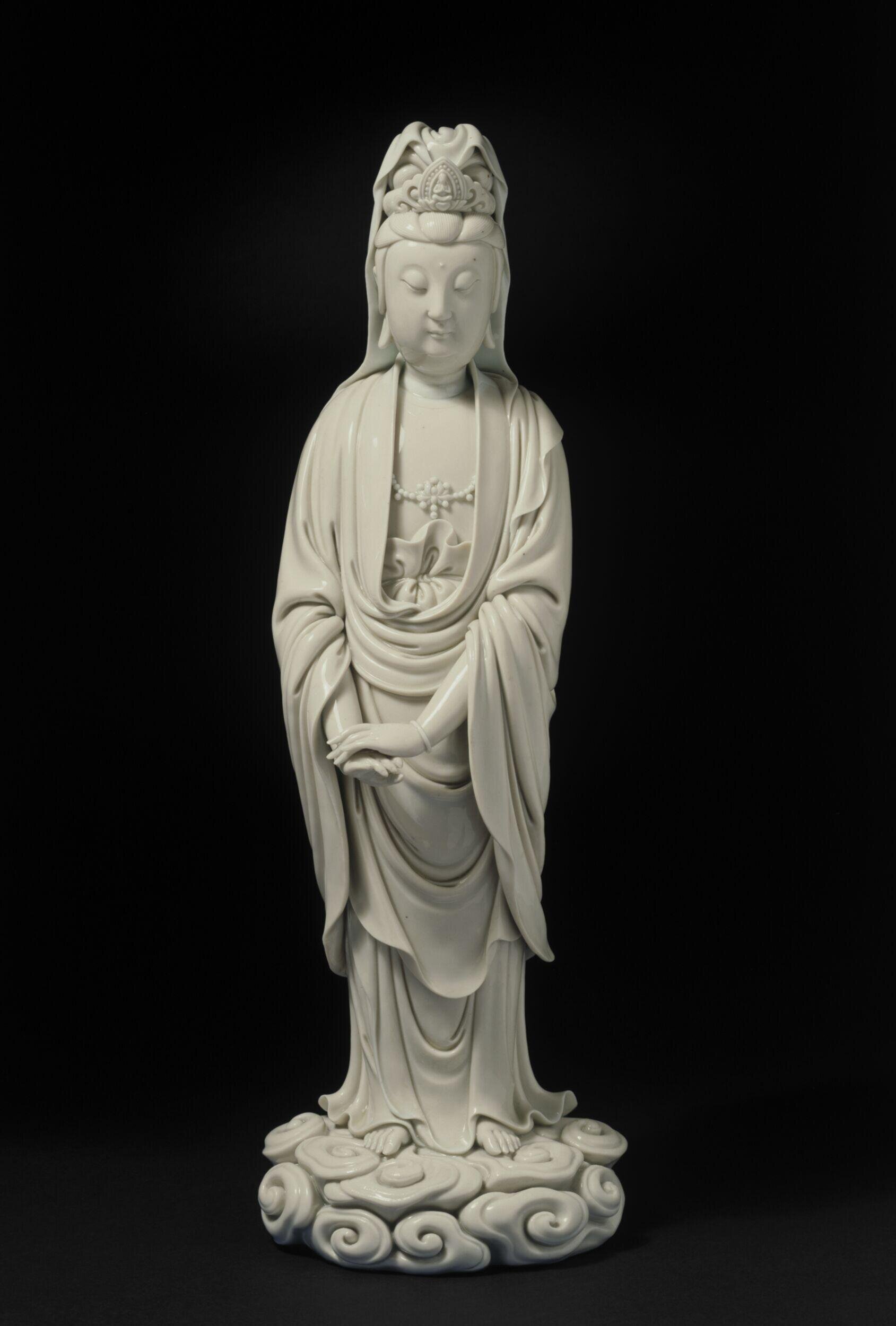
Dehua white porcelain. Victoria and Albert Museum, O176735.
2.5 Donnelly — One Man Defined a Field
P.J. Donnelly's contribution to the study of Blanc de Chine cannot be circumvented.
Published in 1969, Blanc de Chine: The Porcelain of Têhua in Fukien (Faber & Faber, London, ISBN 0-571-08078-2) comprises 407 pages of text plus 160 plates. It defined the terminology, established the classification framework, and surveyed global collections. Every subsequent English-language study of Dehua porcelain begins from Donnelly's footnotes. In 1980, he donated his personal collection to the British Museum in its entirety — scholar and collection ultimately coming to rest under the same roof.
2.6 Marchant — A Century of Commitment
The position of the London dealers Marchant in the Dehua porcelain market warrants specific attention.
Founded in 1925, three generations of family management. Relocated to Mayfair in spring 2025. Five dedicated Dehua porcelain exhibitions — 1985, 1994, 2006, 2014, 2024 — spanning nearly four decades. The 2014 exhibition included works from the Captain Meuldijk collection; the exhibition catalogue was priced at £80/$130.
Marchant's operating model combines an extremely narrow category focus with an extremely long client-relationship cycle. In the high-end antiques market, the connoisseurship credibility accumulated over forty years of concentration on a single category itself constitutes a source of pricing authority. No domestic dealer with equivalent focus and international visibility has yet emerged for Dehua porcelain.
Sources & References
Core Scholarly Literature
- P.J. Donnelly. Blanc de Chine: The Porcelain of Têhua in Fukien. London: Faber & Faber, 1969. ISBN 0-571-08078-2. LCCN 77-417633. 407 pp. + 160 plates. The Faber Monographs on Pottery and Porcelain. — Foundational English-language monograph on Dehua white porcelain
- Suzanne G. Valenstein. A Handbook of Chinese Ceramics. New York: Metropolitan Museum of Art, revised edition 1989. ISBN 0-87099-514-6. 331 pp. + 32 plates. — Includes Dehua dating, favours late Ming
- Robert H. Blumenfield. Blanc de Chine. Berkeley/Toronto, 2002. — Described the paucity of biographical data on He Chaozong as “shocking”
- Rose Kerr & John Ayers. Blanc de Chine: Porcelain from Dehua. Singapore: Asian Civilisations Museum, 2002. 164 pp. Including Eva Ströber's chapter “Dehua Porcelain in the Collection of Augustus the Strong in Dresden.” — Scholarly study of the Frank Hickley collection of 160 pieces
- Liu Youzheng (刘幼铮). Blanc de Chine: A Study of Dehua White Porcelain (中国德化白瓷研究). Beijing: Science Press, 2007. ISBN 978-7-03-019558-6. 243 pp. + 300+ colour plates. — First application of archaeological typology and statistical methods to nearly 4,000 Dehua porcelain specimens for systematic classification and periodisation; Appendix II contains a 38-page catalogue of Chinese and international Dehua collections
- Wan Jun (万钧). “Production and Trade of Ming-Qing Dehua White Porcelain in a Global Perspective.” Palace Museum Journal (Gugong Xuekan), no. 22 (2021): 305–322. — Systematic compilation of EIC shipping records, seventeenth–eighteenth-century royal and aristocratic collection inventories, and a summary table of 60+ museums worldwide
- Gan Shumei (甘淑美). “The Trade of Dehua White Porcelain in Europe and the New World, Late 17th to Early 18th Century” (Parts I & II). Fujian Wenbo, no. 4 (2012) & no. 3 (2014). — The most systematic Chinese-language study of EIC archival records for Dehua porcelain
- Shen Maojian (沈茂坚). Dictionary of Chinese Artists (中国美术家辞典). Shanghai, p. 255. — He Chaozong biographical entry
- Lin Meicun (林梅村). “Venice San Marco basilica Dehua porcelain.” European Journal of Archaeology, 2017. — Argument for early Dehua porcelain at San Marco Basilica
Historical Sources
- Quanzhou Gazetteer (泉州府志), 1763 (Qianlong 28th year) — Source of the “treasured by the whole world” (天下共宝之) assessment
Museum Collection Sources
- Palace Museum (Beijing) — 4 pieces attributed to He Chaozong, transmitted from the Qing imperial collection
- Victoria and Albert Museum (London) — C.546-1910 (George Salting bequest), FE.52:1,2-2012 (Peter Ting), FE.52-2018 (Su Xianzhong), C.49-1953 (Su Xuejin confirmed)
- Rijksmuseum (Amsterdam) — AK-MAK-594 (T.H. Westendorp collection)
- Musée Guimet (Paris) — G 535 (Ernest Grandidier collection)
- Nelson-Atkins Museum of Art (Kansas City) — 33-588 (Laurence Sickman, purchased in Beijing 1933)
- British Museum (London) — Donnelly collection, donated in full 1980, accession prefix 1980,0728
- Art Institute of Chicago — 1925.1482
- Metropolitan Museum of Art (New York) — 63.176, 79.2.479, 1974.356.319
- Staatliche Kunstsammlungen Dresden — c. 29,000 East Asian ceramics including 1,000+ Dehua pieces (PO 8638, PE 2373, PE 2188)
- Asian Civilisations Museum (Singapore) — 160 pieces from the Frank Hickley collection
Auction Sources
- Christie's Hong Kong: 2017 Lot 8120 (HK$19.3M) / 2014 Lot 3120 (HK$14.44M) / 2015 Lot 2912 (HK$8.92M) / 2016 Lot 3324 (HK$4.26M)
- Christie's London: 2015 Lot 155 (£818.5K)
- Christie's: 2014 Lot 1628 ($317K)
- Sotheby's: 2015 Lot 259 ($970K) / HK 2016 Lot 3606 (HK$7.28M) / HK 2013 Lot 3196 (HK$3.4M, by Xu Yunlin) / NY 2025 Lot 136 ($635K)
- Kami Auction (Osaka), Autumn 2022 — ≈RMB 12.07M
- Shizhuzhai 2023 (RMB 15M) / China Guardian Shengjia Spring 2023 (RMB 12.075M)
- Lempertz (Cologne) 2014 Lot 56 (€856K) / Nagel (Stuttgart) 2010 Lot 1023 (€425.6K) / Bonhams 2012 Lot 297 (£529.25K) / Hindman 2020 ($357K)
- CANS Arts Dehua porcelain sculpture ranking (1 Jan 2007 – 31 Aug 2023) — Systematic transaction data
Commercial & Market
- Marchant (London), founded 1925, three generations of family management. Five Dehua porcelain exhibitions (1985/1994/2006/2014/2024)
Image Sources
- Fig. D2-01: Metropolitan Museum of Art, 63.176 · CC0 Public Domain
- Fig. D2-02: Victoria and Albert Museum, C.546-1910 · Open Access
- Fig. D2-03: Rijksmuseum, AK-MAK-594 · CC0 Public Domain
- Fig. D2-04: Metropolitan Museum of Art, 79.2.479 · CC0 Public Domain
- Fig. D2-05: Victoria and Albert Museum, O176735 · Open Access
Frequently Asked Questions
- Who was He Chaozong?
- He Chaozong (何朝宗) was a Ming-dynasty master of Dehua porcelain sculpture, active in the early seventeenth century in Dehua, Fujian Province. He is celebrated for Buddhist statuary — Guanyin, Bodhidharma, and Samantabhadra figures — and was described by the 1763 Quanzhou Gazetteer as one whose works are “treasured by the whole world” (天下共宝之). His works are held in over ten major museums worldwide. Wikidata: Q3503086.
- What is the auction record for He Chaozong?
- The international auction record is HK$19.3 million (approximately US$2.47 million), achieved at Christie's Hong Kong on 27 November 2017, Lot 8120, for a white-glazed Guanyin Crossing the Sea bearing the “He Chaozong yin” seal. A Bodhidharma figure at Kami Auction (Osaka, Autumn 2022) reached approximately US$1.7 million.
- Which museums hold his works?
- Verified major holdings: Palace Museum Beijing (4 attributed), Victoria and Albert Museum London (C.546-1910), Rijksmuseum Amsterdam (AK-MAK-594), Musée Guimet Paris (G 535), Nelson-Atkins Museum Kansas City (33-588), British Museum London (Donnelly collection), Art Institute of Chicago (1925.1482), Metropolitan Museum of Art New York (63.176 etc.), Staatliche Kunstsammlungen Dresden (1,000+ pieces), Asian Civilisations Museum Singapore (160 pieces). Full table at §2.3.
- What is Donnelly's Blanc de Chine?
- P.J. Donnelly, Blanc de Chine: The Porcelain of Têhua in Fukien, Faber & Faber, London, 1969. ISBN 0-571-08078-2, LCCN 77-417633. The foundational English-language monograph on Dehua white porcelain. Donnelly donated his personal collection to the British Museum in 1980 (accession prefix 1980,0728).
Cross-Dimension References
- Historical Evolution of Dehua White Porcelain — Positioning He Chaozong's Ming-dynasty ivory-white zenith within the 3,700-year continuum
- Shipwreck Archaeological Database — Guanyin figures recovered from the Hatcher and Vùng Tàu wrecks, extending the He Chaozong sculptural tradition into the maritime trade sphere
- European Imitation Evidence Chain — Dresden holdings (PO 8638 etc.) as core comparative material for Meissen copying studies
- Dehua Porcelain Auction Market Intelligence — Full auction analysis and the seven-tier pricing model
- International Luxury Porcelain Benchmarking — Marchant's four-decade category focus as a brand-building case study
- Contemporary Ceramic Art from Dehua — Peter Ting (V&A FE.52:1,2-2012) and Su Xianzhong (V&A FE.52-2018)