6.1 Record Prices
The He Chaozong global corpus already lists He Chaozong and major Dehua auction results in descending order. Rather than repeating the table, this section analyses the structural features of the price distribution.
Geographic distribution of top results — the three highest prices were achieved in Tokyo (Uesugi, ¥320M), Hong Kong (Christie’s, HK$19.3M) and Nanjing (Shizhuzhai, RMB 15M). None occurred at a European or American saleroom. The implication: pricing power for the highest tier of Dehua porcelain currently sits in Asia, not London or New York.
Asia–West price gap — Lempertz Cologne at €856K, Bonhams London at £529K, Sotheby’s New York at $635K stand an order of magnitude below Christie’s Hong Kong at HK$19.3M. This means that for a He Chaozong work of comparable rank, the premium achievable at an Asian auction house far exceeds what the same piece would fetch in Europe or the United States. The reason is straightforward: Asian buyers — especially from mainland China, Hong Kong and Taiwan — have a far stronger cultural identification with and collecting preference for He Chaozong.
The Hindman effect — in 2020, a Dehua white porcelain figure at Hindman Auctions in Chicago was estimated at $600 and sold for $357,000. This extreme divergence between estimate and hammer is known in the trade as a “price discovery event” — the market correcting a severe prior undervaluation in real time. Hindman is a regional auction house whose core business is not Chinese ceramics; the initial estimate reflected a knowledge gap outside the specialist field. The moment a buyer who understood the true value of Dehua porcelain entered the room, the price snapped to its proper level.
Events like this continue to occur. They indicate that Dehua porcelain remains systematically undervalued in non-core markets — small and mid-tier auction houses outside Asia.
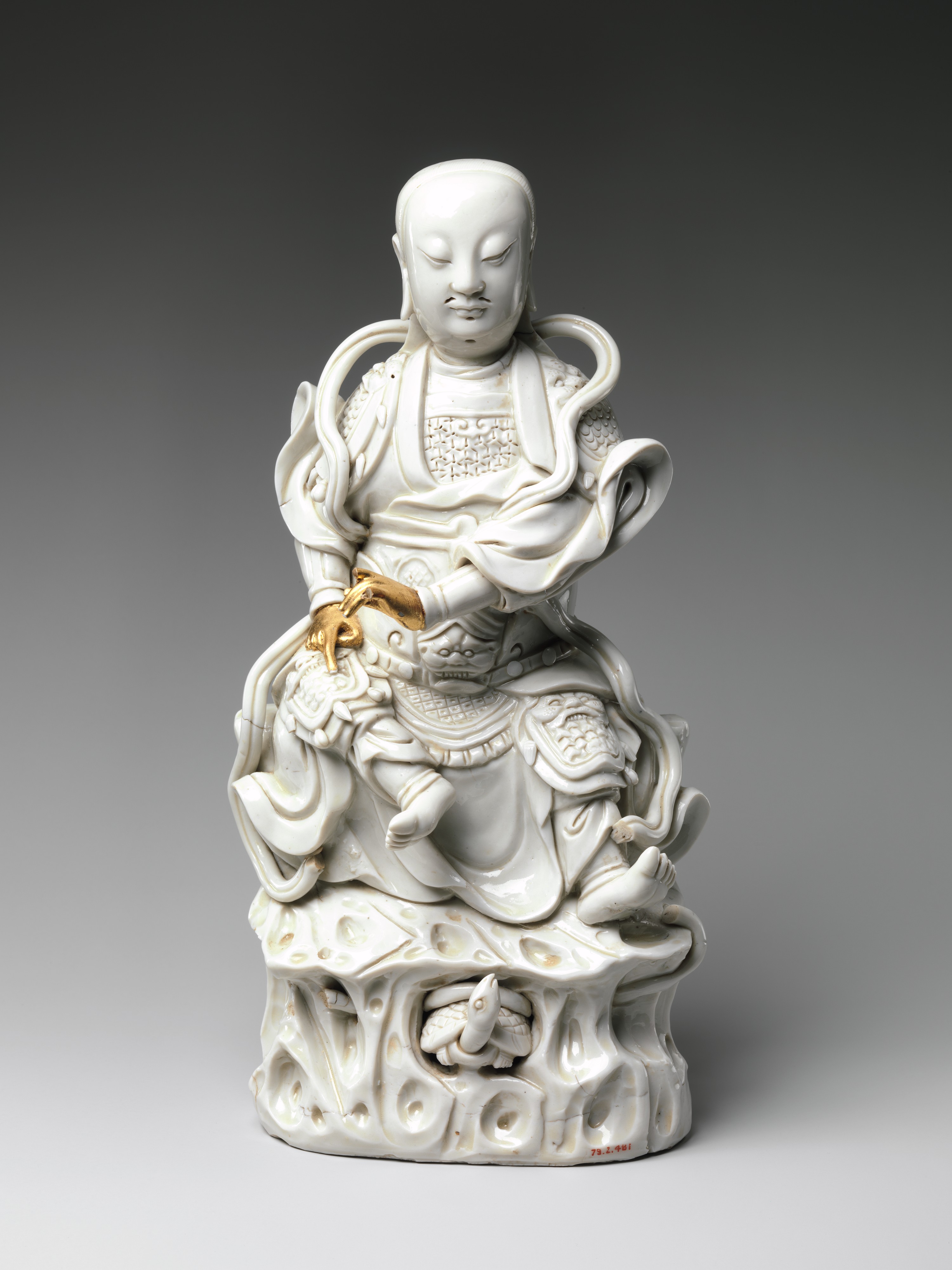
White porcelain with ivory-white glaze, early 18th century, H. 29.8 cm. Daoist deity figures are the second-largest category of religious porcelain sculpture at auction after He Chaozong Buddhist subjects, falling mainly within Tier III (non-He master works, $5,000–$50,000). The Metropolitan Museum of Art, 79.2.481.
6.2 The Seven-Tier Pricing Model
Based on a comprehensive analysis of public auction records through late 2025, the Dehua porcelain market can be segmented into seven price tiers:
| Tier | Category | Price Range (USD) | Market Characteristics |
|---|---|---|---|
| I | He Chaozong masterworks (clear seal, reliable provenance, perfect condition) | $600K–2.5M | Top auction houses, Asian buyers dominant |
| II | He Chaozong mid-range (seal disputed or minor condition issues) | $100K–500K | International auctions, requires scholarly support |
| III | Non-He master works (Zhang Shoushan, Lin Chaojing, Chen Wei, etc.) | $5K–50K | Upper-mid market, specialist bidding |
| IV | Unsigned fine ware (Ming to early Qing, high quality, no seal) | $2K–30K | London, New York, Hong Kong mid-tier auctions |
| V | Libation cups and special forms | $500–15K | Miscellaneous sales, dual material + form premium |
| VI | Late Qing reproductions | $500–5K | High volume, low price, entry-level collecting |
| VII | Contemporary mass-produced ware | $20–1K | Retail market, mostly non-auction channels |
The spread between Tier I and Tier VII exceeds 10,000×. The same material, the same place of origin, with prices ranging from $20 to $2.5 million. In any single ceramic category with publicly available data, this depth of price range is exceptionally rare.
This depth is both an asset and a liability. The asset: the barrier to entry is extremely low ($20 gets you in), the ceiling is extremely high ($2.5M for masterworks), covering the full spectrum from novice collectors to institutional buyers. The liability: price signals are extremely dispersed, and non-specialist buyers have almost no way to tell whether they are looking at a Tier IV or a Tier VI piece — visual similarity is high, and the authentication barrier is steep.
6.3 Marchant’s Role in the Market
The He Chaozong global corpus introduced Marchant’s background. This section supplements it from a market-intelligence perspective, focusing on its pricing mechanism.
Marchant is not an auction house. It is a primary market dealer. The distinction: auction prices are bid-driven; a dealer’s prices are set by the dealer. Marchant’s asking prices reflect the pricing confidence underwritten by three generations and ninety-nine years of accumulated connoisseurship and client relationships.
Five dedicated exhibitions (1985 / 1994 / 2006 / 2014 / 2024) also function as scholarly publications — all five exhibition catalogues have been cited by subsequent research. The 2014 catalogue, priced at £80 / $130 at publication, now circulates at a premium on the secondary book market.
Marchant’s client base has never been disclosed. But its location (in 2025 it moved to Mayfair — one of London’s most expensive commercial addresses) and exhibition frequency suggest that its core clientele consists of high-net-worth collectors in Europe, the Americas and Asia, as well as museum acquisition funds.
6.4 Key Private Collections and Their Market Impact
The Donnelly Collection
P. J. Donnelly’s collection was donated to the British Museum in 1980, removing it from market circulation. But the authority of his monograph (507 pages, 160 plates) as a reference for authentication means that “published in Donnelly 1969” has become a premium label in auction catalogues. A work with a Donnelly publication record typically carries a higher estimate than a piece of comparable quality without one.
The Hickley Collection
Frank Hickley’s 160 pieces of Dehua porcelain are now held by the Asian Civilisations Museum in Singapore. Rose Kerr and John Ayers’s 2002 publication covering all 160 pieces gave the collection complete scholarly documentation. Were any piece from the Hickley collection to appear on the market, it would carry the label “ex-Hickley Collection, published in Kerr & Ayers 2002” — one of the most valuable provenance annotations in the auction trade.
Burghley House
The 1688 household inventory of Burghley House records Dehua porcelain. This confirms that Blanc de Chine had entered English aristocratic households by the late seventeenth century.
Blenheim Palace
Covered in the He Chaozong global corpus. The Vanderbilt marriage alliance gives the Blenheim collection a transatlantic provenance narrative with appeal for collectors on both sides of the Atlantic.
Taft Museum, Cincinnati
The museum’s 1904 catalogue already records Dehua porcelain holdings. This makes it one of the earliest American museums to formally accessioned Blanc de Chine and publish a catalogue entry — sixty-five years before Donnelly’s monograph.
Cleveland Museum of Art
Cleveland’s Dehua porcelain holdings serve as a reference standard for the American Midwest region.
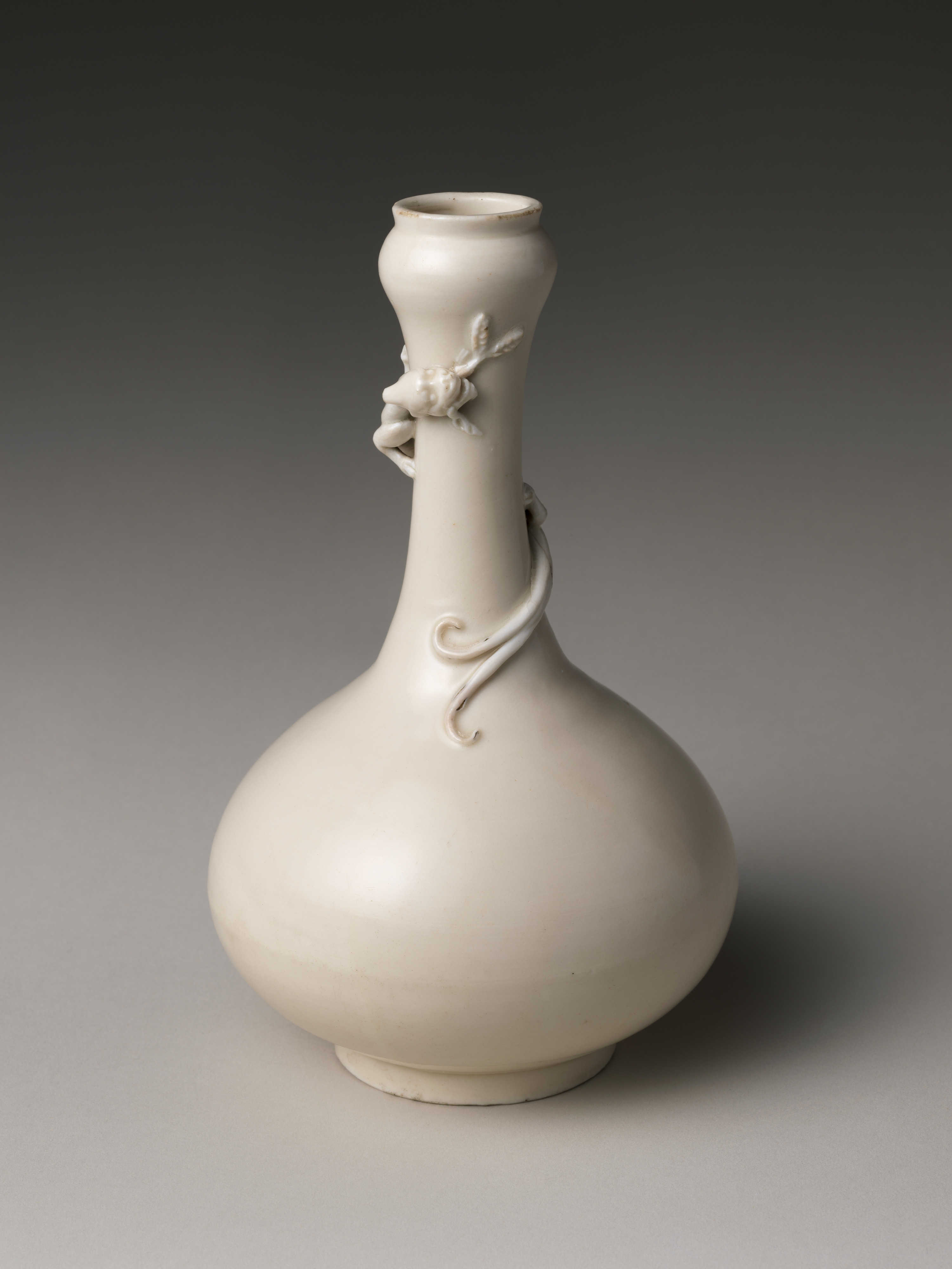
White porcelain with transparent glaze, late Ming Wanli period (1573–1620), H. 21 cm. Acquired by the Metropolitan Museum in 1918 — over a century of institutional provenance constitutes one of the most credible provenance chains in the auction market. Late Ming pieces, scarce in number, command a significant provenance premium over Qing-dynasty equivalents at comparable quality. The Metropolitan Museum of Art, 18.56.60.
6.5 The Provenance Premium
In the Dehua porcelain auction market, the premium attached to provenance is exceptionally pronounced. For a He Chaozong Guanyin of comparable quality, provenance differences alone can produce 2–5× price variation:
- Top-tier provenance: Donnelly publication + museum exhibition record + 18th-century European aristocratic collection — highest premium
- Strong provenance: known dealer handling (Marchant, Vanderven, Luisa Vinhais) + early 20th-century collection
- Ordinary provenance: recent market circulation, no notable historical provenance
- Compromised provenance: unknown origin or broken provenance chain — heaviest discount
Provenance affects not only price but also access. Top auction houses (Christie’s, Sotheby’s) apply increasingly rigorous provenance vetting for high-estimate lots; works with broken provenance chains find it harder and harder to reach these platforms.
6.6 Market Outlook
Market signals as of late 2025:
Upside signals —
- The 2022 Uesugi ¥320M result reset the global price ceiling for He Chaozong
- Sotheby’s New York achieved $635K in 2025, indicating rising Western awareness of Dehua porcelain
- Continued ICAA international exhibitions (Dehua contemporary ceramic art) are raising the global visibility of contemporary Dehua work
Downside risks —
- A slowing Chinese economy may dampen mainland buyers’ purchasing power
- Authentication disputes: debate over He Chaozong seal marks has never been settled; any high-profile attribution reversal could shake market confidence
- Tier VI and VII mass-produced goods dilute the brand equity of “Dehua porcelain” — when the same name points to both a $2.5M He Chaozong Guanyin and a $20 tea cup, brand value is pulled down
Structural assessment — the core tension in the Dehua auction market is this: the supply of top-tier works is extremely scarce (there may be no more than a few dozen genuine He Chaozong pieces worldwide), yet the authentication consensus remains fragile. Scarcity should drive prices up, but authentication uncertainty suppresses bidding confidence. The maturity of the authentication framework — particularly the uptake of materials-science testing methods — is the key variable determining whether this scarcity can be fully reflected in prices.
Frequently Asked Questions
- What is the highest auction price ever paid for Blanc de Chine?
- As of late 2025, the record is ¥320 million (approximately $2.4 million) at Uesugi Auction, Tokyo, 2022, for a He Chaozong Buddhist figure. The top three results were achieved in Tokyo, Hong Kong and Nanjing — pricing power sits in Asia, not London or New York.
- What is the price range for Blanc de Chine at auction?
- From $20 to $2.5 million, spanning seven price tiers with a depth exceeding 10,000×. Tier I covers He Chaozong masterworks ($600K–$2.5M, Asian buyers dominant); Tier VII covers contemporary mass-produced ware ($20–$1K, mainly retail channels). This price depth within a single ceramic category is exceptionally rare.
- How much does provenance affect Blanc de Chine auction prices?
- At comparable quality, provenance differences can cause 2–5× price variation. Donnelly publication + museum exhibition record + 18th-century European aristocratic collection constitutes top-tier provenance with the highest premium. Works with broken provenance chains increasingly struggle to reach Christie’s and Sotheby’s.
- Who is Marchant and why do they matter for Blanc de Chine pricing?
- Marchant is London’s foremost primary market dealer for Blanc de Chine, with ninety-nine years of specialisation across three generations. Unlike auction houses where prices are bid-driven, Marchant sets prices based on accumulated connoisseurship and client relationships. Five exhibition catalogues (1985–2024) function as scholarly publications cited by subsequent research.
References
- Donnelly, P. J. Blanc de Chine: The Porcelain of Tehua in Fukien. London: Faber and Faber, 1969. 507 pp., 160 plates.
- Kerr, Rose, and John Ayers. Blanc de Chine: Porcelain from Dehua. Chicago: Art Media Resources, 2002.
- Marchant. Blanc de Chine (exhibition catalogue series). London: S. Marchant and Son, 1985, 1994, 2006, 2014, 2024.
- Christie’s Hong Kong. Auction records, Dehua porcelain lots, 2018–2025.
- Sotheby’s New York. Auction records, Dehua porcelain lots, 2020–2025.
- Uesugi Auction (上氏拍卖). Tokyo, 2022. He Chaozong Buddhist figure, ¥320,000,000.
- Hindman Auctions. Chicago, 2020. Dehua white porcelain, lot estimate $600, sold $357,000.