9.1 Purpose of the Benchmarking
Dehua’s ¥76 billion annual output demonstrates that capacity and quality are not the bottleneck; the core gap lies in international pricing power. The five brands examined below have each established stable international premium structures, and their pathways permit direct comparison.
These five brands were not selected at random. They represent five distinct brand-building paths, each directly comparable to Dehua’s present condition.
9.2 Meissen—Crystallisation of State Will
Founded: 23 January 1710. Fully funded by Augustus the Strong.
Crossed-swords mark: In use since 1722—the longest continuously used trademark in human history. Three hundred and four years.
Current ownership: Wholly owned by the Free State of Saxony since 1991. A state enterprise.
Annual revenue: Approximately €35 million.
Employees: ~600.
Historical moulds: 700,000.
Colour library: 10,000 colours.
Swords painters: Only 2 in the entire factory—the crossed swords on the base of every Meissen piece are hand-painted by these two individuals.
Price range: €59 (entry-level accessories) → €500,000 (museum-grade reproductions).
Approximately €35 million in annual revenue—under ¥300 million RMB. One two-hundred-and-fiftieth of Dehua’s ¥76 billion. Yet Meissen’s brand value, cultural standing and pricing power far exceed what output figures can measure.
Meissen’s crossover collaborations include co-branded lines with Hugo Boss and Adidas. That a three-hundred-year-old porcelain manufactory can partner with sportswear brands without diluting its brand identity is itself evidence of the liquidity and dilution-resistance of Meissen’s brand equity.
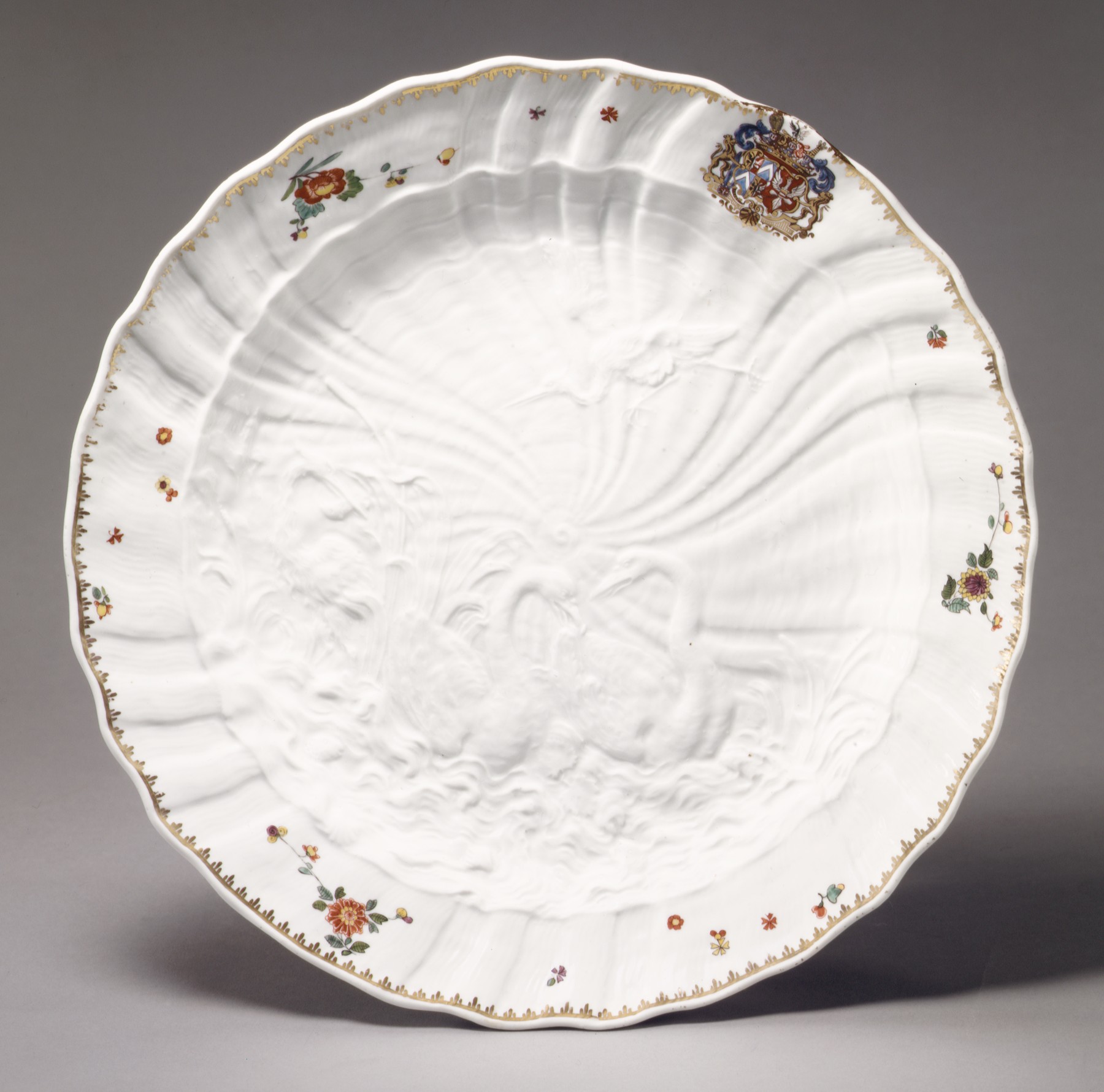
Hard-paste porcelain with moulded swan motifs and coat of arms, c. 1738. Model led by J. J. Kändler. The Metropolitan Museum of Art, 48.165.
Comparison: The Meissen crossed-swords mark, in continuous use since 1722, derives its core value from uniqueness and continuity. Dehua currently lacks a unified visual symbol of comparable recognition. “Blanc de Chine” as a name has been registered with EUIPO (March 2025), but a supporting visual-symbol system has not yet been developed.
9.3 Royal Copenhagen—The Generational-Loyalty Machine
Founded: 1775.
Current ownership: Acquired by Finland’s Fiskars Group in 2013 for approximately €62 million.
Signature product: Flora Danica dinnerware—commissioned in 1790 → 1,802 pieces completed by 1802 → still in production today. Each piece requires 20+ artisans and 8–16 firings. Individual pieces retail at US$1,000–40,000+.
The Flora Danica story is a textbook case in the luxury industry: a dinner service originally crafted for the Danish Crown, still produced more than two hundred and thirty years later, with botanical motifs hand-painted from the 1761 Flora Danica compendium. The Flora Danica premium rests on three compounding factors: two hundred and thirty years of production continuity, the irreplaceability of hand-painted execution, and the original royal commission as provenance.
Christmas plates—Since 1908, a limited-edition annual plate has been released every year, for over 130 consecutive years. This series generates “generational loyalty”—plates collected by a grandmother pass to a mother and then to a daughter, binding three generations of emotional attachment to a single brand.
The acquisition price of approximately €62 million—under ¥500 million RMB. A two-hundred-and-fifty-year-old royal porcelain brand, acquired for less than the valuation of a mid-sized Dehua factory. This demonstrates that brand-value monetisation depends on management capability and market conditions; history alone does not automatically equal commercial value.
9.4 Sèvres—The State Manufactory at Its Extreme
Founded: 1740. Championed by Louis XV and Madame de Pompadour.
Current status: A Manufacture nationale under the French Ministry of Culture. To this day.
Employees: ~120.
Annual output: <5,000 pieces.
One hundred and twenty people, fewer than 5,000 pieces per year, averaging roughly 42 pieces per person per year—an operating model closer to a laboratory than a factory.
Sèvres’s contemporary-art residency programme is its most instructive strategy: Louise Bourgeois, Yayoi Kusama, Pierre Soulages, Zao Wou-Ki, Lee Ufan, nendo—the world’s foremost contemporary artists and designers have created work in residence at Sèvres. Each residency collaboration produces pieces that enter two value systems simultaneously—in the art market they are “the artist’s work,” in the porcelain market they are “produced by Sèvres”—a dual-premium overlay.
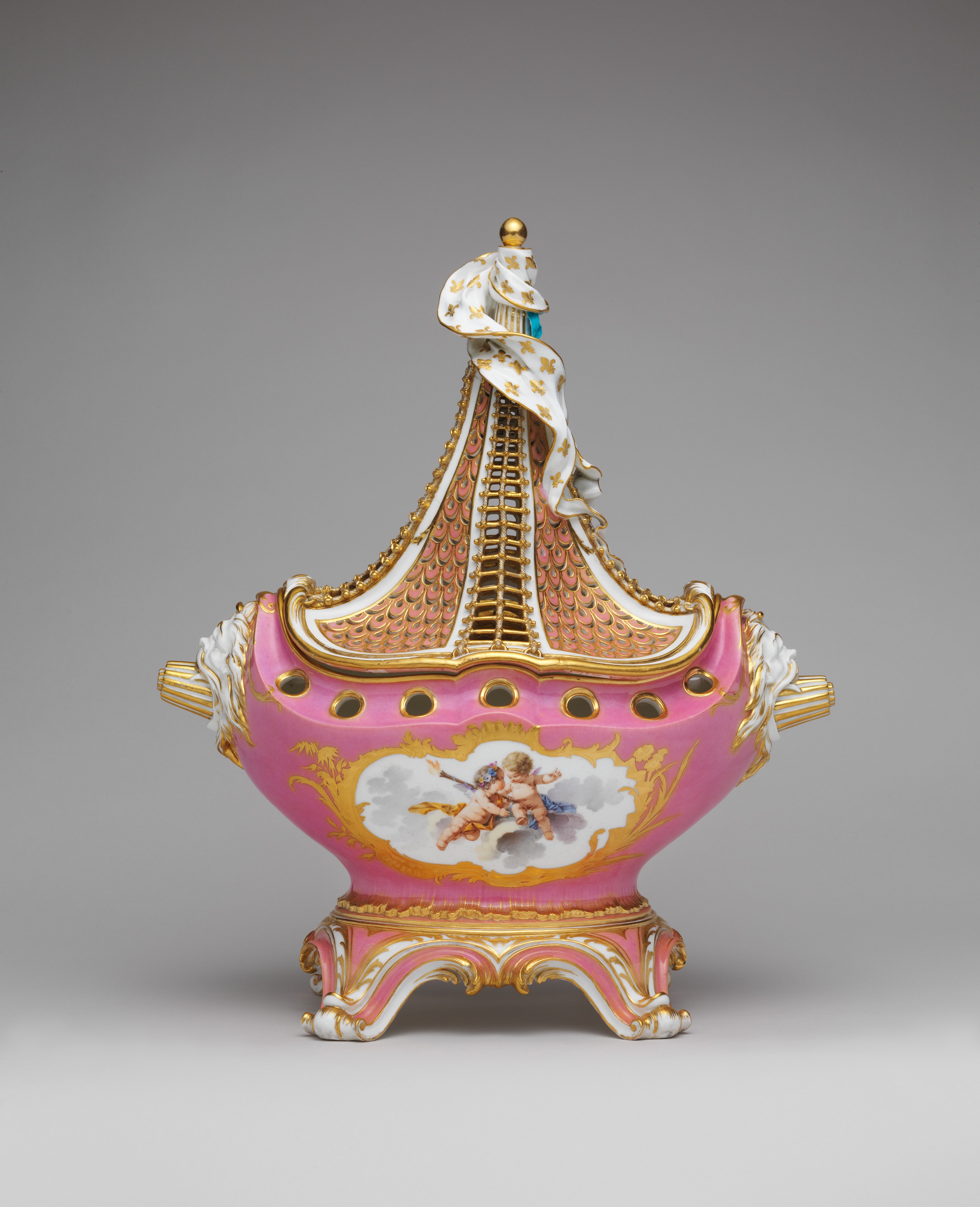
Soft-paste porcelain, painted enamel and gilding, rose Pompadour ground, designed by Jean-Claude Duplessis, 1758. H. 44.8 cm. The Metropolitan Museum of Art, 58.75.89a, b.
Comparison: The Sèvres model proves that “few but fine” can sustain a brand’s global standing. Dehua’s ICAA (Dehua Contemporary Ceramic Art) has launched a comparable international artist residency programme, but its current scale and continuity differ from Sèvres’s by several orders of magnitude.
9.5 Wedgwood—A Rise-and-Fall Warning
Founder: Josiah Wedgwood (1730–1795), often called “the father of modern marketing.”
Signature product: Jasperware—developed through nearly 5,000 experiments. The Portland Vase reproduction alone took four years.
Josiah Wedgwood’s marketing innovations were revolutionary for the eighteenth century: showrooms (not shops), public promotion of royal warrants, mail-order catalogues, instalment payments—methods that seem self-evident two hundred and fifty years on, but were unprecedented in the 1770s.
Yet Wedgwood subsequently entered sustained decline.
January 2009: Wedgwood filed for bankruptcy. Cause: product-line overexpansion to 400+ patterns, brand positioning slipping from “British aristocratic porcelain” to mid-range consumer goods, eroding two centuries of accumulated premium capacity.
KPS Capital Partners acquired Wedgwood for approximately US$82 million.
Fiskars Group bought it from KPS in 2015 for US$437 million—a ~3.4× return for KPS.
Fiskars thus owns both Wedgwood and Royal Copenhagen—two centuries-old porcelain brands under a single Finnish consumer-goods group.
Comparison: Wedgwood’s bankruptcy proves that time depth and historical prestige cannot automatically prevent brand death. The overexpansion to 400+ patterns diluted the brand—a trajectory that structurally parallels Dehua’s current condition: 4,500 enterprises, a price spectrum spanning US$20 to US$2.5 million. When “Dehua porcelain” simultaneously covers state-gift-grade masterworks and commodity mugs at Yiwu prices, the risk of brand dilution is real.
9.6 Arita Ware—Government-Led Collective Revival
Founded: 1616 (Genna 2), when Korean potter Yi Sam-pyeong discovered porcelain stone at Arita.
Current status: 150+ kilns (kamamoto); sales have fallen to roughly one-fifth of their peak.
Arita’s decline story differs from Wedgwood’s—it is not the management failure of a single firm, but the collective ageing of an entire production region. Over 150 kilns each operate independently, with no unified brand, no international channels, and product design stalled within traditional paradigms.
In 2013, Saga Prefecture launched “ARITA EPISODE 2”: 16 international designers collaborated with 10 Arita kilns, reinterpreting Arita traditions through international design language. The collaborative output debuted at Milan Design Week 2016, followed by an exhibition at the Rijksmuseum in Amsterdam.
The methodology is remarkably clear:
- Government-funded and government-led (no reliance on a single enterprise)
- International designers brought in (not to learn tradition, but to use tradition)
- Milan debut (direct entry into the core stage of global design discourse)
- Museum endorsement (Rijksmuseum exhibition = scholarly/cultural certification)
Comparison: Arita’s “EPISODE 2” and Dehua’s ICAA (Dehua Contemporary Ceramic Art) are highly comparable, but their terminal objectives differ—“EPISODE 2” output was directed toward commercially viable products, with designer pieces ultimately entering retail; ICAA output currently remains primarily at the exhibition level.
9.7 Five Commonalities
Five brands, five paths, one shared evolutionary arc:
(1) Origin in imitation, maturation through originality—Meissen imitated Dehua → Swan Service. Sèvres imitated Meissen → contemporary art residencies. Arita originated with Korean potters → Kakiemon style. All five brands began with direct study of external models, yet each ultimately built its market position on an original product language.
(2) A distinctive visual mark—Meissen crossed swords. Royal Copenhagen three-wave motif. Wedgwood blue-and-white relief. Arita’s aka-e (overglaze enamel). Each is identifiable within three seconds. Dehua currently possesses no unified visual symbol of comparable recognition.
(3) State or institutional backing—Meissen is wholly owned by the State of Saxony. Sèvres reports to the French Ministry of Culture. Royal Copenhagen carries the “Royal” prefix (by Danish Crown warrant). Arita’s revival was led by Saga Prefecture government. None of these cases resulted from purely market-driven forces.
(4) Contemporary-art collaboration—Sèvres’s residency programme. Meissen’s Hugo Boss/Adidas co-brands. Royal Copenhagen’s collaborations with contemporary designers. Arita’s “EPISODE 2.” All four surviving brands deploy collaboration with contemporary creators as a core means of maintaining cultural relevance.
(5) Heritage narrative—Every brand possesses a story that can be told in thirty seconds. Meissen: “Augustus traded soldiers for porcelain, then built his own factory.” Royal Copenhagen: “Dinnerware made for a queen two hundred and thirty years ago is still in production.” Wedgwood: “Five thousand experiments to get that blue.” Dehua currently lacks an equally distilled thirty-second narrative. The raw material—3,700 years of ceramic history, the world’s only low-iron clay—is sufficient to construct such a narrative, but it has not yet been integrated into a unified external expression.
9.8 Six Premium Factors
Synthesising the premium logic across all five brands, international luxury porcelain pricing power rests on six factors:
| Factor | Description | Dehua Status | Strength |
|---|---|---|---|
| Time Depth | Historical length of the brand or production region | 3,700 years—longest globally, undisputed | Very Strong |
| Craft Irreplaceability | Manual skills that machines cannot replicate | He Chaozong tradition + master system + ICAA residency | Strong |
| Scarcity | Production or material constraints | Fe₂O₃<0.5% clay—only source worldwide | Very Strong |
| Institutional Endorsement | Museum collections and scholarly publication | V&A / Rijksmuseum / British Museum / Met, etc. | Strong |
| National Link | Brand–state identity alignment | World Heritage status + state-gift porcelain | Medium-Strong |
| Visual Identity | Instantly recognisable visual mark | Extremely weak—the critical gap | Very Weak |
Five of the six factors register as strong or very strong. The sole very-weak score—visual identity uniqueness—constitutes a structural deficit.
The remaining five assets (3,700 years of history, irreproducible clay, world-class museum collections, etc.) are difficult for international consumers to quickly identify, remember and propagate in the absence of a unified visual symbol.