4.1 Fifteen Hundred Years — China’s Porcelain Supremacy
The invention of porcelain is one of China’s most significant contributions to world material civilisation. Encyclopædia Britannica (“Porcelain” entry) dates the emergence of mature porcelain to the Eastern Han dynasty (25–220 CE), when kilns in the Shangyu area of Zhejiang first produced true porcelain with dense bodies and vitrified glazes. Robert Finlay’s framework in The Pilgrim Art: Cultures of Porcelain in World History (University of California Press, 2010) is built on this premise: porcelain as “a Chinese monopoly” that Europe did not break until the early eighteenth century. By the Tang dynasty (618–907), Chinese porcelain had already entered international trade networks via the Maritime Silk Road — the shipwreck archaeological database documents the underwater evidence of these trade routes.
Europe’s first written record of porcelain came in 1295, when Marco Polo returned to Venice from China. In Il Milione he used the word “porcellana” to describe Chinese porcelain — a term derived from the Italian name for a smooth-shelled cowrie (porcellino), whose lustre resembled that of porcelain. Subsequently, the English word “china” became a direct synonym for porcelain — a material named after a country, an extraordinarily rare phenomenon in English lexical history.
From Marco Polo to Europe’s first attempt at manufacturing porcelain, nearly three hundred years passed. In 1575, Francesco I de’ Medici of Florence announced the successful creation of “porcelana dell’India” (Indian porcelain), witnessed by the Venetian ambassador Andrea Gussoni. Gussoni’s report noted that Francesco had spent ten years in development with technical guidance from a Levantine. But Medici porcelain was essentially soft-paste porcelain, fundamentally different from Chinese hard-paste in both chemical composition and firing temperature. Fewer than 70 Medici porcelain pieces survive — a production figure that itself attests to the technology’s instability.
From the Medici failure to Europe’s first true hard-paste porcelain, another 133 years elapsed.
4.2 “White Gold” — The Porcelain Obsession of European Courts
In European courts of the late seventeenth and early eighteenth centuries, Chinese porcelain held a status equivalent to gold. The German term “Weißes Gold” (white gold) was no rhetorical exaggeration — porcelain genuinely functioned as a strategic resource. Finlay (2010, pp. 3–7) systematically demonstrates porcelain’s civilisational significance as a global trade commodity: Spanish galleons carried Chinese porcelain to Peru and Mexico, Persian cobalt ore was shipped to China for blue-and-white production, and the entire system constituted one of the core logistical networks of fourteenth-to-eighteenth-century globalisation.
This obsession left architectural evidence. In 1670, Louis XIV built the Trianon de Porcelaine at Versailles — a pleasure pavilion inspired by Chinese porcelain, its exterior clad in blue-and-white ceramic tiles to please his mistress Madame de Montespan. The Trianon was demolished in 1687 due to structural deficiencies and replaced by the Grand Trianon in marble, but its very existence documents the French court’s extreme pursuit of Chinese porcelain aesthetics.
The Porzellan-Kabinett at Charlottenburg Palace in Berlin (c. 1695–1705) survives intact, its walls entirely covered with Chinese and Japanese porcelain. Room 23 of Copenhagen’s Rosenborg Castle displays the Danish royal collection of East Asian ceramics. Sweden’s Drottningholm Palace likewise has dedicated porcelain display spaces. From northern to southern Europe, from the Atlantic coast to the Eastern European interior, virtually every significant European palace of the seventeenth and eighteenth centuries contained a “porcelain room” or “porcelain cabinet” — their existence constitutes spatial evidence of Chinese porcelain’s centrality in European material culture.
4.3 Augustus and the Prisoner — The Birth of Meissen
Augustus II “der Starke” (1670–1733), Elector of Saxony and King of Poland, was the most obsessive porcelain collector in European history. His total East Asian ceramics holdings exceeded 29,000 pieces (Ströber, in Kerr & Ayers 2002), and he converted Dresden’s Dutch Palace (later renamed the Japanisches Palais) into a dedicated porcelain exhibition hall. The Staatliche Kunstsammlungen Dresden’s ten-year Dresden Porcelain Project (2014–2024) systematically catalogued approximately 8,000 surviving Augustus-era East Asian ceramics (SKD 2024).
Contemporaries described Augustus as suffering from “Porzellankrankheit” (porcelain sickness). One piece of clinical evidence for this diagnosis was the “Dragoon Vases” exchange: Augustus traded 600 Saxon dragoon soldiers to Prussian King Friedrich Wilhelm I for 151 large Chinese blue-and-white porcelain vases (subsequently known as the “Dragoon Vases”), originally housed at Oranienburg and Charlottenburg Palaces in Berlin. Trading military manpower for porcelain — this was not anecdote but a state-level transaction recorded in diplomatic archives.
Augustus’s porcelain ambitions extended beyond collecting. He needed to crack the manufacturing secret — in German, to find the “Arcanum” (the mystery).
Around 1701, a young apothecary’s apprentice named Johann Friedrich Böttger (1682–1719) claimed to possess the art of alchemy — a “Goldmachertinktur” for transmuting base metals into gold. When word reached Berlin, the Prussian king demanded his arrest. Böttger fled to Saxony, but Augustus likewise detained him — not for gold-making, but to command him to research porcelain formulas. Böttger was imprisoned in laboratories in Dresden and the Albrechtsburg fortress, working under armed guard.
The physicist and mathematician Ehrenfried Walther von Tschirnhaus (1651–1708) was the critical collaborator. Tschirnhaus possessed genuine mineralogical knowledge and systematic experimental methods; his research on high-temperature mineral firing provided the scientific foundation for Böttger’s work. In 1708, kaolin samples from Schneeberg and alabaster as flux proved to be a viable raw-material combination. Tschirnhaus died suddenly on 11 October 1708, temporarily halting research. The following spring, Böttger announced the discovery of the hard-paste porcelain formula.
Regarding the respective contributions of Tschirnhaus and Böttger, scholarly debate continues. Queiroz & Agathopoulos (2006, arXiv:physics/0601111, published in Trabalhos de Arqueologia) argue in “The Discovery of European Porcelain Technology” that Tschirnhaus’s contribution has been systematically undervalued. Regardless of credit attribution, one point is undisputed: the entire research programme was driven by Augustus’s obsession with Chinese porcelain, and the models came from Dehua.
In 1710, the Meissen porcelain factory was formally established. Gleeson’s (1998) title for this history — The Arcanum — itself encapsulates the nature of the enterprise: a king imprisoned an alchemist, and it took nearly a decade to crack a technological secret that Chinese artisans had held for fifteen hundred years.
4.4 28 November 1709 — Dehua Blanc de Chine Delivered to Meissen
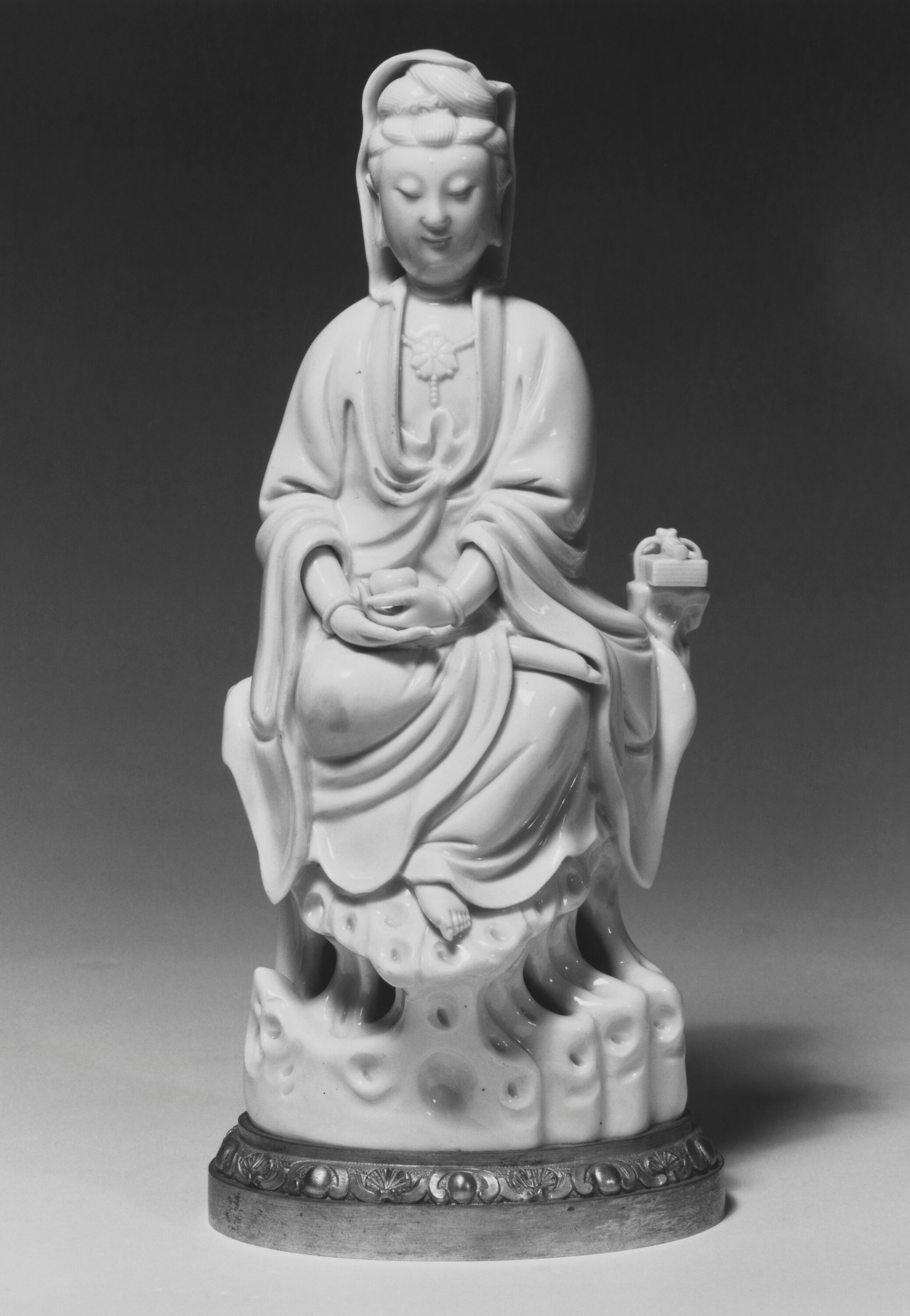
After the establishment of the Meissen factory, Augustus’s next directive was unambiguous: imitate Chinese porcelain. On 28 November 1709, he ordered several Dehua blanc de Chine Guanyin figures transferred from the Japanisches Palais collection to Meissen as models for replication.
The exact number of pieces delivered is subject to documentary discrepancy. The Metropolitan Museum of Art cites Fay-Hallé’s record of 8 pieces; a Staatliche Kunstsammlungen Dresden blog entry records 7. Eva Ströber, in a dedicated chapter of Rose Kerr and John Ayers’s Blanc de Chine: Porcelain from Dehua (Art Media Resources, 2002), discusses “Dehua Porcelain in the Collection of Augustus the Strong in Dresden” and confirms both the Dehua provenance and the imitative purpose of these samples. The Metropolitan Museum’s curatorial text explicitly states: “Among the first objects made at Meissen in red stoneware was the figure of Guanyin, the Chinese goddess of mercy and compassion, derived from a Chinese white-porcelain figure in the Saxon royal collections.”
Seven or eight pieces? The numerical discrepancy is not academically critical. The core fact remains: Meissen’s earliest product lines — including red stoneware (Jaspisporzellan) and subsequent white hard-paste porcelain — were directly modelled on Dehua blanc de Chine Guanyin figures. The first products of Europe’s first hard-paste porcelain factory were copies of wares from Dehua kilns in Fujian.
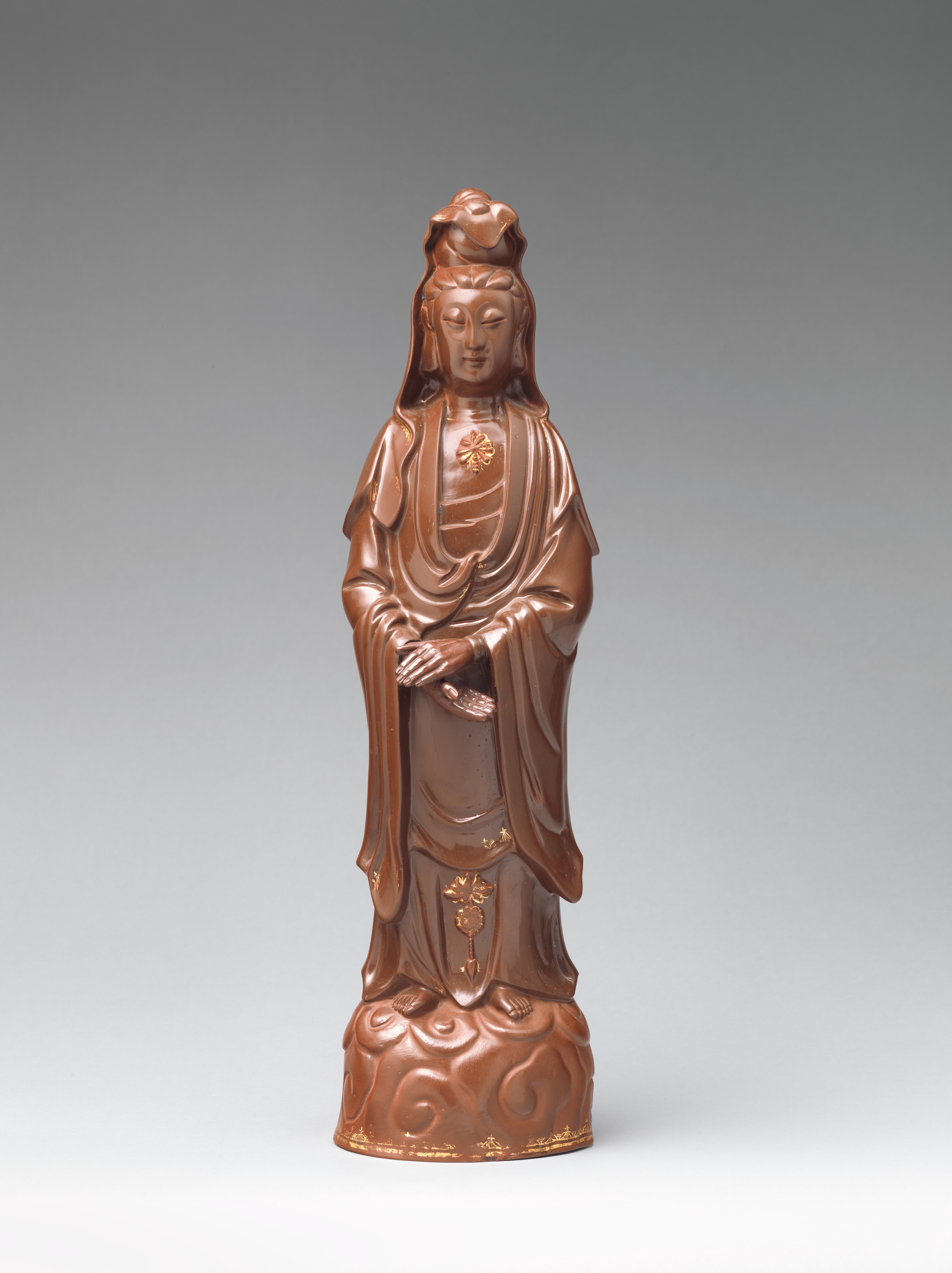
Red stoneware, c. 1710–1713, H. 37.5 cm. The Metropolitan Museum of Art, 1974.356.319.
One of the earliest Meissen products — directly moulded from a Dehua blanc de Chine Guanyin in Augustus’s collection. Due to differential firing shrinkage caused by formula differences, the copy is systematically smaller than the Dehua original.
4.5 The Dresden Three — Physical Evidence of Imitation
Three pieces in the Staatliche Kunstsammlungen Dresden — PO 8638 (Dehua original), PE 2373 (Meissen copy), and PE 2188 (Meissen copy) — constitute the most important known comparative study material between Dehua originals and Meissen imitations. Their juxtaposed display is an object lesson in materials science and craft transmission.
Shrinkage — Meissen copies are systematically smaller than Dehua originals. The reason is materials physics: Meissen’s porcelain paste formula differs from Dehua’s, producing different firing shrinkage rates. Attempting a 1:1 copy inevitably yields a smaller piece upon removal from the kiln. This visible size discrepancy is the macroscopic expression of two different paste chemistries — the chemical fingerprint analysis examines this material difference in detail.
Hand modelling differences — The Guanyin’s hands in the Dehua original are fluid and naturalistic, with soft yet precise transitions between knuckles and joints. The Meissen copy’s hands are noticeably stiff, with inferior proportional relationships and curvature quality. Hands are the most technically demanding element in porcelain sculpture — they expose the Meissen artisan’s gap relative to the He Chaozong tradition documented in the He Chaozong global corpus.
Firing cracks — Cracks appearing on Meissen copies are extremely rare on Dehua originals. Although Meissen’s hard-paste formula was chemically close to true porcelain (this was Böttger’s breakthrough), its thermal expansion coefficient match with the glaze differs from Dehua’s, producing different body-glaze stress relationships and therefore different crack probabilities.
Metropolitan Museum piece 1974.356.319 (H. 37.5 cm) provides another publicly accessible comparative case. The differences in size, glaze texture, and overall presence between this Meissen copy and its Dehua original are perceptible even to non-specialist viewers in side-by-side display.
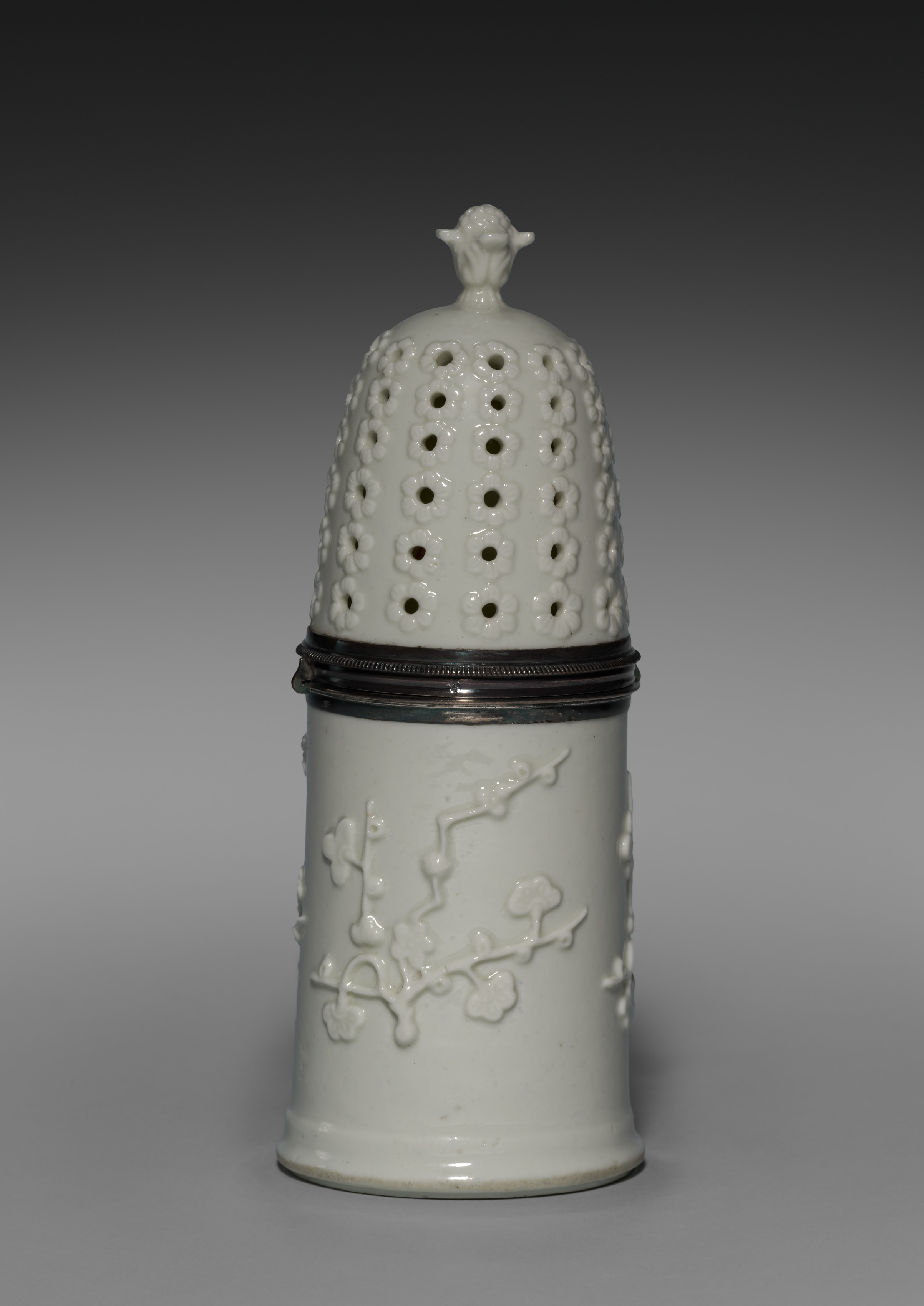
Hard-paste porcelain, c. 1732–1738. Cleveland Museum of Art, 1947.177.
4.6 Three Phases of Imitation — From Moulding to Independence
Meissen’s imitation of Dehua blanc de Chine proceeded through three clearly distinguishable phases. This evolutionary sequence, documented by P.J. Donnelly (Blanc de Chine: The Porcelain of Tehua in Fukien, Faber & Faber, 1969, xiv + 407 pp.) and repeatedly cited by subsequent scholars, has become the canonical case study of technological catch-up in ceramic history.
Phase One: Direct Imitation (c. 1710–1720s)
Early Meissen products were near piece-by-piece moulds of Dehua blanc de Chine. PO 8638/PE 2373/PE 2188 document precisely this phase. The artisan’s task was to replicate Chinese originals as accurately as possible — the results, as detailed above: shrinkage, stiff hands, cracks. The 2006 Frick Collection exhibition “Meissen at the Palace” confirmed this phase’s high dependency on Dehua originals.
Phase Two: Höroldt’s Chinoiserie (c. 1720–1730s)
Johann Gregorius Höroldt joined Meissen in 1720, bringing a revolution in painted decoration. He developed 16 enamel colours and began painting “Chinoiserie” motifs on white porcelain bodies — no longer pursuing Dehua’s plain white aesthetic but using white porcelain as a canvas for a new visual language. This was a critical turning point: from “copying China” to “imagining China.”
Phase Three: Kändler’s Original Period (from 1731)
Johann Joachim Kändler became Meissen’s chief modeller (Modellmeister) in 1731, subsequently creating over 1,300 original models. His Swan Service (Schwanenservice, c. 1737–1741, over 2,200 pieces) for Count Heinrich von Brühl marked Meissen’s complete departure from the Chinese paradigm, establishing an independent aesthetic system. From copying Dehua Guanyin to the Swan Service — this evolution took approximately twenty years.
4.7 The Hoym-Lemaire Affair — The Premium of “Made in China”
Meissen’s early history includes a scandal repeatedly cited in museum scholarship, whose details are more remarkable than the usual summary suggests. A 2024 paper in Archaeometry (Wiley), “Scandal at the Albrechtsburg,” provides a systematic reconstruction.
Count Karl Heinrich von Hoym (1694–1736, Saxon ambassador to Paris) conspired with porcelain merchant Rodolphe Lemaire (born 1688). Lemaire travelled to Dresden, where von Hoym arranged an audience with Augustus and secured a commission for Meissen to produce imitations of Japanese Kakiemon-style porcelain. Augustus required all copies to bear Meissen’s crossed-swords mark — to showcase Saxon manufacturing prowess.
Von Hoym and Lemaire did the opposite. They persuaded painter Höroldt to apply the crossed swords in overglaze rather than underglaze, making the marks removable with nitric acid or diamond abrasion and replaceable with forged Chinese marks. Lemaire took 2,500 pieces; von Hoym privately retained 1,800. Some pieces entered the Paris market, sold as genuine East Asian wares at corresponding prices. When Augustus returned to Dresden in 1731, the scheme was exposed.
The consequences were severe. Von Hoym was dismissed, convicted of treason, sentenced to life imprisonment, and ultimately took his own life at Königstein Fortress. Lemaire was briefly imprisoned and expelled from Saxony, thereafter disappearing from the historical record.
The core insight of this affair transcends the scandal itself: in the European market of the 1720s–1730s, the brand premium carried by a “made in China” porcelain label was so high that an ambassador and a merchant risked a treason conviction to forge it. Meissen’s crossed-swords mark — which in later centuries became one of Europe’s most valuable porcelain trademarks — at the time actually needed to be removed because it diminished market value. The 2027–2035 scenario projection analyses the reversal of this brand-value hierarchy over three centuries.
4.8 Key Evidence from the V&A — C.450&A-1922
The Victoria and Albert Museum holds over 170 pieces of Dehua blanc de Chine, primarily spanning the seventeenth to twentieth centuries — a figure confirmed by Rose Kerr, former principal curator of the V&A’s Far Eastern Department. Kerr is also the lead author of Blanc de Chine: Porcelain from Dehua (2002).
V&A piece C.450&A-1922 — a Meissen prunus-relief chocolate beaker and saucer — is described in the curatorial text as “virtually indistinguishable” from the Dehua original.
For a world-class museum’s professional curatorial team to deploy the phrase “virtually indistinguishable” simultaneously conveys two things: the highest possible assessment of early Meissen imitative precision, and a direct confirmation of Dehua’s status as the model. Yet the same V&A curators in the same context also noted discernible differences — corroborating the shrinkage and cracking phenomena demonstrated by the Dresden Three in §4.5.
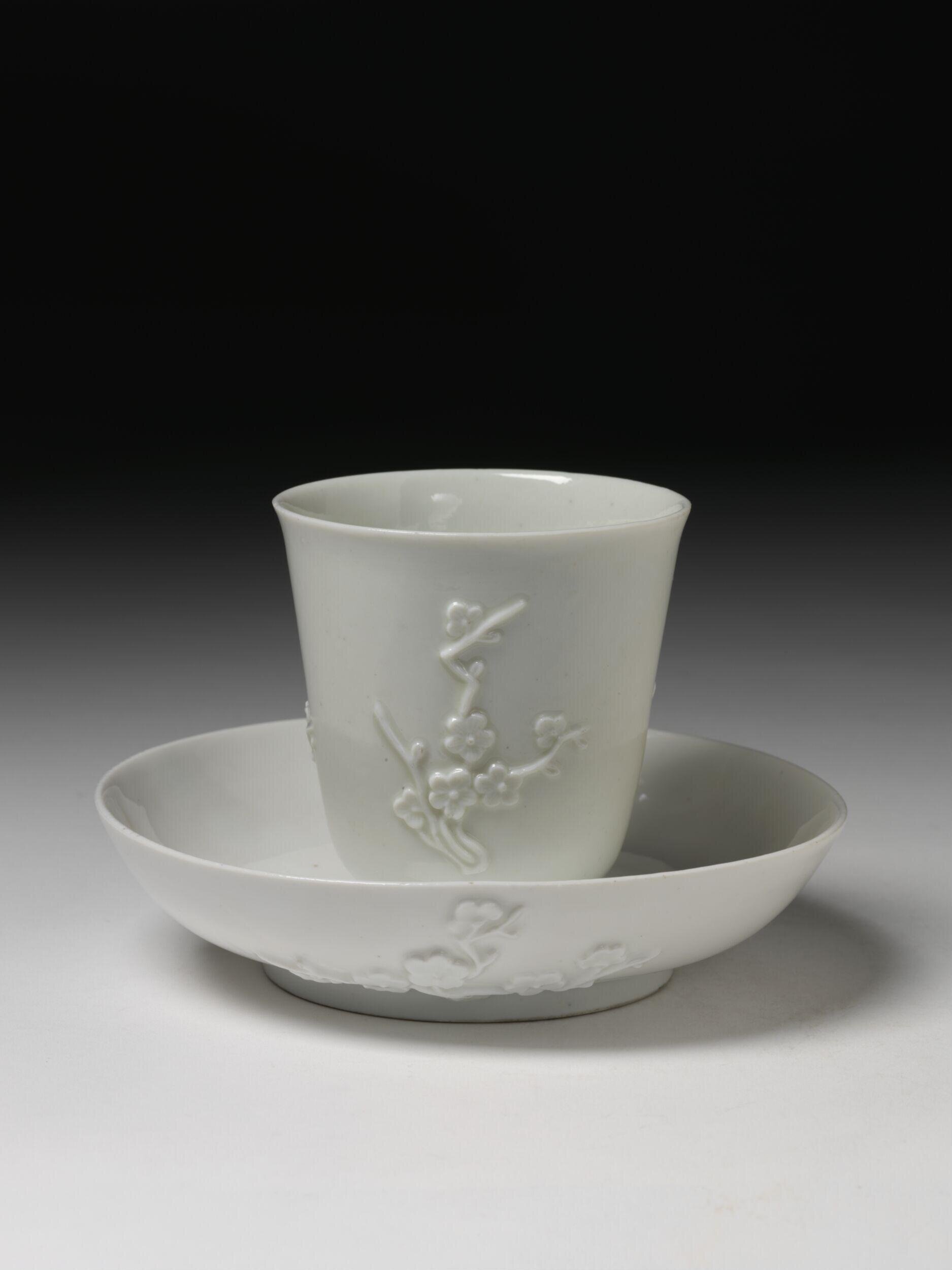
Hard-paste porcelain, c. 1726–1727. Victoria and Albert Museum, C.450&A-1922.
4.9 The Continental Pursuit — Eight Imitation Centres
Meissen was not the only student. From the Netherlands to Naples, from Paris to London’s East End, all of Europe was attempting to replicate Dehua blanc de Chine. The confirmed major imitation centres, in chronological order:
Delft (c. 1690 onwards)
Delft’s De Grieksche A factory (“The Greek A,” Adrianus Kocx, products bearing the AK mark) was among the earliest imitators. Delft used tin-glazed earthenware — not porcelain by any definition — but its white appearance sought to approximate the visual effect of Dehua blanc de Chine. Transaction records from Amsterdam dealer Aronson Antiquairs include multiple Delft white-glaze pieces imitating Dehua. Delft’s positioning was to provide the Dutch middle class with a lower-cost visual approximation of Dehua blanc de Chine.
Saint-Cloud (c. 1693–1766)
The earliest European factory to successfully produce soft-paste porcelain. Encyclopædia Britannica confirms Dehua blanc de Chine’s direct influence on Saint-Cloud. One of Saint-Cloud’s most successful decorative motifs — the “en artichaut” (thistle) pattern — derives directly from Dehua’s relief prunus-blossom decoration. The Musée des Arts Décoratifs in Paris holds 410 Saint-Cloud pieces — the world’s largest Saint-Cloud collection. Bard Graduate Center’s 1999 exhibition “Discovering the Secrets of Soft-Paste Porcelain at the Saint-Cloud Manufactory” systematically presented this material. Approximately 20 examples feature Dehua cups paired with Saint-Cloud saucers — Chinese cup, French saucer — a hybrid born not of aesthetic choice but of supply-chain reality.
Capodimonte (1743–1759)
The marriage of Naples King Charles VII (later King Carlos III of Spain) to Maria Amalia of Saxony — granddaughter of Augustus the Strong — brought the porcelain obsession from Dresden to Naples. In 1743, the couple established a porcelain factory at the Palace of Capodimonte. Products included soft-paste cups with prunus relief imitating Dehua — from Dresden to Naples, Dehua blanc de Chine’s influence crossed the Alps. When Charles inherited the Spanish throne in 1759, the entire factory was relocated to Madrid (Real Fábrica del Buen Retiro).
Bow (c. 1744–1776)
Self-styled “New Canton.” The British Museum holds a Bow inkwell inscribed “MADE AT NEW CANTON 1750.” Bow not only named itself after a Chinese city; the architecture of its first factory was modelled on the East India Company warehouses in Canton. Encyclopædia Britannica confirms that Bow employed approximately 300 workers at its peak, with products including imitations of Dehua blanc de Chine.
Chelsea (1745–1769)
Chelsea factory’s “Triangle Period” (1745–1749) products feature prunus-relief decoration. V&A curatorial texts confirm the transmission chain for this decorative element: Dehua blanc de Chine → Saint-Cloud → Chelsea. Chelsea’s prunus relief was not a direct imitation of Dehua but an imitation of Saint-Cloud’s imitation of Dehua — an influence transmitted through two intermediaries. The origin of the transmission chain remains traceable to Dehua kilns in Fujian.
Worcester (from 1751)
Worcester porcelain works likewise produced Chinese-style soft-paste products in its early years. Worcester used soapstone (steatite) as one of its raw materials — a formula differing from both Dehua and Meissen pastes, but whose products pursued visual approximation of East Asian white porcelain.
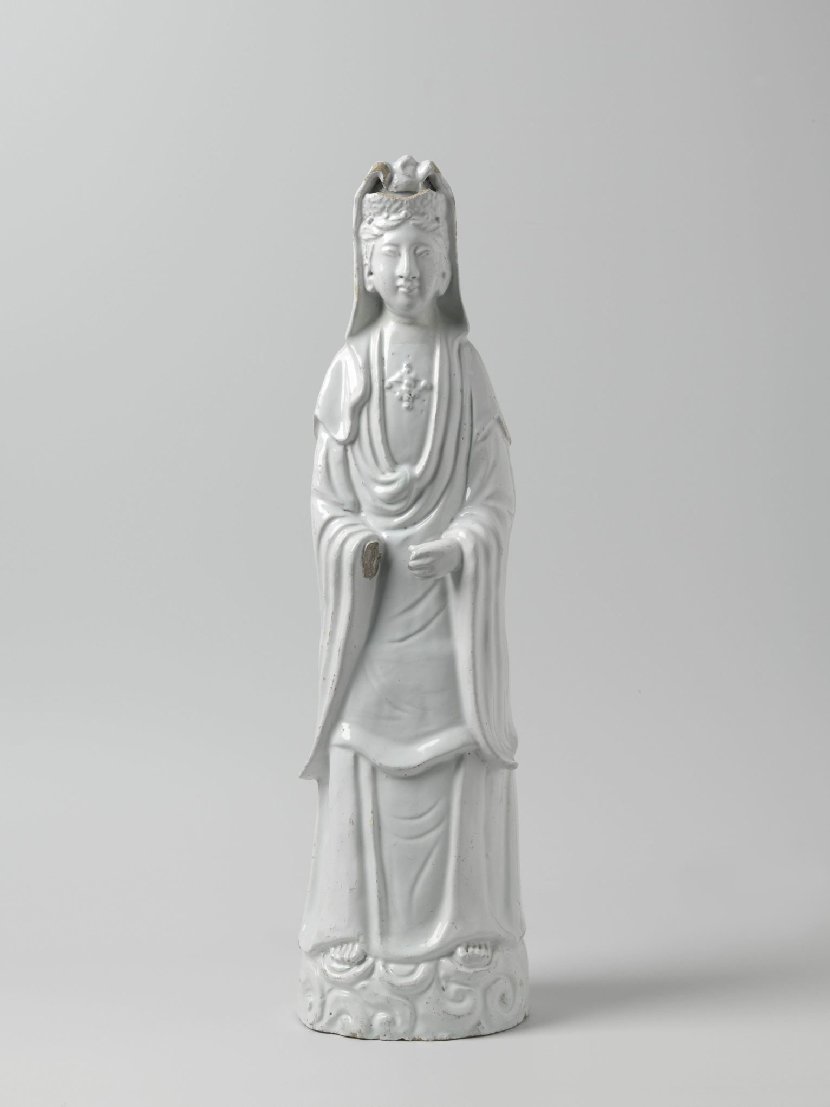
Tin-glazed earthenware, c. 1720–1750. Rijksmuseum, BK-1955-420.
4.10 Ormolu Mounts — The Alchemy of Identity
Eighteenth-century France sustained a distinctive trade: the marchands-merciers (luxury dealers / decorative-arts merchants). They did not produce things; they transformed them — purchasing Oriental porcelain, fitting ormolu mounts (gilt-bronze fittings), and converting “exotic curiosities” into “French interior elements.” Only marchands-merciers, exempt from guild restrictions, held the legal right to perform this cross-material conversion — bronze-fitting, lacquer-inlaying, base-mounting — itself a legally protected monopoly.
Lazare Duvaux’s Livre-Journal (1748–1758) is the most important primary document for this trade, edited and published in 1873 by art historian Louis Courajod and since established as a canonical source for eighteenth-century decorative arts research. This account book records luxury goods Duvaux sold to French aristocratic clients. A 1750 entry records for the first time a Chinese celadon carp ewer fitted with ormolu mounts — a pair of similar pieces sold at Christie’s in 2023 descends from this tradition. Madame de Pompadour was among Duvaux’s principal clients; in 1752 she purchased “quatre morceaux de porcelaine céladon… le tout garni en bronze doré d’or moulu” (four celadon pieces, all fitted with ormolu mounts).
Duvaux’s records pertaining directly to Dehua blanc de Chine are equally significant. On 4 August 1755, Duvaux sold a pair of Dehua blanc de Chine cockerel figures with ormolu mounts (No. 2207) to Madame de Pompadour — a transaction that precisely locates Dehua blanc de Chine within the decorative system of Louis XV’s court. The Royal Collection likewise contains multiple examples of Dehua blanc de Chine with metal fittings; John Ayers catalogued at least Cat. 163, 164, 170, 171, 172, and 173 in his 2017 inventory.
Metal fittings on Dehua blanc de Chine took two forms: first, fitting traditional Chinese vessels with Western-style mounts — as with a Royal Collection Dehua prunus vase fitted with gilt-bronze lip and foot mounts, the rim and lid edge mounted in silver-gilt, its lid also set with a miniature portrait of George III; second, transforming damaged pieces into new objects through metal fittings — as with a Dehua vase with a broken neck repurposed as an incense burner, its lid pierced with six silver-set holes and crowned with a gilt finial, reassembled into an entirely new functional object.
The peak period for ormolu mounts was 1740–1760. A Dehua Guanyin without bronze mounts was, in a European drawing room, an exotic curiosity from the Orient — foreign, conversational. With Louis XV-style ormolu mounts, the same Guanyin became an organic component of French Rococo interior design. This identity transformation was unidirectional. Dehua potters did not know their work would be fitted with bronze feet in Paris. Buyers did not care about the potters’ intentions. The marchands-merciers’ profit derived precisely from the identity-transformation process itself — the cross-cultural semantics of white porcelain returns to this phenomenon within a framework of cross-cultural reception.
Hard-paste porcelain (Dehua, c. 1700); gilt-bronze mounts (Paris, c. 1735–1740). J. Paul Getty Museum, 78.DE.64.
4.11 The Great Reversal — the 1750s
In 1752, the VOC vessel Geldermalsen sank in the South China Sea (shipwreck archaeological database). Its cargo of Chinese porcelain never reached Europe — but by this date, European market dependence on Chinese porcelain had already declined sharply.
By approximately 1752, the production capacity and quality of Meissen, Sèvres, Chelsea, Worcester, and other European factories had matured. Import substitution was complete. In the same period, China began reverse-imitating Meissen — the direction of imitation had inverted. The Walker Art Center collection includes examples juxtaposing Chinese Meissen-imitations with Meissen Dehua-imitations. The two directions of imitation, placed side by side, constitute a complete footnote to eighteenth-century globalised trade.
The time window of this Great Reversal — approximately 1740–1760 — overlaps with the decline of Dehua blanc de Chine’s ivory-white peak (as described in the historical evolution, Qing-era Fe₂O₃ rebound). Supply-side quality decline and demand-side competitive displacement occurred simultaneously. From 1690 to the 1750s: sixty years. In sixty years, Dehua blanc de Chine went from being the model that European factories copied to being the product they replaced — a complete technological catch-up process with detailed archival documentation in ceramic history.
4.12 Confirmation from Global Museums
Within the twenty-first-century global museum system, the distribution of Dehua blanc de Chine holdings itself constitutes an evidence inventory. Confirmed major collections include:
- British Museum — In 1980 received the entire personal collection of P.J. Donnelly as a bequest, making the BM one of the core global institutions for Dehua blanc de Chine research. Donnelly’s 1969 monograph (507 pages) remains the most frequently consulted Dehua reference in global libraries.
- Victoria and Albert Museum (V&A) — 170+ pieces spanning the 17th to 20th centuries. The T.T. Tsui Gallery of Chinese Art displays Dehua blanc de Chine on permanent rotation.
- The Metropolitan Museum of Art — Holds multiple Dehua originals and Meissen copies (e.g. 1974.356.319), frequently juxtaposed in exhibitions.
- Staatliche Kunstsammlungen Dresden (Porzellansammlung) — Approximately 8,000 surviving Augustus-era East Asian ceramics, of which over 1,000 are Dehua blanc de Chine. The ten-year cataloguing project (2014–2024) was the first systematic record of this collection.
- J. Paul Getty Museum — Distinguished for its collection of Dehua blanc de Chine with ormolu mounts (e.g. 78.DE.64).
- Cleveland Museum of Art — One of the world’s largest dedicated Dehua blanc de Chine collections.
- Rijksmuseum — Holds both Dehua originals and Delft imitations.
- Musée du Louvre — Several seventeenth-century Dehua Guanyin figures.
- Asian Civilisations Museum (Singapore) — In 2002 received 160 pieces of Dehua blanc de Chine donated by Frank and Pamela Hickley; the Kerr & Ayers 2002 catalogue was prepared for this collection.
The above lists only confirmed dedicated collections. The National Palace Museum (Taipei), Palace Museum (Beijing), Guangzhou Museum, Fujian Museum, and Quanzhou Maritime History Museum also hold substantial Dehua blanc de Chine holdings — but this dimension focuses on the European imitation evidence chain; Chinese museum collections are discussed in other dimensions.
17th–18th Century European Royal and Aristocratic Collection Inventories
Beyond museum holdings, the inventory lists and wills of seventeenth- and eighteenth-century European royalty and aristocracy provide direct evidence that Dehua blanc de Chine penetrated the upper echelons of European society. The following records are compiled from EIC shipping archives and various noble-family documents.
| Country | Owner | Date | Collection Summary |
|---|---|---|---|
| England | Thomas Howard, Earl of Arundel (1585–1646) | 1641 | Inventory lists 69 white porcelain figures: white man-and-boy, laughing Buddha (Budai), white lion on pedestal, seated lady, standing lady figures |
| England | Lady Diana, Viscountess Cranborne | 1675 | Inventory: lion figures, two figures, one Virgin Mary with ewer, one Cupid |
| England | 5th Earl of Exeter (Burghley House) | 1688/1690 | 1688: two seated white nuns, two standing white nuns, two figures on lions, two white lions, two large white figures, two lidded white teapots. 1690: two figures with child on lap |
| England | Queen Mary II (1662–1694), Hampton Court | c. 1696 | Six large seated Guanyin figures (inventoried from Kensington Palace, 1696–1697) |
| England | Duke of Marlborough, Blenheim Palace | early 18th c. | Cups of various sizes, three Virgin Mary figures, one seated child-giving Guanyin, one cold-painted standing Guanyin, one European-on-monkey seated figure |
| Germany | Augustus the Strong | 1721 | Inventory lists 1,122 pieces: figure sculptures and dolls, various bowls, butter dishes, dessert plates, salt boxes, bottles, jars and spoons, tea sets and accessories (teapots, milk jugs, saucers and coffee cups) — many lots annotated as “Blanc de Chine” |
| France | Philippe II d’Orléans, Régent (1674–1723) | 1724 | Inventory: small ewers, cups, silver-mounted teapots, figures, European family groups, silver-mounted crane candlesticks |
| France | Lazare Duvaux, dealer (c. 1703–1758) | 1748–1758 | Sales ledger documents Dehua transactions; 4 August 1755 sold a pair of ormolu-mounted Dehua cockerel figures (No. 2207) to Madame de Pompadour |
| Netherlands | Jan Blasse, painter (d. before 1637) | before 1637 | Inventory includes lion candlesticks — per documentary sources, among the earliest Dehua blanc de Chine to reach the Netherlands |
| Italy | Anna Maria Luisa de’ Medici (1667–1743), Palazzo Pitti | late 17th c. | Numerous Dehua figures and wine cups: European-on-qilin, European family groups, lion candlesticks in three sizes, and seated child-giving Guanyin |
| Spain | Palacio Real, Madrid | 1759–1788 | Posthumous inventory of King Charles III lists two clocks mounted with Dehua blanc de Chine figures |
| Denmark | Christian IV, Rosenborg Castle | 1718 | Earliest castle inventory lists five Guanyin figures and three standing lady figures in robes with high-booted headdress |
| Sweden | Queen Hedwig Eleonora (1636–1715), consort of Charles X | 1690–1700 | Purchased from the Netherlands: one seated Guanyin-with-child, two standing Buddhas, two cold-painted Virgin Marys, lady figures including one holding an infant |
| America | Jacob De Lange, barber-surgeon | 1685 | New York inventory lists two white teapots and three white male figures — very probably Dehua blanc de Chine |
| America | Margrieta van Varick (1649–1695) | 1695 | New York will and inventory: one white porcelain lion incense-holder, one figure, and two lidded cups or bowls |
Sources: Wan Jun, “Production and Trade of Dehua Blanc de Chine in a Global Perspective,” Journal of the Palace Museum, 2021, Vol. 22, Appendix III; Rose Kerr, “Dehua Blanc de Chine Trade to Europe and the New World” (Parts I & II), Fujian Wenbo, 2012/2014.
The table reveals three important findings. First, the earliest record appears in 1637 (Dutch painter Jan Blasse), predating the conventionally recognised bulk-trade period — indicating that Dehua blanc de Chine entered European private collections earlier than the bulk trade. Second, the 1685 New York record of Jacob De Lange and the 1695 New York record of Margrieta van Varick prove that Dehua blanc de Chine had crossed the Atlantic into daily life in North American colonies by the late seventeenth century. Third, Augustus the Strong’s 1721 inventory of 1,122 pieces and the French Régent’s 1724 multi-category inventory demonstrate not only collection scale but also that Dehua blanc de Chine’s function in European courts had expanded from “exotic curiosity” to utilitarian ware (tea sets, coffee cups) and interior decoration (candlesticks, figures) — entirely consistent with the cross-cultural reception pathways discussed in the cross-cultural semantics of white porcelain.
4.13 Evidence Chain Summary
The European imitation evidence chain for Dehua blanc de Chine, arranged chronologically:
| Date | Event | Location | Nature |
|---|---|---|---|
| c. 200 CE | Eastern Han China — mature porcelain appears | China | Global monopoly |
| 1295 | Marco Polo brings porcelain records to Europe | Italy / China | First record |
| 1575 | Medici soft-paste porcelain (failed) | Italy | First attempt |
| c. 1690 on | Delft imitation (tin-glazed earthenware) | Netherlands | Low-end substitute |
| c. 1693 | Saint-Cloud begins soft-paste production | France | Earliest European soft-paste |
| 1708 | Böttger discovers hard-paste formula | Saxony | Technological breakthrough |
| 1709.11.28 | Augustus orders Dehua samples sent to Meissen | Saxony | Hard-paste imitation begins |
| c. 1710–1720 | Meissen direct imitation phase | Saxony | Piece-by-piece moulding |
| c. 1720–1730 | Höroldt Chinoiserie phase | Saxony | Adaptive innovation |
| 1731 on | Kändler original phase | Saxony | Independent system |
| c. 1740–1760 | Ormolu mount peak period | France | Identity transformation |
| 1743 | Capodimonte factory founded | Naples | Soft-paste imitation |
| c. 1744–1776 | Bow "New Canton" | England | Imitation + self-naming |
| 1745–1749 | Chelsea Triangle period prunus relief | England | Second-hand imitation |
| c. 1750s | Great Reversal — China begins imitating Meissen | China / Europe | Direction reversed |
European factories completed the catch-up in craft and design, but could not replicate the chemical characteristics of Dehua paste — Fe₂O₃ content below 0.5% is a geological endowment, not transferable. The chemical fingerprint analysis examines this material difference in detail. The international luxury porcelain benchmarking returns to Meissen’s evolutionary arc from imitation to original creation within a brand-comparison framework.
Methodology Note
The factual claims in this dimension are based on the following categories of sources: (1) Museum curatorial texts and collection databases (Met, V&A, SKD, Rijksmuseum, Getty); (2) Peer-reviewed journal articles (Archaeometry, etc.); (3) Authoritative encyclopaedia entries (Encyclopædia Britannica); (4) Field-standard scholarly monographs (Donnelly 1969, Kerr & Ayers 2002, Finlay 2010). All figures, dates, and quotations are attributed to sources. Where sources disagree (e.g. the number of Dehua samples sent to Meissen on 28 November 1709: 7 vs. 8), this report presents the discrepancy without arbitrary resolution. The term “imitation” is used throughout in accordance with ceramic-history convention, denoting reference and replication of craft and form without pejorative judgment.
Sources & References
Scholarly Works
- Donnelly, P.J. Blanc de Chine: The Porcelain of Tehua in Fukien. London: Faber & Faber, 1969. xiv + 407 pp., 6 colour plates, 165 plates. Donnelly’s personal collection bequeathed to the British Museum in 1980.
- Kerr, Rose & John Ayers. Blanc de Chine: Porcelain from Dehua. Chicago: Art Media Resources, 2002. Includes Eva Ströber’s chapter “Dehua Porcelain in the Collection of Augustus the Strong in Dresden.”
- Finlay, Robert. The Pilgrim Art: Cultures of Porcelain in World History. Berkeley: University of California Press, 2010. California World History Library, Vol. 11.
- Gleeson, Janet. The Arcanum: The Extraordinary True Story. London: Bantam Press, 1998. Narrative history of Böttger’s imprisonment and the founding of Meissen.
- Zumbulyadis, N. “Scandal at the Albrechtsburg: The Hoym–Lemaire affair and its impact on the early 18th-century development of pigment technology at the Meissen Manufactory.” Archaeometry (Wiley), 2024. doi:10.1111/arcm.12985.
- Queiroz, C.M. & S. Agathopoulos. “The Discovery of European Porcelain Technology.” arXiv:physics/0601111, 2006. Published in Trabalhos de Arqueologia. Reappraisal of Tschirnhaus’s role.
- Wan Jun. “Production and Trade of Dehua Blanc de Chine in a Global Perspective.” Journal of the Palace Museum, 2021, Vol. 22, pp. 305–322. — Systematic compilation of EIC shipping records, 17th–18th-century royal inventories, and 60+ museum holdings worldwide.
- Rose Kerr. “Dehua Blanc de Chine Trade to Europe and the New World, Late 17th to Early 18th Century” (Parts I & II). Fujian Wenbo, 2012, No. 4 & 2014, No. 3. — The most systematic Chinese-language study of Dehua in the EIC archives.
Meissen and Saxon Archives
- Fay-Hallé — 28 November 1709 Augustus order record, 8 Dehua pieces delivered to Meissen (Met-cited version)
- Staatliche Kunstsammlungen Dresden — Same event recorded as 7 pieces; Dresden Porcelain Project (2014–2024) catalogued c. 8,000 surviving East Asian ceramics
- Dresden holdings PO 8638, PE 2373, PE 2188 — Core comparative material between Dehua originals and Meissen copies
- Metropolitan Museum of Art, 1974.356.319 — Meissen Guanyin after Dehua (H. 37.5 cm)
- Frick Collection. “Meissen at the Palace” exhibition, 2006.
European Factory History
- Johann Friedrich Böttger (1682–1719) — Imprisoned by Augustus to research porcelain; discovered hard-paste formula 1708
- Ehrenfried Walther von Tschirnhaus (1651–1708) — Böttger’s scientific collaborator, died 11 October 1708
- Johann Gregorius Höroldt — Joined Meissen 1720, developed 16 enamel colours
- Johann Joachim Kändler — Meissen Modellmeister from 1731, created 1,300+ original models
- Swan Service (Schwanenservice) — c. 1737–1741 for Count Heinrich von Brühl, 2,200+ pieces
- Saint-Cloud (c. 1693–1766) — Encyclopædia Britannica confirms Dehua influence; Bard Graduate Center 1999 exhibition
- Musée des Arts Décoratifs (Paris) — 410 Saint-Cloud pieces (world’s largest Saint-Cloud collection); c. 20 examples of Dehua cups with Saint-Cloud saucers
- Capodimonte (1743–1759) — Founded by Charles VII and Maria Amalia of Saxony; relocated to Madrid 1759
- Bow (c. 1744–1776) — BM holds “MADE AT NEW CANTON 1750” inkwell; c. 300 workers at peak
- Chelsea Triangle Period (1745–1749) — Prunus relief transmission: Dehua → Saint-Cloud → Chelsea
- Delft De Grieksche A — AK mark (Adrianus Kocx), tin-glazed earthenware imitating Dehua blanc de Chine
- Medici porcelain (1575–1587) — Fewer than 70 surviving pieces; Andrea Gussoni 1575 report
Ormolu Mounts
- Lazare Duvaux, Livre-Journal (1748–1758) — Edited by Louis Courajod, 1873; contains Madame de Pompadour transactions
- Christie’s 2023 — Ormolu-mounted Chinese celadon carp ewer (Lot 6520287)
European Royal Porcelain Collections
- Japanisches Palais, Dresden — Original repository of Augustus’s 29,000 East Asian ceramics
- Trianon de Porcelaine (Versailles, 1670–1687) — Louis XIV’s porcelain pavilion
- Charlottenburg Palace Porcelain Cabinet (c. 1695–1705) — Berlin, intact
- Rosenborg Castle Porcelain Cabinet (Room 23) — Copenhagen, Danish royal collection
- Dragoon Vases — Augustus traded 600 Saxon dragoons for 151 large Chinese blue-and-white vases
- John Ayers. Chinese and Japanese Works of Art in the Collection of Her Majesty the Queen, Vol. 1–3. London: Royal Collection Trust, 2017. Cat. 145, 163, 164, 170, 171, 172, 173.
Museum Collections
- Victoria and Albert Museum — C.450&A-1922 (Meissen prunus beaker, “virtually indistinguishable”); 170+ Dehua pieces
- Cleveland Museum of Art — 1947.177 (Meissen caster, c. 1732–1738)
- Rijksmuseum — BK-1955-420 (faience Guanyin after Dehua)
- J. Paul Getty Museum — 78.DE.64 (Dehua Guanyin with Parisian ormolu mounts)
- Walker Art Center — Chinese Meissen-imitations and Meissen Dehua-imitations displayed in juxtaposition
- Aronson Antiquairs (Amsterdam) — Delft blanc de Chine imitation records
- Asian Civilisations Museum (Singapore) — Hickley donation of 160 Dehua pieces (Kerr & Ayers 2002 catalogue)
Image Sources
- Fig. D4-02: The Metropolitan Museum of Art, 1974.356.319 · CC0 Public Domain
- Fig. D4-03: Cleveland Museum of Art, 1947.177 · CC0 Public Domain
- Fig. D4-04: Victoria and Albert Museum, C.450&A-1922 · Open Access
- Fig. D4-05: Rijksmuseum, BK-1955-420 · CC0 Public Domain
- Fig. D4-06: J. Paul Getty Museum, 78.DE.64 · CC0 Public Domain
Cross-Dimension References
- Historical evolution of Dehua blanc de Chine — Qing-era Fe₂O₃ rebound and ivory-white peak decline overlapped with the completion of European imitation
- He Chaozong global corpus — The Dresden Three (PO 8638 et al.) are core evidence of the He Chaozong sculptural tradition being imitated by Europe
- Shipwreck archaeological database — The Geldermalsen (1752) marks the Great Reversal inflection point
- Chemical fingerprint analysis — Meissen copy shrinkage stems from paste chemistry differences; Fe₂O₃ below 0.5% is a geological condition that cannot be transplanted
- Cross-cultural semantics of white porcelain — Ormolu mounts transformed Dehua Guanyin into French Rococo interior elements
- International luxury porcelain benchmarking — Meissen’s three-phase evolution from imitation to original creation
- 2027–2035 scenario projection — The three-century reversal of the brand-value hierarchy revealed by the Hoym-Lemaire affair
Frequently Asked Questions
- Why did the Meissen factory imitate Dehua Blanc de Chine?
- Augustus the Strong, Elector of Saxony, owned 29,000 East Asian ceramics and suffered from what contemporaries called “Porzellankrankheit” (porcelain sickness). On 28 November 1709, he ordered Dehua blanc de Chine Guanyin figures sent to Meissen as models for imitation. Meissen’s earliest products — including red stoneware and white hard-paste porcelain — were directly modelled on Dehua blanc de Chine.
- How many European centres imitated Blanc de Chine?
- At least eight: Delft (tin-glazed earthenware, c. 1690 onwards), Saint-Cloud (soft-paste, c. 1693), Meissen (hard-paste, 1710), Capodimonte (1743), Bow “New Canton” (1744), Chelsea (1745), Worcester (1751), and Parisian marchands-merciers with ormolu mounts (c. 1740–1760).
- What were the three phases of European imitation?
- Meissen’s imitation proceeded through three phases: (1) Direct imitation (c. 1710–1720), piece-by-piece moulding from Dehua originals; (2) Höroldt Chinoiserie (c. 1720–1730), painting Chinese-inspired motifs on white porcelain; (3) Kändler’s original period (from 1731), creating 1,300+ original models. By the 1750s the direction reversed — China began imitating Meissen.
- What was the Hoym-Lemaire scandal?
- Saxon ambassador von Hoym and merchant Lemaire conspired to grind off the Meissen crossed-swords mark from 2,500+ pieces and replace it with forged Chinese marks for sale in Paris at higher prices. This proves that in the 1720s–1730s, “made in China” carried a greater brand premium than “made in Meissen.” Von Hoym was convicted of treason, sentenced to life imprisonment, and took his own life.